What happened
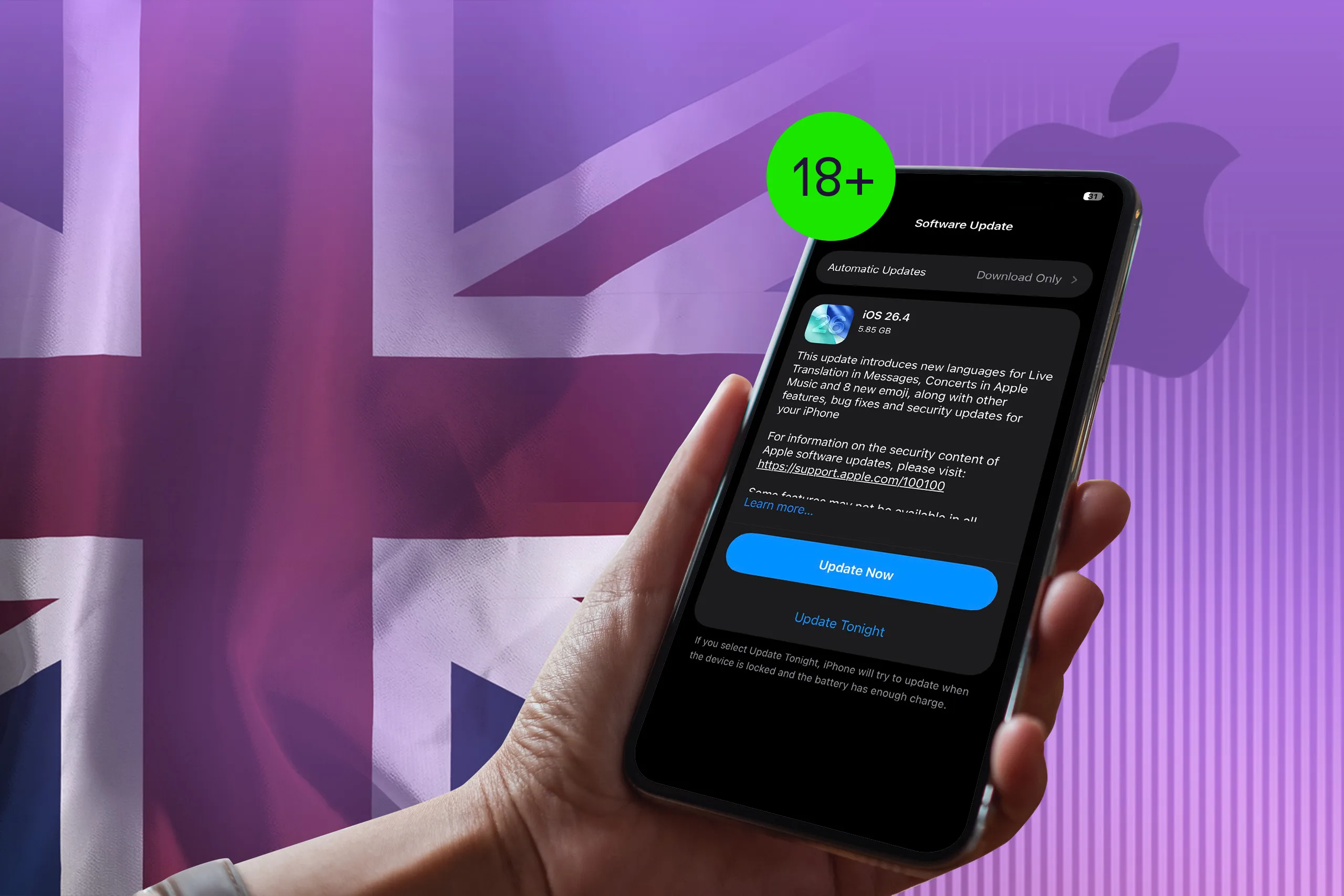
On March 24th, Apple added an adult-confirmation step for some UK Apple Account actions. In the UK, users may be asked to prove they are 18 or older before using certain Apple services or features, or before changing some account settings.
If they do not confirm, Apple turns on Web Content Filter and Communication Safety.
What is changing
Apple says adulthood can be confirmed with a credit card, a scanned driver’s license or national ID, and in some cases, existing account data, such as a payment method on file or the length of time the account has been active.
Passports, debit cards, and gift cards are not accepted for this on-device UK age check.
In certain regions, apps that implement Apple’s Declared Age Range API can use Apple-provided age categories as one input when deciding whether to allow access to age-gated content or features.
Developers can receive an age band or category, limited context on how that status was set, parental-control status, and eligibility for age-gated features.
.webp)
Reddit users reported seeing a Settings prompt saying ‘UK law requires you to confirm you are an adult to change content restrictions.’
Real business implications
Those affected the most by this change are apps and online services that already gate content or features by age, especially those that operate inside Apple’s app ecosystem.
The list includes (but is not limited to):
search services,
other products that need to separate adult and minor experiences.
For them, there is a real privacy upside: if adulthood can be confirmed once at account level, they may have less reason to collect raw birth dates, ID scans, or card data themselves.
At the same time, the overall value of Apple’s check will depend on the use case. For apps that need an age signal as one input, it may reduce friction and limit how much sensitive data they collect themselves. But for adult content, tightly regulated categories, or any flow where the business needs stronger proof and clearer accountability, basic Apple age verification may not be sufficient on its own.
A vital consideration: Identity signal integrity
Importantly, if you are a business that is looking to take advantage of this new age verification method, be aware that using it does not remove liability.
Apple says developers are still responsible for their own age restrictions and, in some regions, must still check the age of people using their apps. Ofcom’s guidance points in the same direction: system-level age assurance can be part of the process, but the regulated service remains responsible for making the full process highly effective.
This is also why identity signal integrity starts to become relevant. By that, we understand the reliability of the signals behind an identity-related decision, and not only the final result. If a system says a user is an adult, the real issue is what evidence produced that answer, whether it came from a trusted source (or a mix of them), and whether it is strong enough for the next use case.
Apple’s own materials show that adulthood may be inferred from a mix of account history, payment data, or document checks. That may be better for privacy than repeated uploads, but it also means some businesses could end up relying on evidence they did not collect or inspect themselves.
That’s why apps and services ideally need to ask where the underlying identity inputs came from, how they were checked, whether they line up with one another, and whether they are still strong enough for the next decision.
Who will be responsible for maintaining identity signal integrity?
Apple’s UK age verification rollout shows that a check result on the device can be reused instead of recreated again and again. That may reduce duplicate checks and limit how often users have to hand sensitive data to multiple services.
What remains unresolved is how much trust that reused result should carry. For businesses, the harder question is whether the identity signals behind the label are reliable enough for their specific service or risk level.
In many cases, that will still require the business (or their identity verification vendor), to examine the strength of the evidence behind the age result.
That is where identity signal integrity becomes important, and why this debate is likely to grow well beyond Apple.
.webp)