

Most identity verification platforms now cover the same baseline: document checks, face matching, liveness, fraud signals, and KYC workflows. That makes vendor shortlists look deceptively similar. Needless to say, each vendor claims to be the leader and promises the most reliable identity verification out there.
To help you choose the right solution, our team reviewed more than two dozen providers and shortlisted five established platforms commonly considered for enterprise identity verification projects in 2026. Here’s how Regula, Entrust, Sumsub, Jumio, and Veriff compare.
Methodology: We reviewed several established identity verification providers and shortlisted five that regularly appear in enterprise evaluations. We compared them using publicly available product documentation, independent review data, and criteria that typically matter in enterprise deployments: document coverage, biometrics, fraud controls, workflow capabilities, compliance, and deployment options.
There's no universal winner: the right shortlist depends on document coverage, deployment requirements, fraud controls, compliance scope, and the markets you serve.
Product information was reviewed in September 2026.
Comparative overview of the best identity verification software
| Feature / Segment | 1. Regula | 2. Entrust | 3. Sumsub | 4. Jumio | 5. Veriff |
|---|---|---|---|---|---|
| ID document support | 16,500+ documents | 2,500+ documents | 14,000+ documents | 5,000+ documents | 12,500+ documents |
| Biometrics |
|
|
|
|
|
|
Workflow & orchestration |
|
|
|
|
|
| KYC/AML & screening |
|
|
|
|
|
| Fraud signals | Extensive cross-checks of identity signals (ID document authentication, biometrics, device, geo, IP) | Device, IP, geolocation signals | Device fingerprinting, IP, fraud network analysis | Device, phone, email, geo risk signals | 1000+ session signals (behavioral, etc.) |
| Hosting | On-premises or private cloud | Cloud | Cloud or private cloud | Cloud | Cloud |
| Unique strength | High-assurance identity verification with exceptional document depth and fully in-house R&D | Broader identity stack spanning onboarding, authentication, and access control | Flexible verification with No-Doc and KYB options | Cross-transaction identity intelligence via Identity Graph | Session-level fraud assessment with RiskScore |
| Typical users | Banks, aviation, border agencies, government, telecom, travel | Fintech, gaming, consumer platforms | Crypto, fintech, marketplaces, mobility | Financial services, banks, gaming | Financial services, marketplaces, gaming, HR |
1. Regula
⭐ Ratings: Gartner 4.8 | G2: 4.9 | Capterra: 5.0
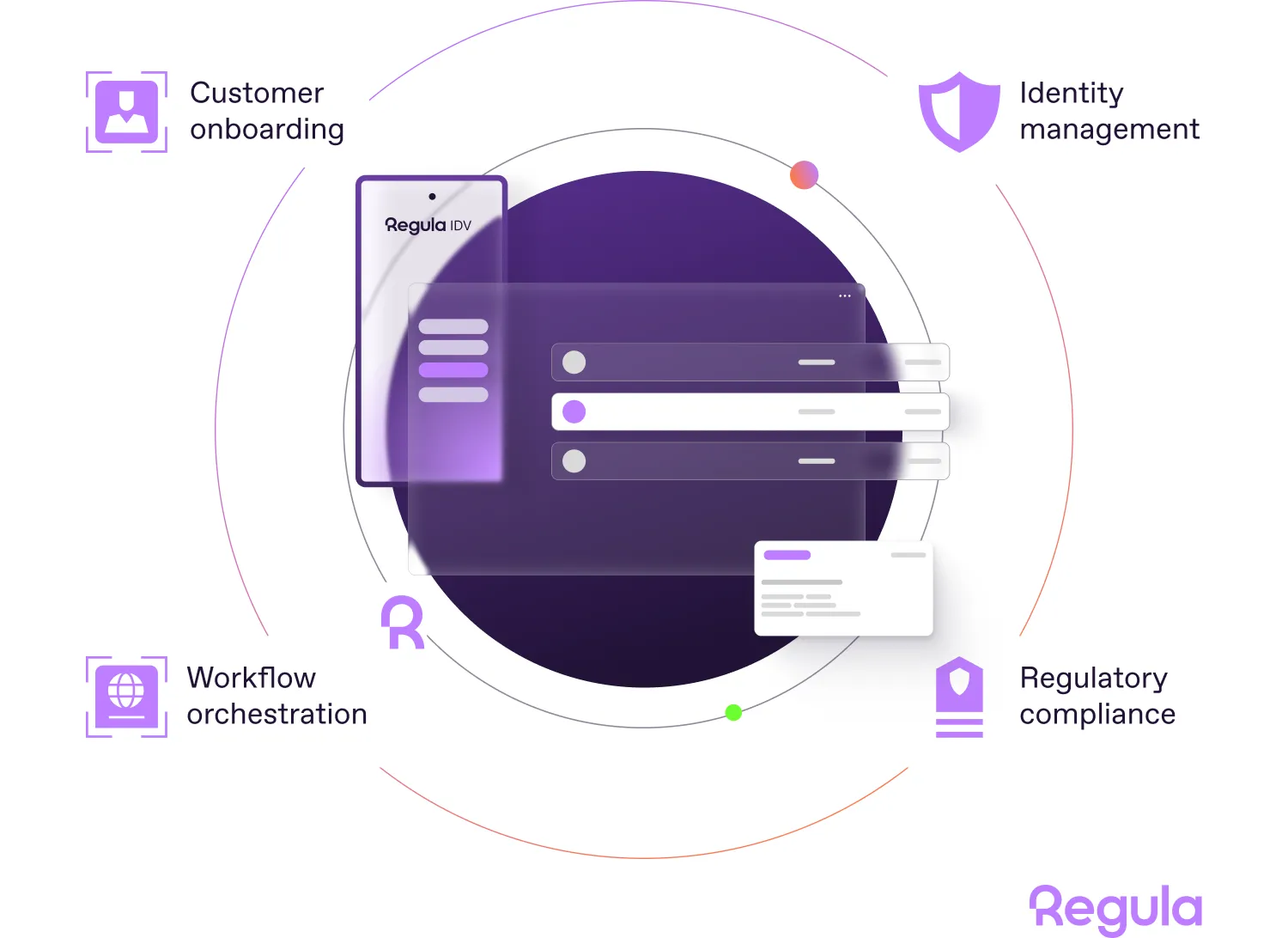
Regula offers a full-service identity verification platform that combines document checks, biometrics, KYC, and compliance screening, including AML, PEP, and sanctions checks, in one system. It helps organizations manage the full identity journey — from onboarding to ongoing verification and authentication — through orchestrated workflows that reduce fraud and support changing compliance needs.
Regula’s forensic background brings expertise that goes beyond standard identity verification, delivering higher trust, accuracy, and stronger resistance to fraud throughout the process. This results in a precise detection of forgeries and better handling of various document types from across the globe.
Today, the company applies that depth across sectors, from banking and telecom to aviation, with a modular platform approach that lets customers enable only the checks and workflows their use case requires.
Key features:
-
An end-to-end identity lifecycle management platform that flexibly orchestrates ID document checks, biometrics, risk rules, user continuous authentication, and more into one workflow, so customers do not have to stitch together multiple solutions.
-
Workflow orchestration to define the sequence of steps — whether it’s a user scanning a document, an automated system check, or compliance validation — to make identity verification seamless, fraud-resistant, and fully compliant.
-
A centralized audit trail across the verification lifecycle, covering user profiles, biometrics, verification results, and all user and system interactions.
-
Document intelligence: Support of over 16,000 document types worldwide (passports, IDs, licenses, mDLs, digital IDs) with forensic-grade authenticity checks: OCR, MRZ/barcode, hologram, and chip (NFC) verification.
-
Advanced biometric verification with face matching, face identification, liveness checks, and NIST-winning age estimation.
-
Flexible deployment for regulated environments, allowing full on-premises installation for sensitive clients, as well as private cloud or hybrid options.
-
Vendor-agnostic architecture, allowing customers to integrate Regula with their existing tech stack and third-party systems through customizable connectors.
Best for: Regula is best for enterprises with high-assurance, high-volume onboarding and authentication workflows. It is a strong fit for banks, fintechs, telecoms, mobility and travel providers, governments, and other organizations that need global ID coverage, advanced fraud checks, biometric verification, and flexible deployment on a single platform.
What customers say
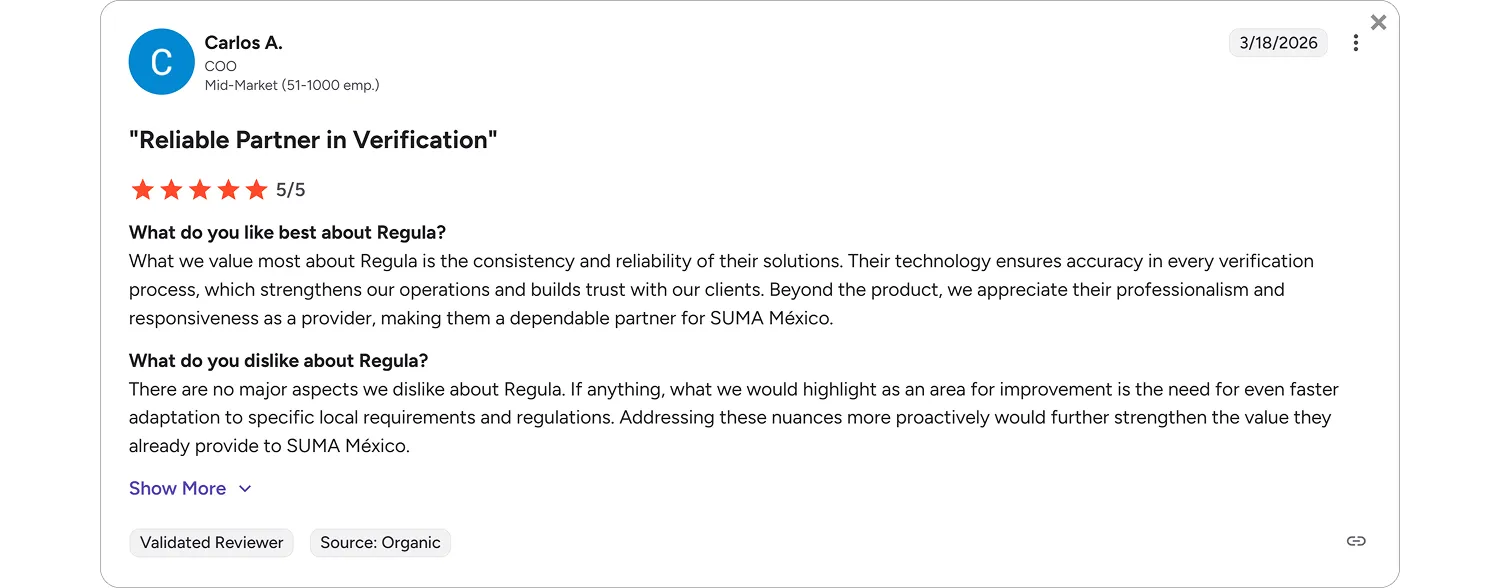
Source: G2

2. Entrust (formerly Onfido)
⭐ Ratings: Gartner 4.4 | G2: 4.4 | Capterra: 4.6
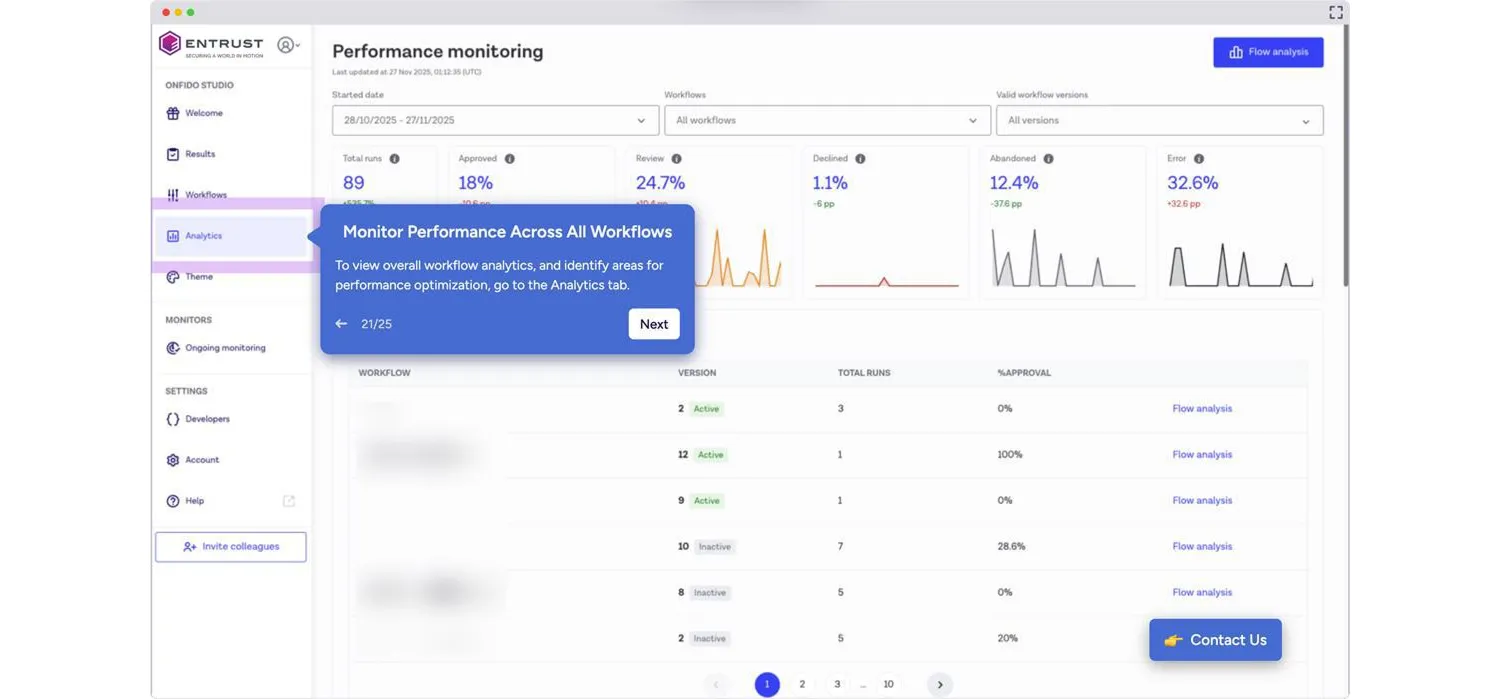
Following its acquisition of Onfido, Entrust positions identity verification as part of a broader identity-centric security portfolio. Its cloud-based platform helps organizations build secure, low-friction digital onboarding journeys that combine identity checks, fraud signals, and workflow orchestration to reduce abandonment while meeting compliance requirements.
Key features:
-
No-code identity verification workflow builder
-
Document verification with OCR-based analysis, support for NFC on compatible documents, and coverage of 2,500+ document types, focusing on the most common documents
-
Biometric verification with face matching and liveness checks
-
Passive fraud signals such as device integrity, IP, and geolocation data, plus repeat-attempt detection for reused or modified identity documents
Best for: Entrust is best for organizations that prioritize smooth digital onboarding. Most of its customers are financial services and crypto platforms that want a solution to help them reduce fraud while delivering seamless digital customer experiences.
What customers say
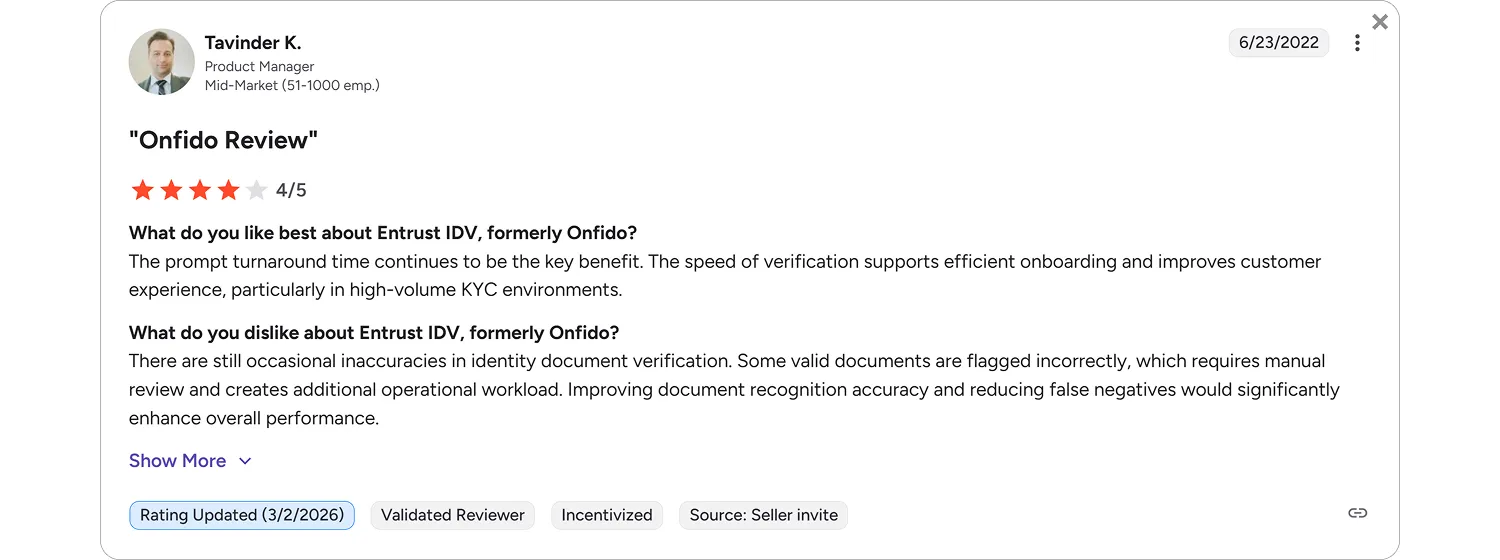
Source: G2
3. Sumsub
⭐ Ratings: Gartner: 4.6 | G2: 4.6 | Capterra: 4.7
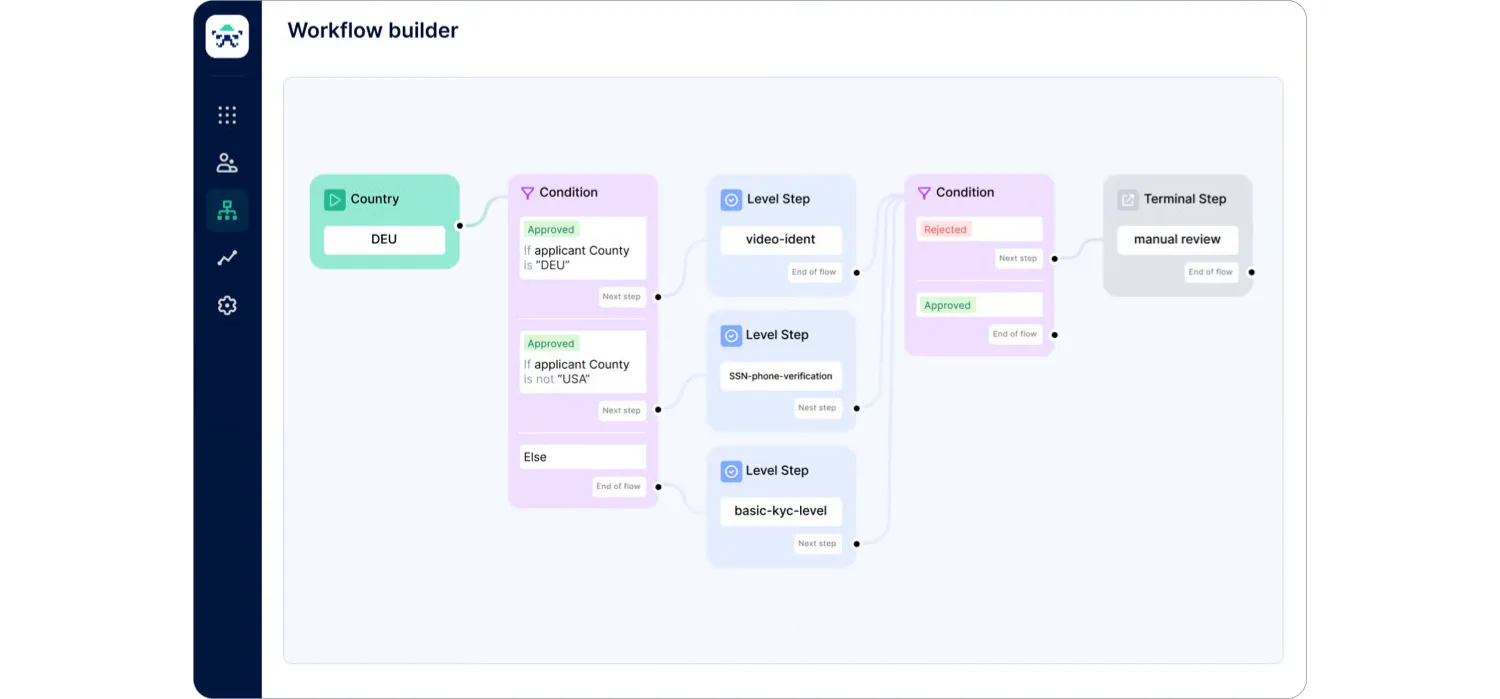
Sumsub is a full-cycle verification and anti-fraud platform for digital businesses. It combines fast onboarding, configurable risk-based workflows, fraud prevention, and compliance controls.
Alongside individual identity verification, it also offers KYB capabilities for company onboarding and due diligence, making it a strong fit for businesses that need both customer and business verification in one configurable platform.
Key features:
-
Configurable no-code verification workflows for different scenarios
-
Global document coverage with 14,000+ ID types supported
-
Biometric verification with face matching and liveness check
-
No-Doc verification (without a physical ID) for lower-friction onboarding in eligible scenarios
-
Fraud prevention tools such as fraud network detection, device intelligence, and behavioral anti-fraud
-
KYB capabilities, including corporate registry checks, UBO verification, questionnaires, company document review, and corporate AML screening
Best for: Sumsub is particularly well-suited to fast-moving sectors such as crypto, fintech, trading, gaming, and shared mobility that need flexible onboarding and compliance controls for both users and legal entities.
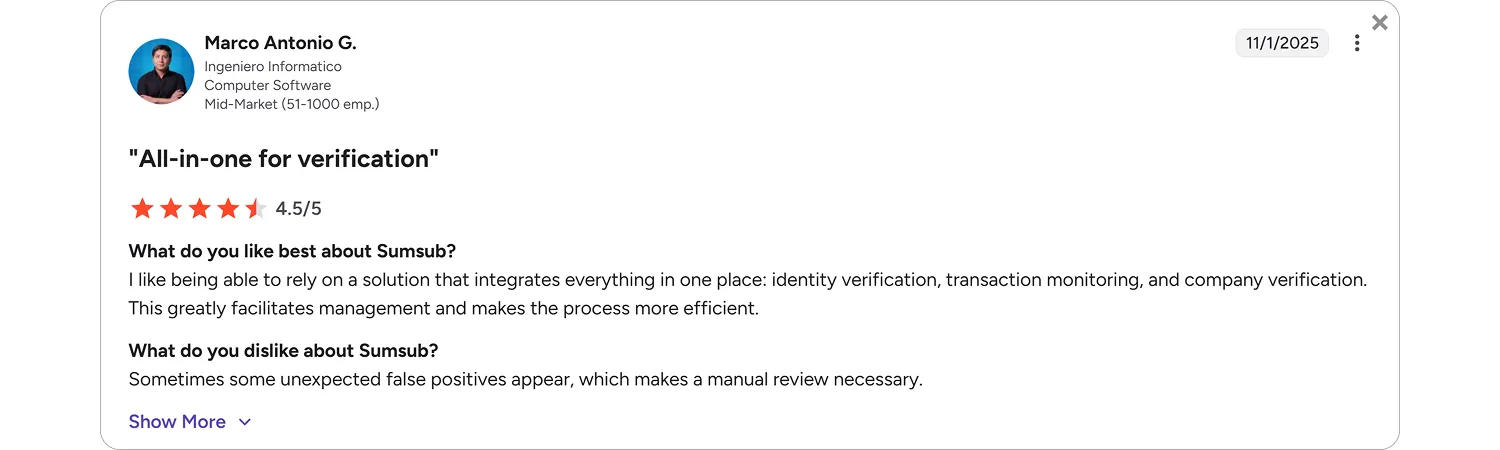
What customers say
Source: G2
4. Jumio
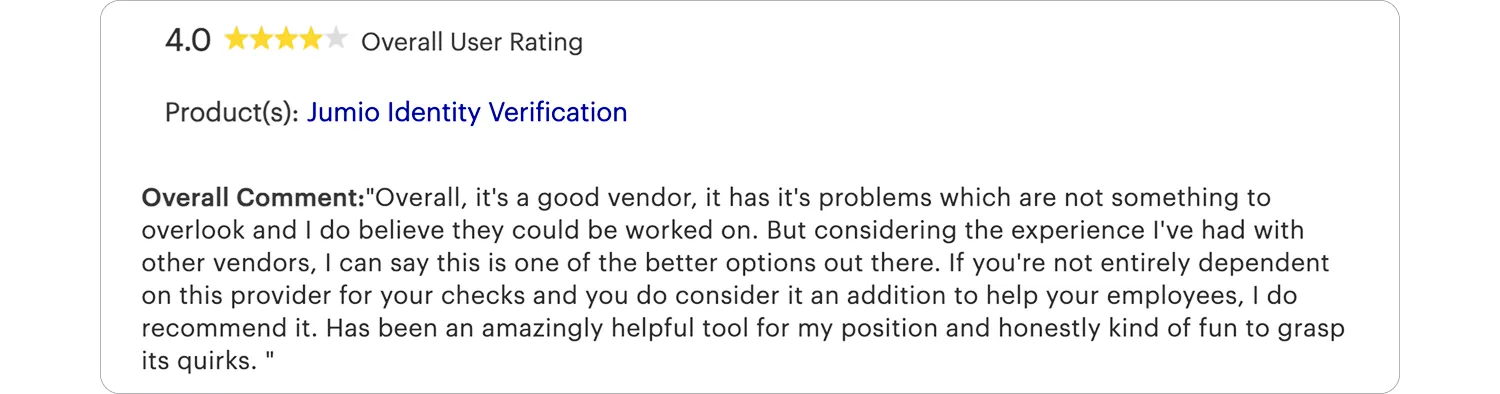
⭐ Ratings: Gartner: 3.5 | G2: 4.0 | Capterra: N/A
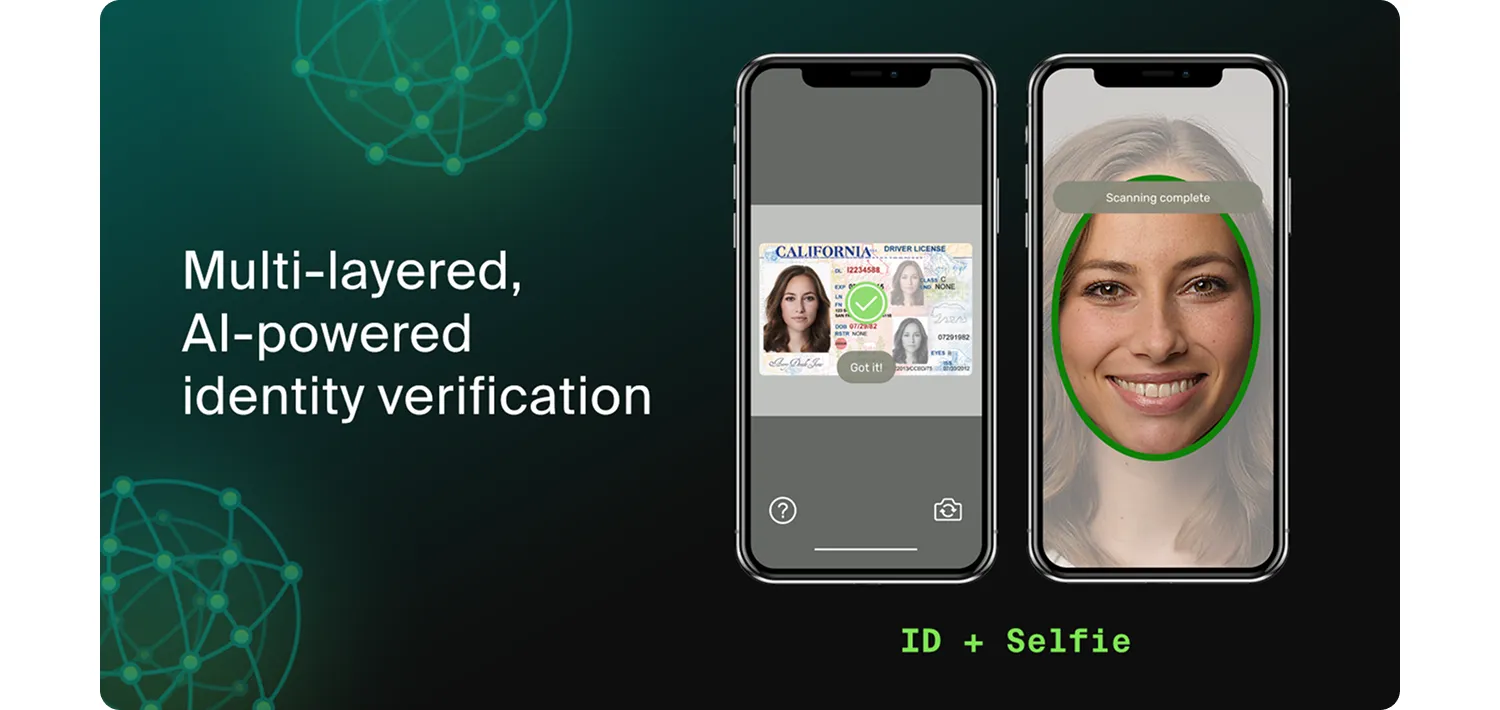
Jumio offers an enterprise-grade identity verification platform for regulated and fraud-sensitive environments. It is geared toward businesses that want identity verification to feed into broader fraud and risk decisions, rather than serving as a standalone pass/fail step during onboarding.
Key features:
-
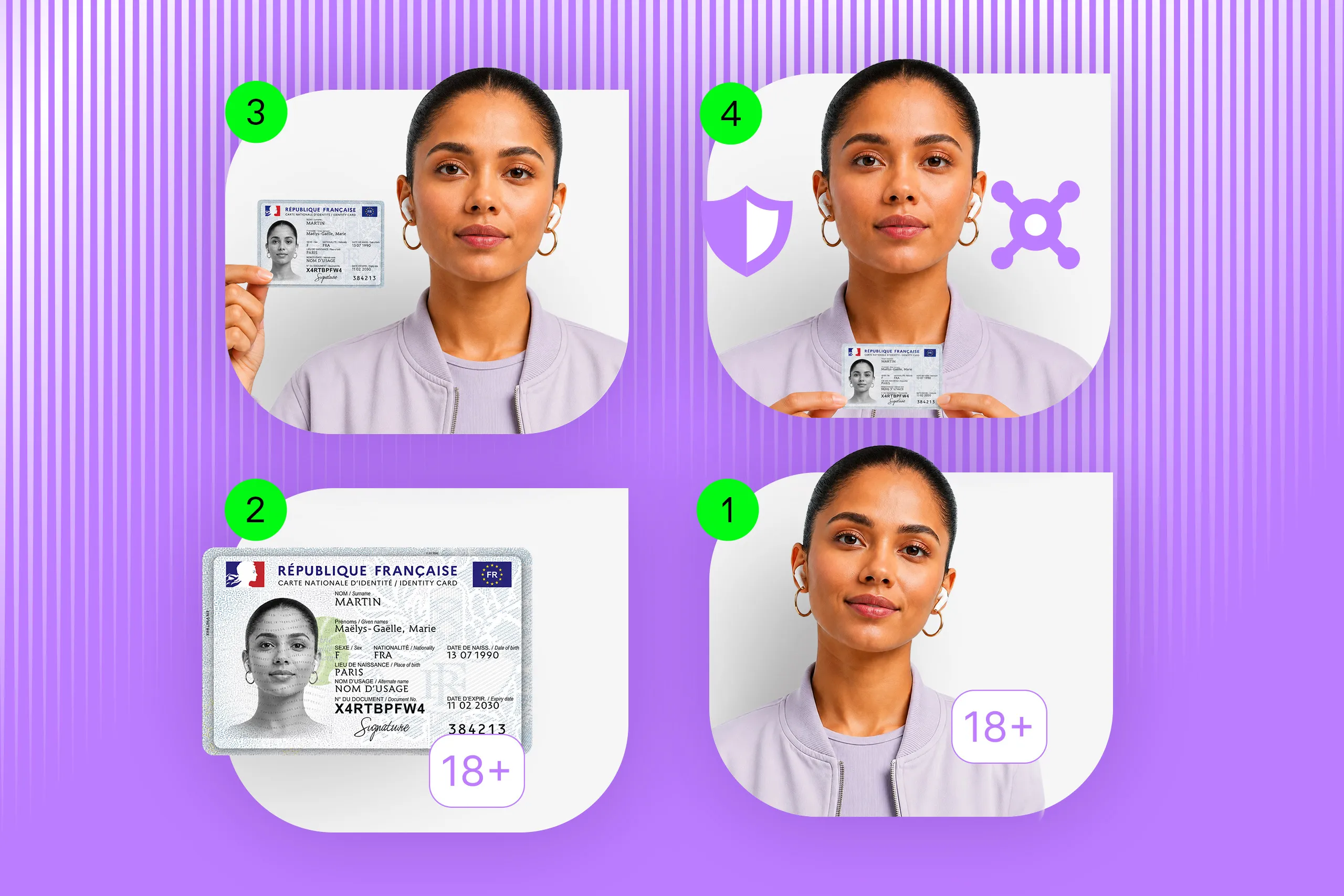
Biometric verification with face matching, age estimation, and liveness check
-
Global document coverage with 5,000+ ID types supported
-
Jumio Identity Graph and Cross-Transaction Risk that link identity signals across multiple verification attempts, customers, channels, and transactions
-
Risk signals from additional data sources, such as device, phone number, email, address, and geo/IP-related checks
-
AML screening and ongoing compliance support with sanctions, PEP, and adverse media checks during onboarding and through the customer lifecycle.
Best for: Jumio is a fit for organizations that want identity verification to inform broader fraud and risk decisions, not just serve as a one-time onboarding gate. It is a strong fit for regulated and fraud-sensitive environments where repeat fraud detection, risk signals, and ongoing monitoring matter.
What customers say
Source: Gartner Peer Insights

5. Veriff
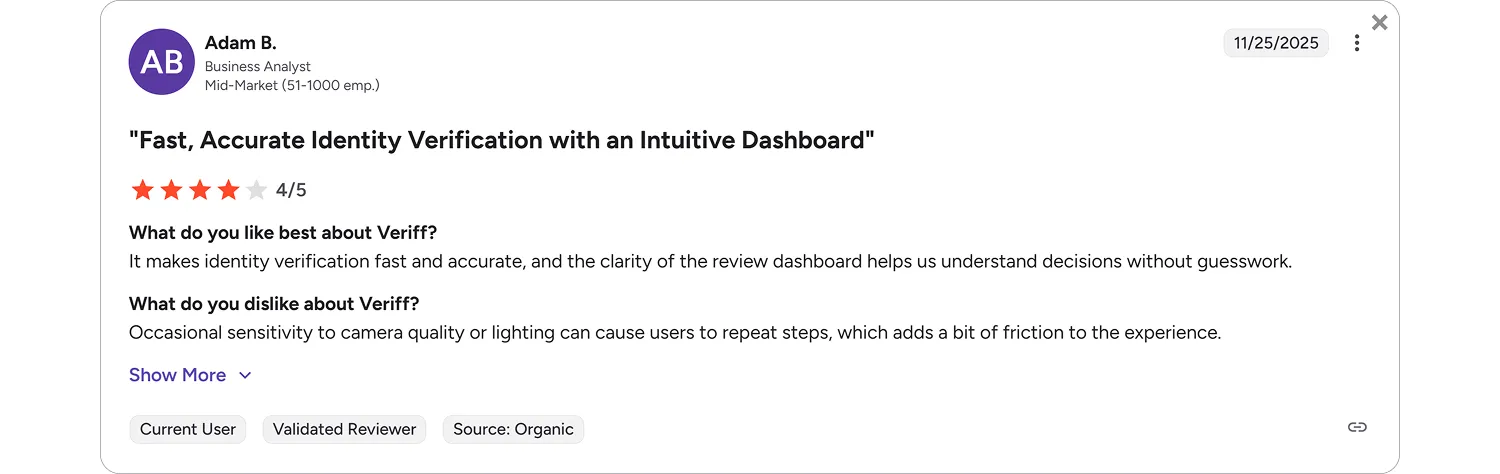
⭐ Ratings: Gartner: 4.5 | G2: 4.5 | Capterra: 4.7

Veriff is an identity verification platform built for fast, low-friction global onboarding. It combines document and biometric checks with session-level fraud analysis to help businesses approve more genuine users while flagging risky attempts.
Key features:
-
Session-level fraud assessment based on 1,000+ signals (device, network, image quality, behavioral patterns, etc.) with a real-time risk score (0–100) generated per verification
-
Global document coverage with 12,500+ document types supported
-
KYB capabilities as part of Veriff’s broader trust-platform expansion
-
Option for an assisted identity verification process that combines AI-based automation with support from trained verification specialists
Best for: Veriff is a strong fit for fintechs, travel and mobility companies, marketplaces, and other digital businesses running high-volume global onboarding flows, where fast approval of legitimate users is just as important as catching risky sessions.
What customers say
Source:G2
What do independent reviews say about these identity verification vendors?
Product pages and vendor comparisons can only tell part of the story. To add an external point of reference, we included selected G2 metrics covering areas such as support quality, requirements fit, and ease of doing business.
Third-party review data can’t replace product evaluation, but it adds useful context on how customers rate vendor support, fit, and overall experience.
Here is how the vendors in this guide compare on G2:
Grid® Report for Identity Verification | Summer 2026
| Regula | Entrust | Sumsub | Jumio | Veriff | |
|---|---|---|---|---|---|
| Net Promoter Score (NPS) | 97 | 57 | 73 | 35 | 65 |
| Quality of support | 99% | 87% | 91% | 91% | 92% |
| Meeting requirements | 97% | 90% | 91% | 91% | 91% |
| Ease of doing business with | 97% | 91% | 93% | 84% | 96% |
How to choose the best identity verification software
Choosing identity verification software is a long-term decision. Companies often have to live with that choice, and all its downstream benefits and limitations, for years.
While identity verification platforms may look similar at the top level, the gap appears in practice: document coverage is uneven, fraud checks vary in depth, compliance needs are not the same, and integration trade-offs become painfully obvious once the system is live.
These four areas usually determine whether the choice holds up:
Document verification depth. The real question is whether the vendor can authenticate the documents your users actually submit, including different document categories, regional variants, legacy versions still in circulation, and their security features. Strong coverage matters, but so does the depth of checks behind it.
Biometric check reliability. Face matching and liveness are now standard. What differs is how well vendors handle presentation attacks (such as spoofing or deepfakes), injection attacks, and edge cases. Independent testing (e.g., by iBeta or NIST) and clear performance evidence matter more than broad biometric claims.
Workflow fit. Some companies need a simple onboarding flow. Others need digital identity orchestration across channels, user groups, markets, and risk levels. If your verification process is complex, make sure the platform can adapt without turning every change into a development project.
Deployment and compliance. In regulated environments, deployment flexibility, auditability, data control, and support for local compliance requirements can be just as important as verification accuracy.
If you are evaluating vendors in detail, we put together a practical guide with the criteria, questions, and checklists to use during selection.

If your team already knows what it needs and wants to discuss specific document types, fraud risks, or deployment requirements, talk to Regula. We can help you assess fit based on your actual verification scenario.