

With identity fraud constantly evolving, regulators are asking tougher questions about evidence and assurance in the context of ID verification. More and more often, if a company claims strong verification or step-up, they may be asked to show evidence that matches those claims.
That’s why holistic identity platforms have recently emerged as an alternative (or an improvement) to ID verification SDKs. While SDKs are excellent at one part of the identity verification process (capture and document authenticity checks), they don’t immediately provide centralized management and configuration for services and storage, end-to-end workflows orchestration with branching, enforced API authorization, operator roles, or case-ready audit exports.
In this article, we will break down what an identity platform is, how it compares to SDKs, what benefits businesses can expect from it, and how it is already being used worldwide.

Get posts like this in your inbox with the bi-weekly Regula Blog Digest!
What is an identity platform?
An identity platform is a system that runs identity lifecycle management end to end: it verifies people’s identities, controls authenticators, gates user access by policy, records evidence, and gives risk and compliance a single place to audit across cloud-based SaaS, private cloud, or on-premises deployments.
While specific functionality varies from solution to solution, most identity platforms are expected to:
Design and govern the process: Build policy-driven workflows for onboarding, payout checks, recovery, and re-screening; add branches, retries, and step-up rules; apply changes without shipping new app builds, and keep every revision in audit.
Run checks with shared session context: Execute document authentication and NFC verification where available to corroborate fields such as date of birth; perform biometric capture with liveness checks, PAD, and 1:1 comparison; add data corroboration, and include KYC plus anti-money laundering (AML) screening and geo/device risk signals, recording each step’s result in the same session record.
Control authenticators and access: Bind in-flow authenticators when policy calls for them, record the outcome, and transfer machine-readable results that relying systems can use to grant or deny secure access, with clean handoffs to your identity and access management tier.
Keep reliable records: Create or update subject profiles when managing user data, and store evidence, decisions, and biometric templates in separate stores with retention and redaction defined in configuration, indexed for search and export so investigators can work cases of financial crime or identity theft without chasing logs.
Meet regulatory needs: Produce export-ready logs and artifacts for AML reviews and privacy requests, capture operator actions and policy edits, and give financial institutions and other regulated teams the information they need to ensure compliance without ad-hoc data hunts.
What is the difference between an identity platform and an SDK?
SDKs are focused toolkits that let developers add specific IDV functions inside an application, such as capture, NFC reading, liveness, face comparison, and data extraction.
An identity platform is a system that runs those tools as a controlled process: it defines the workflow, applies policy, creates user profiles, records evidence, connects results to the databases an organization can use so the identity can be checked during onboarding and later, and much more.
Many types of databases can be managed, such as:
Evidence storage for images and liveness clips.
Internal customer records and document/biometric history.
Fraud pattern lists.
Sanctions and watchlists.
External sources like government datasets.
Thus, a mature platform still can include SDKs, but the SDKs report to a platform and a workflow service.
For a more detailed breakdown, let’s draw a pros-and-cons comparison:
Identity platform: Pros
Unified verification flow for all actions. The workflow controls the entire identity lifecycle from onboarding, user profile management, risky profile changes, AML/PEP screening and compliance to user deprecation, so that verification logic stays consistent and is managed through one tool rather than split across apps.
You can change the flow without rebuilding the apps. Add a new step, change the order, tighten thresholds, or introduce re-screening and step-up checks through platform configuration instead of shipping a new client release.
All results end up in one place, per person and per session. Document checks, NFC outcomes, liveness and face match results, watchlist hits, manual review notes, and timestamps sit in a single record that support, risk, and compliance teams can pull later.
Role-based access and activity history. The platform controls who can view evidence, edit workflows, or export records, and it logs those actions.
Built-in compliance “paperwork”. The platform keeps retention and deletion rules together with the evidence, and it can export a clean file for audits or AML reviews without someone needing to assemble it by hand.
Better for repeat checks throughout the lifecycle. You can re-verify after high-risk changes, new devices, unusual activity, or periodic re-checks, and keep each result linked to the same customer history.
Identity platform: Cons
Often requires tech-savvy staff for small businesses with early-stage solutions. If you have low volume, one channel, and no dedicated risk/compliance operations, implementing a platform may not pay off.
It needs strong operational ownership to work well. Someone must own workflows, environments, roles, and evidence rules, and treat the platform as part of production infrastructure.
You make more decisions up front. You need to define the flow, what happens on failures, and what evidence is kept, which takes time but prevents chaos later.
SDKs: Pros
Low entry barrier for small teams. You can add a single verification step without introducing new operational roles, admin tooling, or platform ownership.
Fast way to add one verification feature. If you only need to add document capture or face matching to an existing onboarding flow, SDKs are often the quickest path.
Easier to pilot and validate the flow early. You can ship a simple verification step, test conversion and failure cases, and adjust the process before committing to a full platform rollout.
SDKs: Cons
Audits take effort to reconstruct. Evidence and logs live across services, so answering “what happened with this user” can turn into a manual investigation.
Compliance usually turns into extra integration work. SDK results often have to be exported, normalized, and stored so you can run checks against external services (sanctions/PEP, watchlists, data corroboration), and produce audit-ready reports.
Maintenance multiplies with more apps and devices. With SDKs, capture and verification logic lives inside each client, which means that any OS updates, new device models, or security strengthening will force repeated upgrades and QA for each channel.
Quick decision rule
Choose SDKs when verification is a small feature and you can accept more custom work around auditing and compliance.
Choose an identity platform when verification is a solution you run over time, across channels, for entire identity lifecycle management, with repeat checks and storage of evidence you need to retrieve later.
How does an identity platform work?
An identity platform is like a “control center” that unifies and coordinates numerous verification tools into one cohesive, secure and auditable process.
A typical IDV platform flow involves several distinct steps:
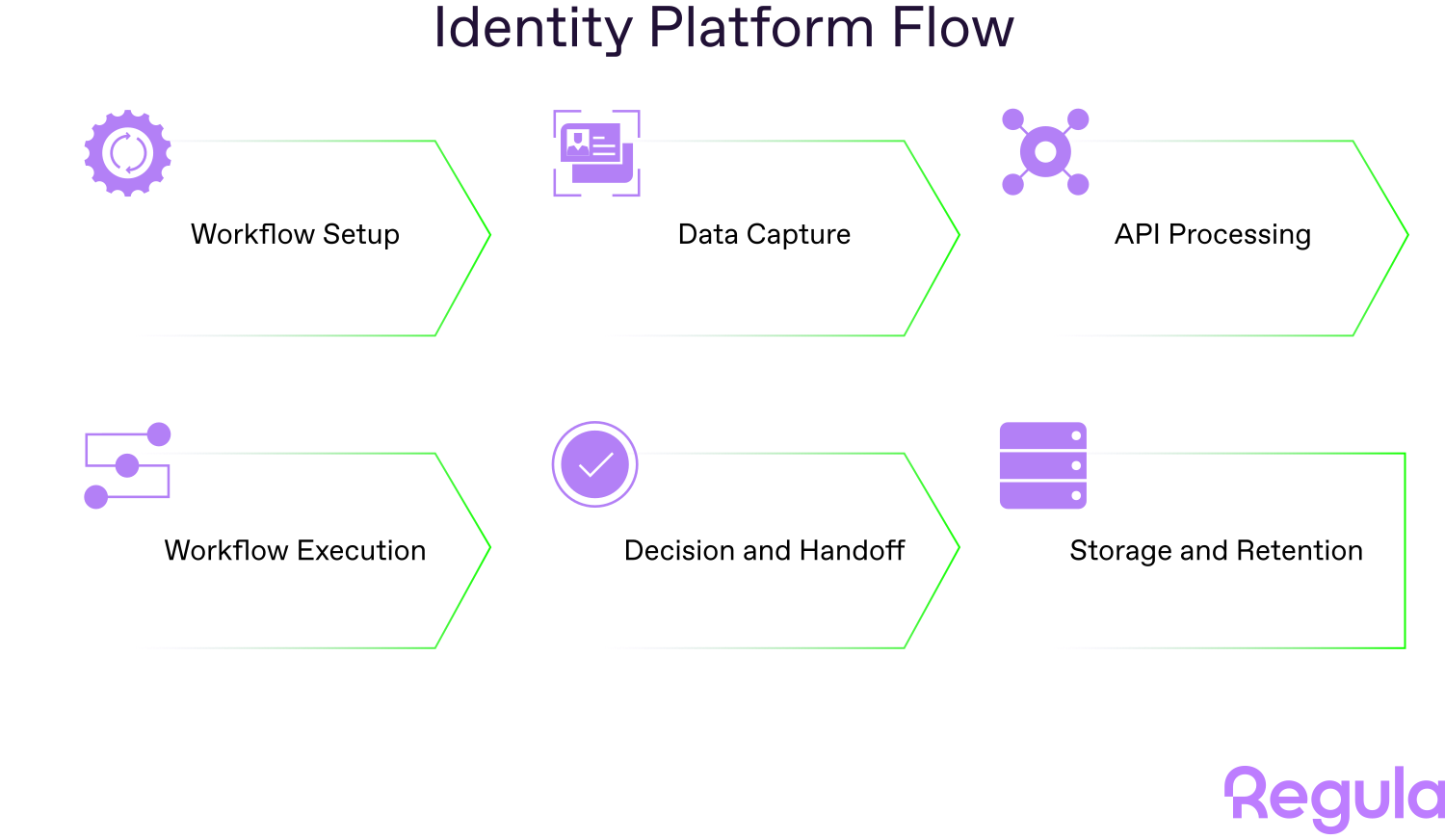
1) Workflow setup
Everything starts with a workflow that models the business process: the exact steps, branch rules, retries, re-screening cadence, and when to trigger step-up checks. The workflow includes document authentication, NFC chip reading where available, biometric PAD and 1:1 face matching, corroboration against data sources, sanctions/PEP screening for identity verification processes under AML policy, and recovery logic for high-risk edits.
The point is simple: risk and product can adjust the flow, test alternatives, and publish changes without waiting on a new mobile build—while every change is versioned and written to the audit trail.
2) Data capture
Once the workflow is in place, integrate web or mobile clients and external services with the platform. The clients then perform document and face capture with quality gates before upload: bad glare, motion blur, and cropped edges are rejected on the device. If there is an RFID chip, the app also prompts for NFC and reads signed data groups. A liveness check with a presentation attack detection (PAD) report is run, then the client hands artifacts to the platform API. The client does not call verification engines directly, which helps avoid blind spots in logging and authorization.
3) API layer: Processing and integration
An API acts as a gateway to the platform, receiving captured data and orchestrating the flow. It authenticates the caller, validates scopes, normalizes headers, opens an audit record, creates a correlation ID, and forwards the job to the workflow engine.
This provides one place to enforce service-to-service trust, rate limits, and mTLS where required, and it makes evidence collection easier. The same API surface connects external checks (for example, watchlists used in AML) and internal systems, so engineers don’t have to build one-off adapters every time a rule changes.
4) Workflow execution
The workflow service runs the graph you define:
Document authentication, including security feature checks and chip verification outputs.
Biometric capture evaluation and 1:1 match against the document portrait, with PAD.
Optional database corroboration or a call to a trusted attribute provider when policy allows.
Sanctions, watchlist and PEP screening as part of identity verification processes for regulated customer onboarding.
Risk scoring and conditional step-up to a stronger authentication assurance level when signals cross thresholds.
Each node writes structured results (pass/fail, confidence, references) and drops artifacts into the correct object store prefix. The scheduler picks up retries, periodic re-screening, and cleanup.
5) Decision and handoff
When the flow is completed, the identity verification platform records a decision and either creates a new subject profile with provenance and timestamps or updates an existing one according to the policy.
Downstream systems receive the outcome through webhooks, events, or a pull API together with the minimal attributes they need to grant or deny user access. If further access is granted, the platform can also record the authenticator ceremony that was used at that moment (for example, a selfie match against the enrollment portrait or a hardware-backed factor) so the evidence file shows what actually happened at release time.
6) Storage, retention, and redaction
Identity platforms ensure data governance, privacy, protection with data encryption and secure storage in line with GDPR, SOC 2, and ISO 27001, as well as configurable data retention policies.
Artifacts are stored in clearly separated layers:
Binary evidence (images, video liveness) lives in object storage with prefixes that group content by sessions, persons, and workflows.
Decisions and metadata live in a database.
Biometric templates live in a vector store with strict access control.
Retention timers, redaction jobs, and backup targets are all in config, which matters when AML teams or prosecutors ask for evidence.
There are also ongoing maintenance operations: cleanup, archival, routine re-verification, and long-running tasks can be scheduled for execution on a regular basis.
The main benefits of an IDV platform
We’ve already looked at the pros and cons of choosing between SDKs and an identity platform. This section is slightly different. These benefits stand on their own and apply even when you already use SDKs well, because they come from running identity verification as a managed system with workflows, records, and governance around it.
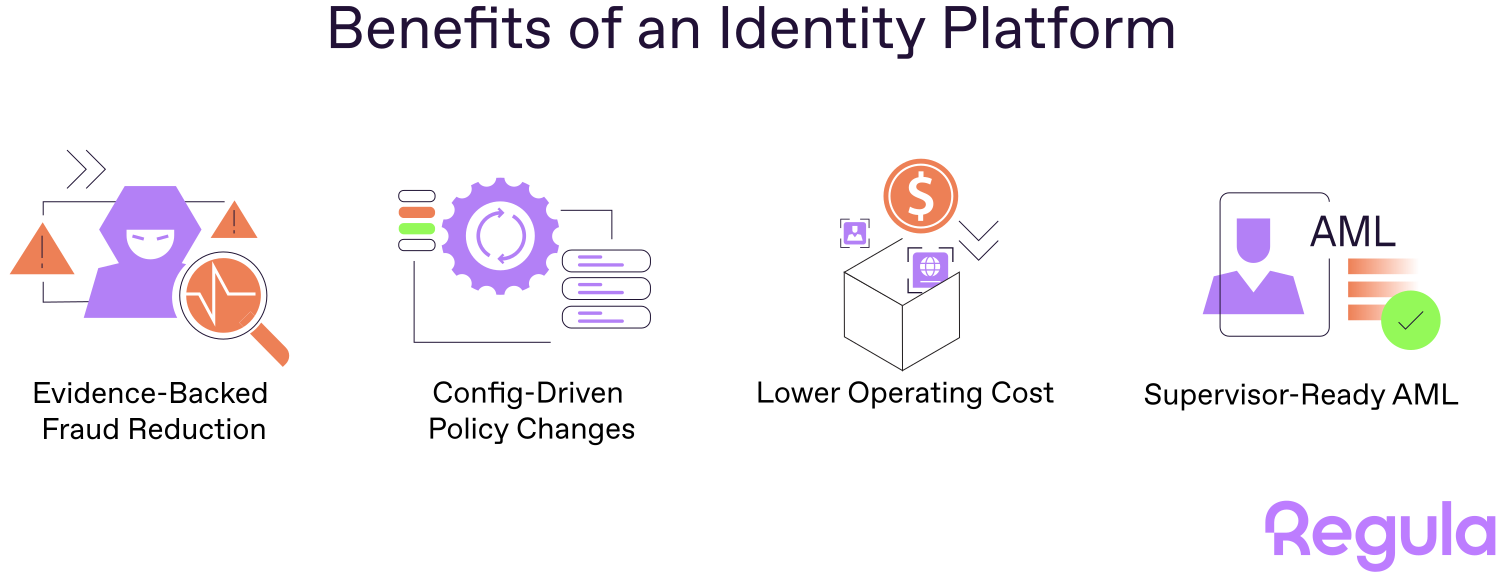
Artifact-backed fraud reduction
Fraud teams often need more than a yes/no verdict. They need the full verification record for a session: document authentication signals, NFC chip outputs where available, liveness results, face match scores, watchlist hits, and the context of the decision, all in one place and easy to retrieve.
When those elements are tied to one subject record with timestamps and integrity protections, attackers have a harder time replaying captured materials or manipulating support through partial evidence. It also makes a real difference in disputes, because chargeback cases and identity theft investigations usually depend on showing exactly what checks were run and what the system saw at the time.
Policy changes without code releases
Regulations change and fraud patterns shift. A platform allows risk and compliance updates to be made through workflow and configuration changes, not through app releases. That includes changing step order, adding screening steps, turning on optional corroboration for a segment, and adjusting when step-up checks are triggered.
This also improves day-to-day work. Product can test an onboarding path for a specific region without asking mobile engineers to rebuild the entire flow. Compliance can add an extra screening step for a subset of customers and keep a clear record of when the change went live. Security can require stronger AML checks before sensitive actions, and need to know that the workflow applies consistently across channels.
Lower operating cost
Running IDV at scale has a lot of hidden overhead: maintaining integrations, dealing with retries, recording evidence, supporting reviewers, and answering “what happened” questions quickly. A platform reduces that overhead because workflows, storage, and access controls are managed in one place, rather than being spread across application code, scripts, and one-off tooling.
The savings are usually practical. Engineering spends less time maintaining separate logic per channel. Operations spends less time reconstructing sessions, because the session record already contains the artifacts and outcomes needed for troubleshooting. Compliance spends less time preparing audit packs, since exports are produced from data that is already structured and complete.
Superior AML supervision
AML teams and supervisors need traceability. They want to see what checks ran, when they ran, what the outcomes were, and what actions followed. An identity lifecycle management platform supports all of that by treating sanctions, PEP, and monitoring steps as part of the workflow, with outcomes and timestamps tied to the same customer record as the identity evidence.
When a supervisor asks for a file, teams can export a clean chronological evidence chain without chasing data across systems. If you operate in multiple regions, you can apply different retention windows and reporting formats based on the market while keeping the underlying investigation workflow consistent for staff.
Where identity platforms can see implementation
Lastly, here are some ways identity platforms can be used, performing the entire cycle of capture, checks, decisions, storage, redaction, and audit:
Retail banking (KYC onboarding and payout step-up): Cut chargebacks by tying document checks, liveness, chip reads, and sanctions hits into one case file that dispute teams can export in minutes.
Crypto exchanges (CDD with re-screening): Pass inspections faster by scheduling periodic sanctions/PEP runs inside the workflow and producing ready-made evidence packs per account.
Marketplace sellers and gig workers (verified onboarding and recovery): Block duplicate or synthetic profiles by binding first-run proofing to the subject and requiring re-proof for risky edits or device changes.
Insurance (claims step-up): Reduce opportunistic fraud by comparing a face match against the enrollment portrait before claim payout and logging the outcome in the claim record.
Airlines and airports (kiosk and bag-drop IDV): Reduce manual checks at counters by running document authentication and 1:1 match on the spot and returning structured failure reasons to staff systems.
Enterprise workforce (contractor and vendor access): Prevent badge-sharing and identity drift by re-proofing at device enrollment and recording authenticator status alongside employment milestones.
iGaming (jurisdiction and affordability gates): Reduce regulator findings by encoding geo, age, and sanctions checks as first-class workflow steps with per-market retention rules.
Regula IDV Platform as a solution for customer identity management
A robust identity platform is a system that verifies people with recorded evidence, records artifacts for audits and AML, and lets you change flows through configuration rather than code. With its help, you will be able to easily grant secure access that fits risk at each step, stay compliant using solid records, and protect customers' identities without piling up data you don’t need.
All of this can be performed by our flagship turn-key solution, Regula IDV Platform. It provides you with:
Identity lifecycle management with flexible orchestration and tailored workflows across every stage of the user journey.
Complete document and biometric verification, backed by the biggest template database in the world (16,000+ documents from 254 countries and territories).
Instant facial recognition with liveness detection, preventing the use of static face images, printed photos, video replays, video injections, or masks.
AML/PEP screening, as well as validation against trusted global databases.
User data management and analytics for continuous monitoring.
Smooth integration with your existing tech stack via flexible connectors.
And more.
Let’s drive the future together. Book a call to learn more about our solutions!
.webp)