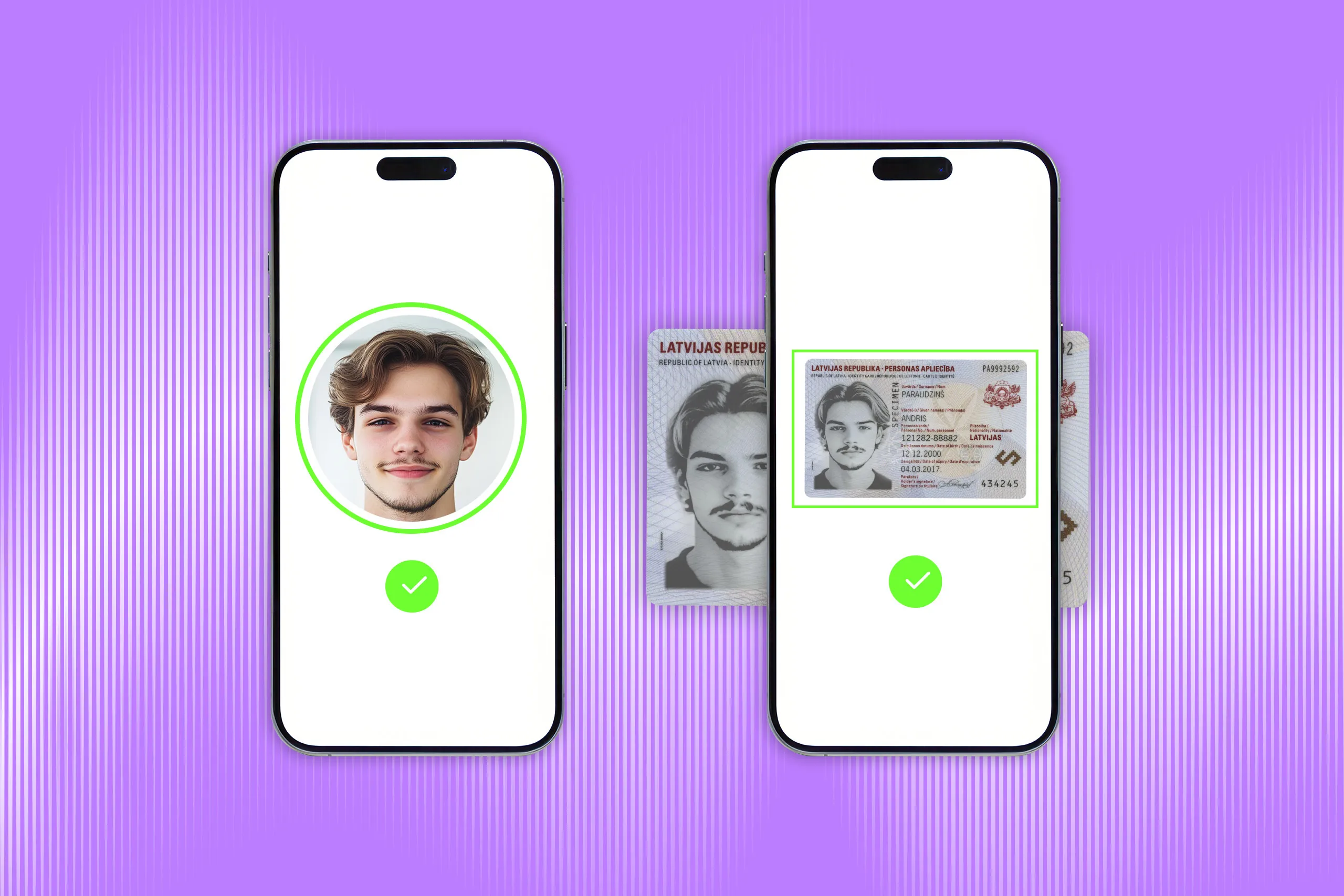


In brief: Strong healthcare identity verification combines several layers: patient data matching, government-issued ID verification, face matching, liveness detection, MFA, step-up checks, and manual review when needed.
Patient portals have become the front door to healthcare. They handle appointment booking, lab results, prescription requests, insurance details, billing, and access to medical records. Each of these actions depends on one assumption: the person behind the account is the legitimate patient. If identity checks are weak, the portal can become a shortcut to medical identity theft, account takeover, prescription abuse, or claims fraud.
Healthcare identity verification connects the person requesting access, care, prescriptions, or insurance benefits to the correct patient identity and medical record, while adding stronger checks only when the action carries real risk.
A risk map for healthcare identity verification
Healthcare providers handle protected health information: medical records, diagnoses, prescriptions, lab results, billing data, insurance details, and other individually identifiable health data.
In the US, the HIPAA Privacy Rule sets national standards for protecting medical records and other protected health information, while the Security Rule requires administrative, physical, and technical safeguards for electronic protected health information.
In Europe and other GDPR-influenced jurisdictions, health data is treated as a special category of personal data, so healthcare platforms need appropriate safeguards and control over who can access or process it.
That makes identity a practical compliance issue: before a platform gives someone access to a patient portal, it needs reasonable controls to confirm that access is going to the right person.
At the same time, healthcare identity verification is not one checkpoint at registration. It matters wherever the wrong person can access care, view medical records, request medication, change profile data, use insurance benefits, or touch patient information as a staff member. Each workflow carries a different mix of clinical, financial, privacy, and compliance risk.
| Workflow | Potential threat | Business implications |
|---|---|---|
| Patient portal registration | Someone creates an account under another person’s identity | Medical identity theft, privacy exposure, compliance risk |
| Login to an existing account | Stolen credentials give fraudsters access to medical records | Account takeover, data exposure, reputational damage |
| Access to test results or medical history | Sensitive health data is shown to the wrong person | Privacy breach, compliance risk, patient trust loss |
| Prescription request or refill | Medication is requested by an impostor or ineligible user | Prescription abuse, patient safety risk, regulatory exposure |
| Insurance or claims workflow | Someone uses another person’s benefits or submits fraudulent claims | Claims fraud, financial loss, audit risk, reputational damage |
| Profile changes | A fraudster changes name, DOB, email, phone, or insurance details | Account takeover persistence, record corruption, billing errors |
| Staff access to patient data | Unauthorized or compromised staff account accesses records | Insider misuse, privacy breach, compliance penalties |
Get posts like this in your inbox with the bi-weekly Regula Blog Digest!
How does identity verification work in healthcare?
Healthcare identity verification does not follow one universal script. The process depends on the country, service type, healthcare system, and level of access the patient needs. Still, most healthcare identity checks follow the same basic logic:
-
The patient enters personal details such as name, date of birth, address, phone number, email, or health-system identifier.
-
The system checks whether those details can be matched to an existing patient record, trusted identity source, or service eligibility requirement.
-
If the match is enough for the use case, verification may stop there.
-
If stronger assurance is needed, the patient may be asked to submit a government-issued ID, such as a passport, national ID card, or driver’s license.
-
The provider may also ask for a selfie, face scan, or short video to compare the person with the ID portrait.
-
Contact checks, one-time passwords, email verification, MFA, and device/session signals may support account security, but they usually prove account control rather than legal identity.
-
If the automated check fails or the workflow is high risk, the patient may be asked for additional documents or routed to manual review.
-
Once verified, the patient can access the relevant service: full portal access, appointments, prescriptions, health records, insurance-related workflows, or profile changes.
Let’s see some real-world use cases.

Example 1: National health service
NHS login is a reusable login and identity verification service for digital health and care services in the UK. Patients can use it to access the NHS App and approved partner apps or websites with one account, rather than use separate registration flows for every provider.
In the NHS login model, the level of verification determines what the service knows about the user and what the user can access::
-
Low-level verification: The user registers with an email address and phone number. The user’s identity is not verified. At this level, users can access limited services, such as booking appointments without viewing or managing them.
-
Medium-level verification: The service verifies email and phone number, then checks details such as date of birth, NHS number, first name, last name, and GP surgery code against the NHS Personal Demographics Service. Users cannot access medical records or personal information, but they can submit online consultations, record data such as blood pressure readings or contact their GP.
-
High-level verification: The service fully authenticates the user ID and verifies email, phone, date of birth, NHS number, name, and GP surgery information. At this level, users can read medical records, view their NHS number, order repeat prescriptions, manage appointments, and more.
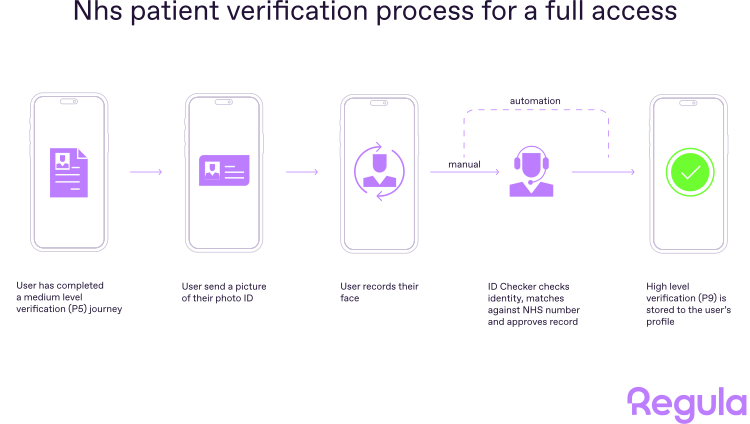
Prove your identity (PYI) process in the NHS.
Example 2: Connected provider portals
MyChart is a patient portal used by many healthcare organizations in the US. Patients use it to view test results, manage appointments, request prescription refills, and access other provider-specific services.
Unlike NHS login, MyChart is not one national identity model. It is a portal product used by different healthcare organizations, so the exact identity verification process depends on the provider.
Typically, MyChart access starts in one of three ways:
-
Provider-issued activation code: The patient receives a code from the healthcare provider. The code helps link the online account to an existing patient record.
-
Online self-signup with record matching: Some providers let patients request access online by entering personal details, such as name, date of birth, contact information, or the last four digits of their Social Security number. The system then tries to match those details against the provider’s records before sending or granting an activation code.
-
Online self-signup with third-party identity verification: Some providers add an external verification step. The user enters demographic information, then answers questions generated by a third-party verification system before the MyChart account is created.
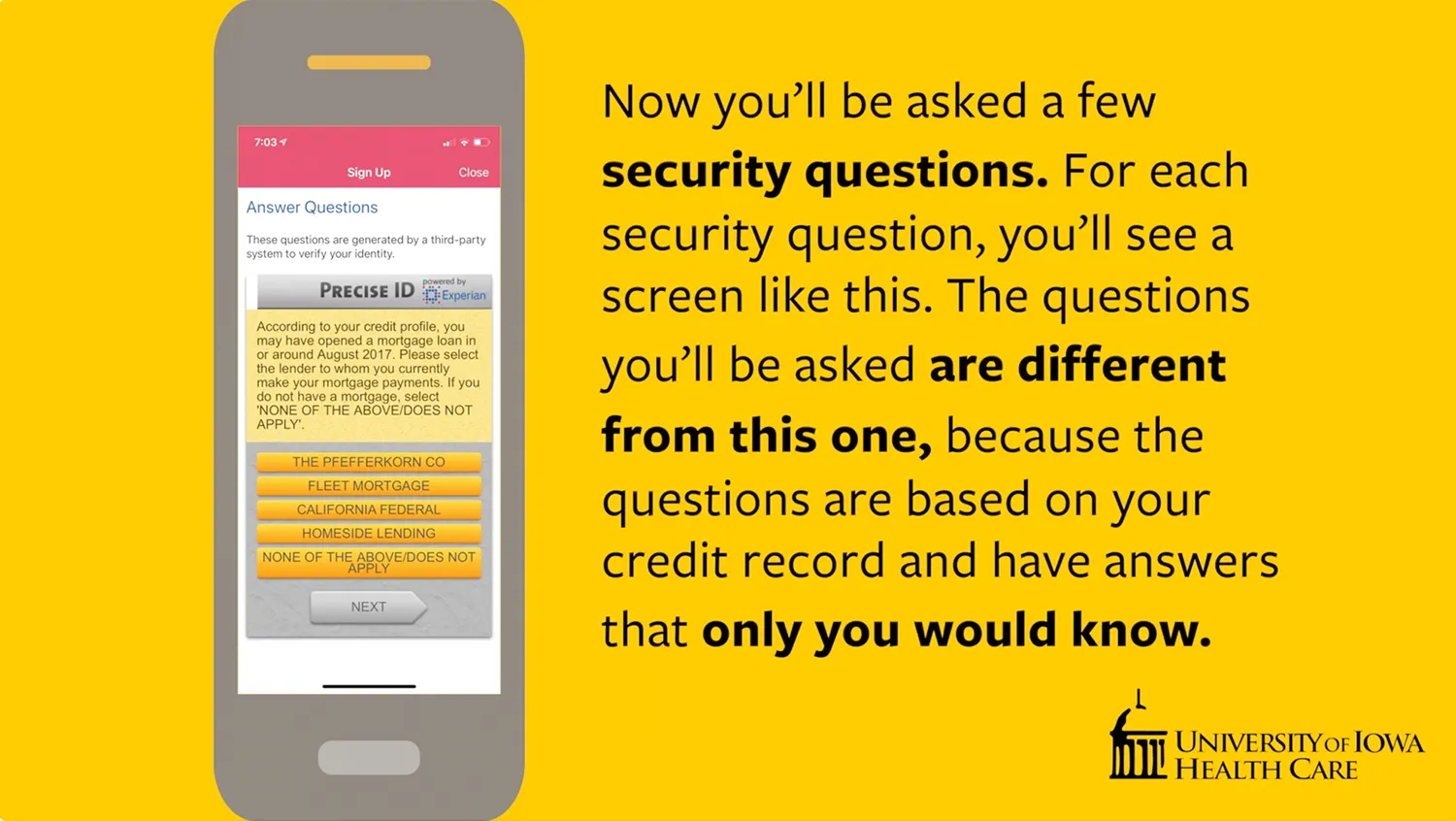
MyChart security questions are based on patients’ credit history.
Example 3: Telehealth services providers
Telehealth providers often support more than one identity verification route. The exact flow depends on the country, state or province, and available digital identity tools.
The Latvian provider Medon, for example, offers several verification options, including ID document submission and verification through third-party services such as banks or digital identity platforms. New users can verify their identity with options such as Smart-ID, banking apps secured with biometrics, or standard ID verification. This model works well in markets where bank authentication or national digital identity tools are already familiar to patients.

New users of Medon can verify their identity using options such as a personal number (Smart-ID), banking apps secured with biometrics, or standard ID verification.
Maple, a Canadian telehealth provider, shows a more treatment-triggered flow. In Ontario, Maple asks patients to verify their identity with a valid government-issued photo ID when they submit a visit request to see a doctor or nurse practitioner. The patient selects the ID type, such as a photo health card, then takes or uploads clear photos of the front and back of the ID. Once the ID is verified, the patient moves to the waiting room.
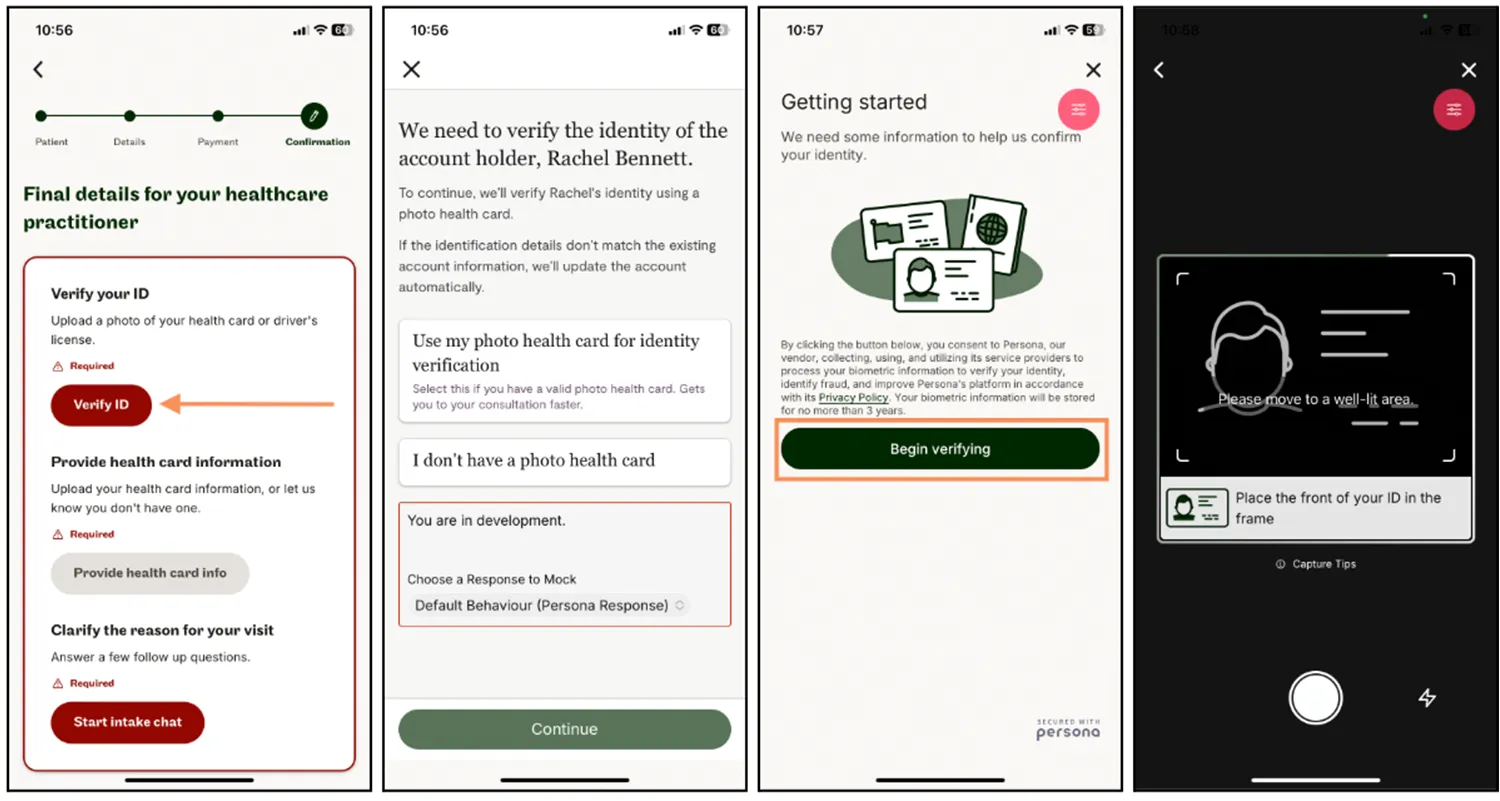
In other Canadian states, practitioners may also ask for a valid government-issued photo ID for providing prescriptions or uploading lab test results after a patient’s visit.
How can fraudsters exploit weak healthcare identity checks?
Weak healthcare identity checks can let an impostor access a patient portal, receive care under another person’s name, request medication, and manipulate insurance workflows.
The examples below show why healthcare identity verification should not stop at basic account creation. The identity signal has to stay reliable across portal access, treatment, prescriptions, claims, and provider-facing workflows.
Medical identity theft
Since many online healthcare providers offer non-video consultations, fraudsters can exploit this by using stolen or fake IDs to register for medical services. The primary sources of personal data in these cases are healthcare data breaches, phishing emails, messages, and phone calls.
As a result, legitimate patients may be left paying for someone else’s medical bills. Additionally, their healthcare records can be compromised, potentially leading to mixed medical histories with the fraudster. This can result in incorrect diagnosis and improper medical care.
Case to the point
In 2024, a woman from Arizona, USA, was billed hundreds of thousands of dollars after a scammer used her identity to receive medical care from multiple healthcare providers, including consultations, medical tests, and treatments.
Because the US lacks a centralized medical records system, detecting impersonators remains a significant challenge for both healthcare institutions and law enforcement. In this case, authorities were unable to identify a suspect, and the investigation was eventually closed.
Health insurance fraud
In countries with insurance-based healthcare systems, fraudsters can use stolen or fabricated identities to commit health insurance fraud. Common tactics include submitting fraudulent claims using another person’s insurance and enrolling in multiple insurance plans with fake IDs to maximize benefits.
This type of fraud directly impacts both insurance companies and healthcare providers, causing financial losses and reputational harm.
Case to the point
A New York medical biller orchestrated a multimillion-dollar health insurance fraud scheme, resulting in a 12-year prison sentence and $336M restitution. Among his many tactics, he impersonated patients and their relatives in thousands of phone calls to insurance companies, pressuring them to reconsider denied claims or increase payments on approved ones.
Deepfake and synthetic identity fraud
Deepfakes in the Healthcare industry aren’t uncommon. According to Regula’s study, companies in the sector have encountered both audio (43%) and video (41%) deepfakes. These incidents can lead to reputational damage, business disruptions, and legal expenses.
By generating entirely fake or partially genuine synthetic identities, fraudsters can impersonate patients or even healthcare professionals affiliated with legitimate services. This allows scammers to gain unauthorized access to medical records, receive prescriptions for restricted medication, or exploit a patient's insurance benefits to receive free consultations.
Case to the point
In 2024, a deepfake video campaign on Facebook impersonated a real health expert from The Baker Heart and Diabetes Institute in Melbourne, Australia. In the fake ad, the “doctor” promoted dietary supplements as a treatment for type 2 diabetes while dismissing legally approved first-line treatments.
As a result, both the organization and the impersonated expert had to issue an official statement clarifying that the video was AI-generated and warning patients about the scam. However, many patients who saw the ad began calling the doctor’s clinic to inquire about the false treatment.

How to strengthen identity verification in healthcare?
Fraudsters often exploit two weak points in patient identity verification: new customer onboarding and authentication of returning patients. That’s why to build a reliable system, healthcare providers need robust identity proofing for new users and strong authentication for existing ones.
The following approaches can help combat identity-related threats:
1. Document verification: Verify identity evidence, not just account control
Email verification, SMS codes, and passwords help confirm account control. They don’t prove that the person is the legitimate patient tied to a medical record.
Ideally, healthcare providers need stronger identity evidence. Document verification checks a government-issued ID, such as a passport, national ID card, driver’s license, or health card where applicable. The software analyzes layout, security features, machine-readable zones, barcodes, data fields, expiration date, and signs of tampering to detect fake or altered documents.
The extracted data can then be compared with the patient’s entered details, existing patient record, insurance information, or service eligibility rules.
2. Liveness detection: Check that the patient is physically present
In remote healthcare, a selfie or video is not enough on its own. A fraudster may try to pass verification with a printed photo, screen replay, injected image, AI-generated face, or stolen ID image.
Liveness detection checks whether the person going through verification is physically present during the session. When combined with face matching, it helps confirm that the live person matches the portrait on the ID document or another trusted reference image.
This is especially relevant for remote onboarding, online consultations, prescription-related workflows, and any service where a stolen document image or patient photo could be reused.
For more protection, you can implement liveness detection for ID documents as well to avoid attempts to submit manipulated print-outs instead of authentic IDs.
3. MFA: Keep authentication strong after onboarding
Identity verification establishes trust, but a reliable authentication process preserves it. Replacing or supplementing passwords with biometric authentication, such as face recognition, considerably enhances security.
These methods also help with access management, preventing insider threats from practitioners, nurses, or other staff involved in healthcare fraud.
Bringing healthcare identity verification into one platform
In real healthcare flows, identity verification rarely follows one fixed route. Basic portal access, full medical-record access, prescription requests, and insurance updates all call for different levels of assurance. That flexibility is hard to manage when document checks, biometrics, liveness detection, data extraction, and manual review sit in separate tools.
An end-to-end identity verification platform, such as Regula, brings these signals into one automated decision process. Healthcare providers can configure verification workflows by risk profile, so the result is not more verification everywhere, but stronger checks at the moments that need them.
For example, a healthcare provider can use Regula to:
-
Verify an ID document during remote onboarding
-
Extract patient data and compare it with entered details or internal records
-
Match a live selfie with the ID portrait
-
Add liveness detection for remote processes
-
Route failed, inconsistent, or high-risk cases to manual review
-
Keep verification results available for audit and dispute resolution
Need to protect patient access, records, prescriptions, and claims without making patient verification painful? Talk to Regula’s team to design the right identity verification flow for your healthcare use case.