
.webp)
In brief: AI agents are turning identity verification into an actor problem: a session may contain valid credentials, but it is software that is completing the flow, not a human. With a quarter of organizations already citing AI agents as a threat, there must be rules for when automation is allowed, when it triggers step-up checks, and when it becomes suspected abuse.
Deepfakes have already shown us how quickly an AI threat can turn from a niche topic into a mainstream KYC scenario. And while they are as prominent as ever, now may be the time for a brand new kind of danger to enter the scene.
As per our latest survey, 26% of respondents already cite AI agents acting on behalf of users as an identity threat. That means one in four organizations is already thinking about a question IDV teams have rarely had to answer before: who, or what, is completing the verification flow?
And there is more.
In this article, we break down five key numbers from Regula’s “The New Shape of Identity Threats” report that show how decision-makers across the globe perceive identity threats, and what that implies for the future of ID verification.
This is original data from Regula’s global study of AI-assisted identity activity and identity threats across banking, financial services, crypto, telecom, government, and gaming in the UK, US, Germany, Singapore, the UAE, Brazil, and Mexico.
Get posts like this in your inbox with the bi-weekly Regula Blog Digest!
98% are concerned about identity-related threats
Hardly a surprising figure in 2026, such a high concern rate gains more weight when viewed against the survey’s respondents.
The sample was not limited to KYC officers or fraud analysts: it included a range of decision-makers such as owners/founders, directors, C-level executives, and general managers. Respondents also differed in how close they were to fraud work: for some, fraud detection/prevention was their main responsibility; for others, it was one of several responsibilities.
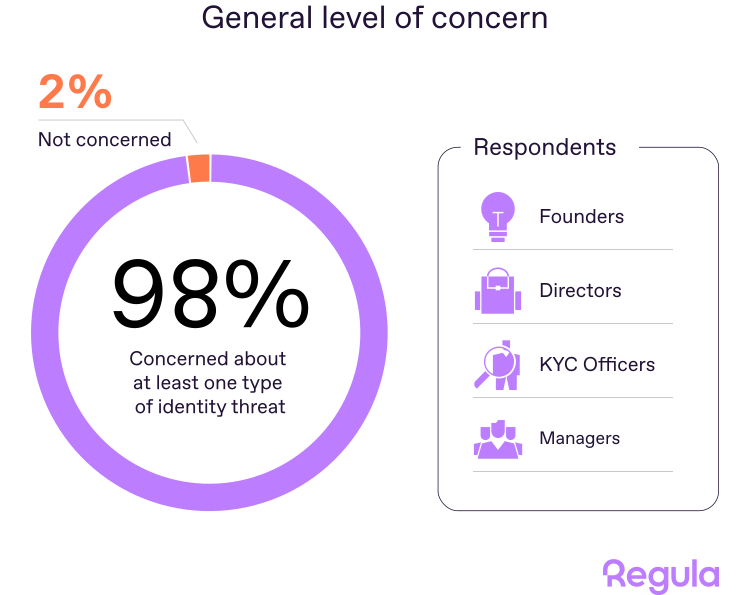
This means identity risk is being flagged not only by specialists who work with onboarding fraud, but also by people with other business priorities. This is something that KYC leaders can use to their advantage when talking to leadership: the nearly universal concern figure can help with prioritization and investment in robust controls.
That said, investment needs to be smart. The key focus should not be adding more checks to the workflow, but building a solid IDV ecosystem that can secure full identity signal integrity.
Some improvement areas to consider:
-
Capture integrity: stronger liveness checks, protection against camera injection, replay attacks, generated media, masks, and manipulated capture paths.
-
Evidence authenticity: document and biometric checks that can detect altered, generated, reused, or inconsistent identity evidence.
-
Visibility: a clear inventory of AI-assisted tools used in IDV, what each tool evaluates, and how its output affects approval, rejection, or review.
-
Audit-grade records: case files that retain the submitted evidence, rule hits, vendor outputs, reviewer notes, override history, and final rationale.
-
Ownership and testing: named teams for thresholds, overrides, vendor performance, escalation, and post-incident rule changes.
35% cite deepfakes as a concern, nearly level with document fraud and identity spoofing
The key finding here is not that deepfakes outrank other threats, but that they now occupy the same concern band as two classic KYC problems: stolen and reused identity data and fake or altered documents.
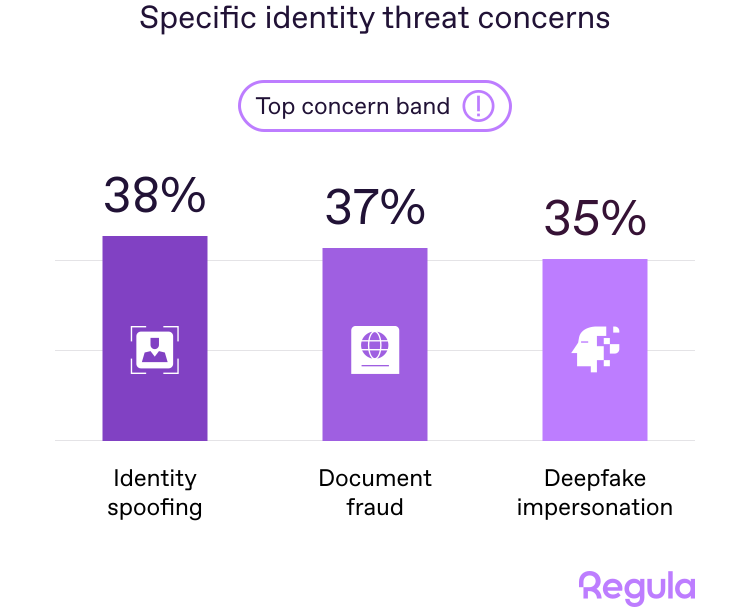
That is a major finding, as the other two have been familiar problems for decades, whereas deepfakes are taking the KYC world by storm. Synthetic media has officially moved from a specialist fraud topic into mainstream identity-risk planning.
The practical response has three parts:
-
Treat liveness and capture integrity as non-negotiable. A face match is weaker if the system cannot prove that the biometric was captured live, through a trusted capture path, during the session. Deepfake checks should therefore be paired with replay and injection resistance, generated-media detection, and rules for low-confidence capture.
-
Connect the biometric result to the document and session. A deepfake attempt may come with a real stolen document image, a manipulated ID, reused personal data, or suspicious device behavior. The decision file should show how those signals fit together, rather than leaving the document result, biometric result, and fraud indicators in separate systems.
-
Make deepfake suspicion reviewable. Analysts need plain labels such as suspected generated media, replay risk, injection risk, failed liveness, face mismatch, document inconsistency, or uncertain automation. Those labels should determine whether the case is approved, stepped up, sent to manual review, blocked, or investigated.
26% already cite AI agents acting on behalf of users as a threat
Moving from one AI threat to another, we have an entry that ranked surprisingly high — AI agents. While fewer people see them as a danger than deepfakes, they present a totally new kind of IDV problem: identity systems may need to verify not only the evidence, but the actor behind the session.
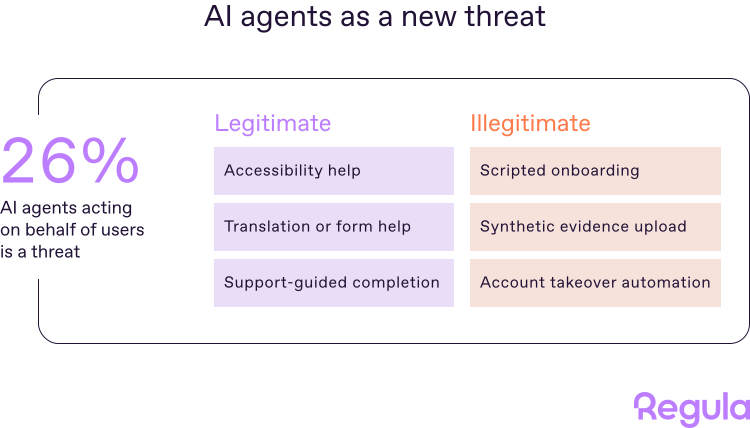
Some of that may be legitimate: a real customer may use accessibility software, a browser assistant, translation tools, autofill, or an approved delegate. More broadly, AI assistants are starting to perform ordinary digital tasks on a user’s behalf: filling out forms, comparing offers, booking tickets, contacting companies, or helping users complete multi-step online processes.
Other cases may be abusive: a fraudster using an agent to test many onboarding variations, drive account takeover, submit synthetic evidence, or complete verification steps at scale.
That’s why, if software completes part of the identity flow, teams need to know whether the user authorized it, whether the action is permitted, whether stronger confirmation is needed, and whether the case should be reviewed.
KYC teams should create rules for machine-operated identity activity:
-
Define allowed assistance: accessibility tools, password managers, translation tools, support-guided flows, and other accepted helpers.
-
Define restricted actions: form completion, document upload, biometric capture, recovery steps, and high-risk account changes may need fresh user confirmation.
-
Detect automation patterns: repeated retries, scripted timing, emulator use, unusual device behavior, copied session patterns, and bulk attempts.
-
Bind sensitive actions to a person: use liveness, step-up checks, trusted device checks, or re-authentication when the action creates risk.
-
Record the decision: note when automation was suspected, allowed, reviewed, blocked, or escalated.
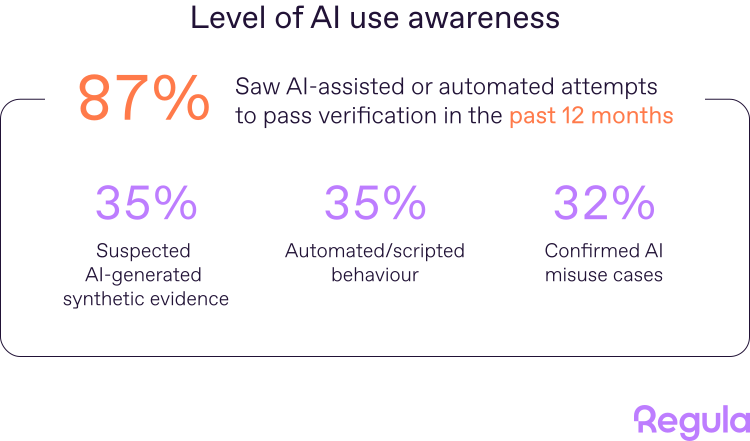
87% saw AI-assisted or automated attempts to pass verification in the past 12 months
While large portions of respondents indicated suspected or confirmed AI misuse (35% and 32% respectively), an equally sizable group witnessed “automated/scripted behavior”. This is worth looking into because automated behavior doesn’t automatically mean attempted identity fraud, as discussed in the previous section.
Automated-looking behavior may come from fraud scripts, bots, or attack tools, but it may also come from password managers, accessibility tools, managed devices, support-assisted flows, or legitimate user-side automation. And the big risk here lies in treating every such identity signal as either harmless or fraudulent too quickly.
That’s why KYC teams must make sure their IDV systems and review teams can label the difference between legitimate assistance, suspicious automation, synthetic evidence, and confirmed abuse.
This also changes vendor evaluation: IDV providers must be asked how they detect AI-generated documents, deepfake media, injection attacks, replayed biometrics, and scripted sessions, but also how those findings are recorded for analyst review and audit.
69% say AI-assisted tool use in IDV flows is common, but only 39% have clear visibility
As we discussed, AI use may include a genuine customer relying on accessibility software, translation tools, autofill, password managers, or other assistance. At the same time, it may also include a script, bot, fraud operator, or AI system helping someone submit synthetic identity evidence.
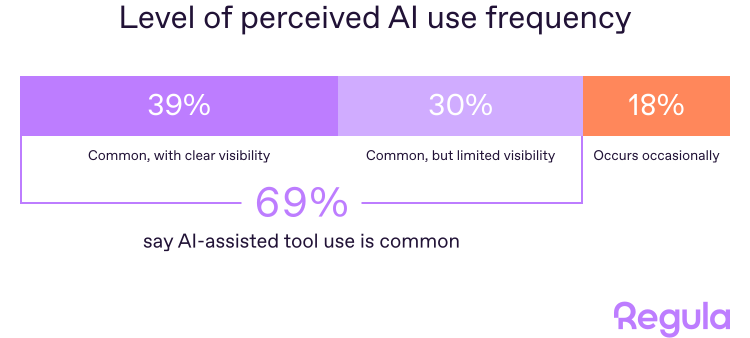
Given how common AI has become, limited visibility creates practical risk. If visibility is weak, legitimate assistance can be treated as suspicious, while risky automation can look like ordinary user behavior. Analysts may see odd timing, repeated retries, unusual capture behavior, or inconsistent evidence, but still lack enough context to decide whether the case should pass, fail, or go to manual review.
That’s why KYC teams should build a customer-side and external-actor AI-use taxonomy for IDV.
Each case should be labeled in operational terms:
-
legitimate user assistance;
-
scripted or automated behavior;
-
suspected synthetic evidence;
-
replay or injection risk;
-
deepfake or generated-media suspicion;
-
uncertain attribution;
-
confirmed abuse.
The taxonomy should connect directly to review rules. Some cases may require step-up verification, some may go to manual review, some may be blocked, and some may be allowed with the right evidence.
BONUS: Insightful correlations that shed more light on threat perception
From the results of our survey, we have identified two compelling correlations that show certain groups as more likely to recognize AI-native identity threats, especially deepfakes, than others.
NOTE: these should not be treated as cause-and-effect claims.
Degree of visibility changes threat naming
If organizations have low visibility into AI-assisted tool use, they are much less likely to flag deepfakes as threats (18%) and more likely to flag document fraud (45%), compared to those with high visibility.
If organizations have high visibility, an impressive 41% flag deepfakes and only 32% flag document fraud.
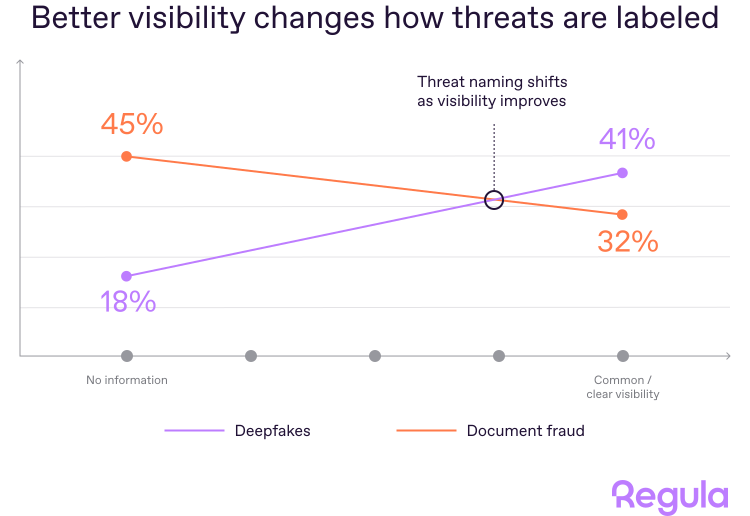
When visibility is weak, teams may rely on familiar categories. A suspicious IDV case may be labeled as document fraud because that is the older, more familiar bucket.
When visibility improves, the same type of case can be separated into more precise components: fake or altered document, generated selfie, replay risk, injection risk, scripted behavior, or uncertain automation.
Dedicated fraud ownership sharpens deepfake recognition
Deepfake concern is higher among respondents whose main responsibility is fraud detection/prevention: 38%, compared with 29% among those for whom fraud is one of several duties.
.svg)
It is a reminder that AI-generated impersonation can be hard to spot as its own category when no one has dedicated time to connect the clues. A failed liveness check, a suspicious selfie, a reused document image, odd retries, and a device anomaly may sit in separate review notes unless someone owns the pattern.
That is especially important for deepfakes because they rarely arrive as an isolated “fake face” event. They can come with stolen identity data, manipulated documents, replay attempts, injection risk, or scripted behavior. Without dedicated review, those pieces can be treated as unrelated friction instead of one coordinated identity attempt.
Key takeaway
The two correlations are united by one hypothesis: AI identity risk becomes clearer when teams can name it, see it, and own it.
They do not prove causation, but they do show where KYC teams can improve. Deepfakes and AI-assisted identity threats are easier to manage when they are not buried under generic labels, scattered between teams, or treated as isolated technical alerts.
More insights on the new shape of identity threats — a click away
The full Regula survey report is publicly available — free, with no strings attached.
Want to know how Regula can help protect your business from AI-powered identity fraud? Talk to our experts.