

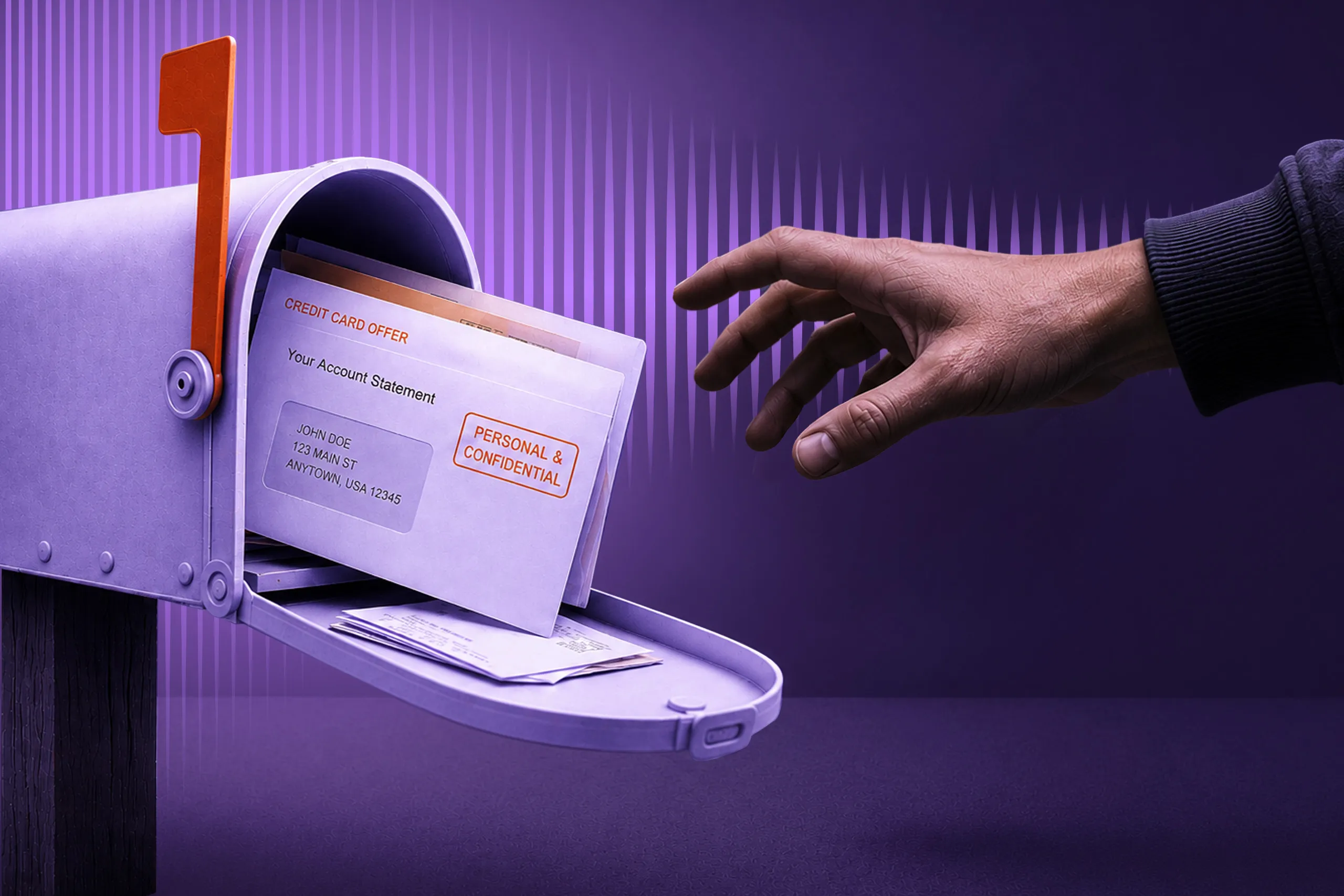
Deepfakes get the headlines, but many identity fraud schemes still start with something much less futuristic: a stolen envelope from a mailbox.
In May 2026, federal prosecutors in Missouri, US, described one such case. A man was sentenced to 42 months in prison after pleading guilty to identity theft. Investigators later found unauthorized bank cards, false driver’s licenses, false Social Security cards, bank paperwork, and a large trash bag full of opened, stolen U.S. mail in his apartment. The stolen identities were used to obtain credit, deposit altered Treasury checks, apply for pandemic relief funds, and even finance a BMW.
For US businesses, the case points to a growing identity verification risk: fraudsters enter digital flows already armed with real personal data.
Get posts like this in your inbox with the bi-weekly Regula Blog Digest!
Mail theft has become a fraud data source
In the US, mail theft sits at the intersection of two realities: sensitive identity data still travels through physical mail, and many digital workflows treat personal information as a trust signal. That makes stolen mail useful for fraudsters, as it gives them fragments of identity that can be reused later in digital onboarding, account recovery, payments, or benefit flows.
A single envelope can expose names, addresses, account numbers, payment details, credit card offers, benefits documents, tax correspondence, utility bills, remittance slips, and other fragments that help a fraudster impersonate a real person.
While the theft may start offline, the monetization often happens later in a business-controlled digital flow. A fraudster may use stolen mail to support:
-
Online account opening
-
Loan applications
-
Mobile check deposits
-
Card activation
-
Benefit claims
-
Account recovery
-
Address, phone, or email changes
-
Fake identity document creation
The pattern is already visible. In another 2026 case, two former US postal carriers, a bank manager, and another participant were indicted over an alleged nearly $5 million bank fraud and mail theft scheme. Prosecutors said the stolen mail included checks, credit cards, and other valuables. A stolen U.S. Treasury check worth about $4.9 million was allegedly deposited into a business account opened using a stolen identity.
The FBI and the US Postal Inspection Service have also warned that mail theft-related check fraud is rising. Suspicious Activity Reports related to check fraud nearly doubled from 2021 to 2023, according to their 2025 public announcement.
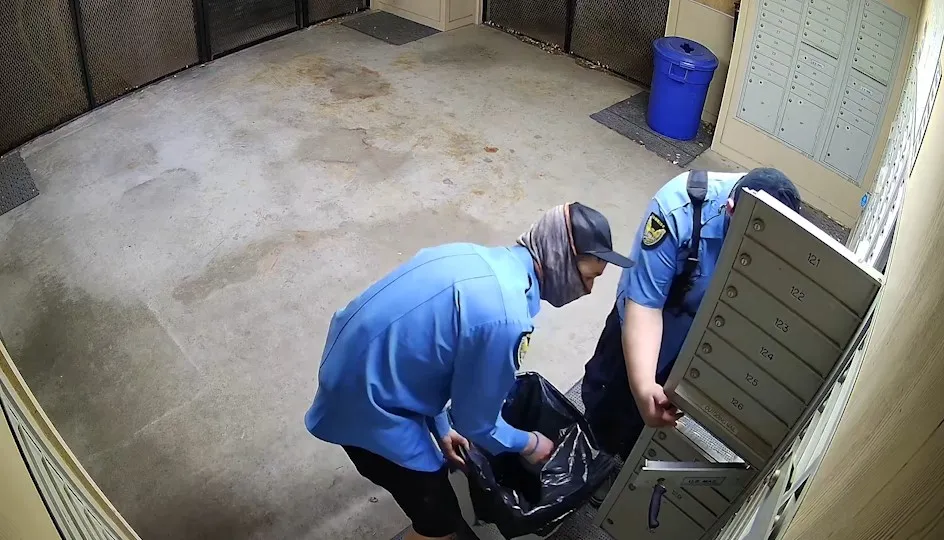
Surveillance footage of mail theft in Austin, Texas. Source: KXAN
What risks does mail theft create for businesses?
Stolen personal data creates a dangerous false positive. If an applicant knows a Social Security number, address, bank name, account detail, or payment history, that can mean one of two things:
-
The applicant is the legitimate identity holder.
-
The applicant is using data stolen from the legitimate identity holder.
For businesses, the risk is that fraudsters may have real data that can pass weak checks. That in turn can create several problems:
-
Bad account approvals: A business may approve a customer who is not the rightful identity holder. The fraudster may then try to obtain loans, deposit stolen checks, redirect payments, or access benefits.
-
Account takeover: Stolen correspondence can help fraudsters reset access, change contact details, or bypass weak recovery flows to access funds.
-
Customer harm and disputes: Victims may later challenge unauthorized accounts, loans, payments, deposits, or profile changes made in their name.
-
Compliance and audit exposure: If a business cannot show how it verified the person behind the data, investigations and disputes become harder to defend.
-
Reputational damage: Fraud tied to weak onboarding or recovery controls can erode trust, especially in banking, lending, fintech, insurance, and public-sector services.
If an identity verification flow only asks, “Does this information match a real person?” mail theft can help a fraudster answer “yes.”
What to check when identity data may be stolen?
Since in mail theft-related fraud, the data may be correct, a stronger identity verification process should move beyond data matching. It should verify the identity evidence, the person presenting it, the context around the interaction — and then check whether all facts are consistent with one another.
That means checking several layers of evidence, also called identity signals, together, rather than treating any one of them as decisive:
| What to check | What it verifies | Why it matters when mail theft is involved |
|---|---|---|
| Document authenticity | Is the submitted ID genuine, not counterfeit or edited? | A fraudster may use stolen name, address, or SSN data to create a fake driver’s license or ID card |
| Document data consistency | Do visible fields match the data stored in the MRZ, barcode, or RFID chip, where available? | A mismatch may show that the document image was altered or that real victim data was inserted into a fake template |
| Document-to-application match | Does extracted document data match the data entered in the application form? | Manually typed names, dates of birth, addresses, or document numbers can be copied from stolen correspondence |
| Face match | Does the applicant’s selfie match the portrait on the identity document? | This helps catch cases where a fraudster uses a document built around someone else’s data but their own face |
| Liveness detection | Is the applicant a real, present person during the remote session? | Fraudsters may use photos, screen replays, printed portraits, masks, or injection attacks to bypass remote checks |
| Session context | Do IP address, geolocation, VPN/proxy signals, timestamp, retry pattern, and behavior fit the claimed identity and transaction? | Suspicious context can reveal risk during account recovery, payout changes, profile updates |
| Reuse patterns | Has the same document, face, phone number, address, device, payment detail, or identity data appeared in other suspicious attempts? | Mail theft can produce batches of usable identity fragments, so repeated patterns matter. |
How can businesses prevent mail theft-related fraud attempts?
Businesses cannot control every stolen mailbox, but they can decide how much trust to place in data that may have come from one. The goal is to make sure high-risk actions require stronger proof than correct personal data.
The stronger question is whether the data, document, biometric check, and session context all support the same identity story. That usually means strengthening several points in the identity journey: onboarding, account recovery, profile changes, payment updates, check deposits, and other moments where stolen data can turn into financial loss.
Treat personal data as already exposed
Assume that some customer data may already be in the wrong hands. That means a correct name, address, SSN, date of birth, or account detail shouldn’t be enough to approve a high-risk action. They should be treated as a signal, not proof of identity.
This is especially important for account opening, loan approvals, mobile deposits, payout changes, account recovery, and benefit claims. For these flows, businesses should require stronger evidence: a genuine identity document, a live presenter, consistent document data, and a session that doesn’t show obvious risk signals.
Add step-up checks for high-risk actions
A low-risk profile update may not need full document and biometric checks. But stronger verification should be triggered when the user tries to:
-
Open a new account
-
Apply for credit or financing
-
Deposit a check remotely
-
Change payout or bank account details
-
Recover account access
-
Update phone, email, or mailing address
-
Access benefits or government-payment services
This keeps friction targeted. Legitimate users are not forced through heavy checks every time, but risky actions receive stronger scrutiny.
Verify the person, not just the data
Mail theft gives fraudsters access to real identity data. That is why data matching alone leaves a gap: it can confirm that the identity exists, but not that the person using it is the rightful holder.
A stronger identity verification flow should connect three elements:
-
The identity data provided in the application.
-
The identity document used as evidence.
-
The live person presenting the identity.
The third element is the one weak flows often miss.
A fraudster may know the victim’s address, SSN, bank relationship, or payment history. They may also use that data to create a counterfeit ID or fill out an application convincingly. But without face matching and liveness detection, the business has limited evidence that the person in the session is the same person represented by the identity document.
Strengthen account recovery and profile-change flows
Fraud doesn’t only happen at onboarding. Stolen correspondence can help fraudsters answer security questions, reset credentials, change contact details, or redirect funds. That makes account recovery and profile changes especially sensitive.
Businesses should apply step-up checks when a user changes:
-
Phone number
-
Email address
-
Mailing address
-
Payout details
-
Linked bank account
-
Password or recovery method
-
Delivery address for cards, checks, or documents
These changes may look routine, but they can be the setup for account takeover or payment redirection.
Detect reuse across attempts
Mail theft can produce batches of identity fragments. A fraudster may test several names, addresses, cards, checks, or documents across multiple attempts.
Businesses should monitor whether the same signals appear repeatedly across suspicious sessions, including:
-
Document number
-
Face
-
Device
-
Phone number
-
Email
-
Address
-
Payment detail
-
IP address
-
Bank account
-
Mailing address
Preserve the full identity decision trail
When fraud is discovered later, businesses need to understand how the identity decision was made, not just whether a user passed or failed. This is hard when different checks and review notes live in separate tools. Each system may show part of the story, but no one has the full decision trail.
An identity verification platform helps bring those signals into one workflow. It can preserve verification results, document authenticity checks, extracted data, face match outcomes, liveness results, session metadata, review decisions, and timestamps where allowed by policy and regulation.
A clear decision trail helps teams investigate fraud, handle customer disputes, support compliance reviews, and improve risk rules over time. The value is not only catching suspicious users at the moment, but also being able to explain, later, why a user was approved, rejected, or sent to review.
Reduce sensitive data exposure in physical mail
Last but not least, identity verification helps when stolen data reaches a digital flow. But businesses can also reduce the supply of usable fraud material by treating identity-rich mail as part of the broader fraud surface.
For many businesses, physical mail is still part of the customer journey: payment cards, checks, account notices, tax forms, benefit documents, recovery instructions, and other identity-rich correspondence. A mailbox can’t guarantee delivery to the rightful person.
That makes physical mail worth reviewing through a simple question: could this item help someone impersonate a customer, access funds, or pass an identity check?
When the answer is yes, teams can reduce the risk in several ways:
-
Limit identity data in mailed correspondence
-
Use tracked, signed, or controlled delivery for high-value or sensitive items
-
Mask account numbers and personal identifiers where full values are not needed
-
Use secure digital delivery for sensitive documents where appropriate
-
Require verification before activating cards, checks, benefits, or account access
Intercepting mail identity theft may not be a business’s direct responsibility, but reducing what a compromised mailbox can unlock is.
To sum it up: Real data still needs verification
Mail identity theft may look like an old-school fraud problem, but the risk doesn’t stay offline. For businesses, the practical response is to put less trust in personal data alone and more trust in verified identity signals: a genuine document, consistent document data, a live person, a successful face match, and a session that makes sense.
Regula helps businesses bring these checks into one identity verification process. With Regula, teams can verify identity documents, match the user’s face to the document portrait, add liveness detection, and route suspicious or inconsistent cases for review.
If your onboarding, account recovery, or high-risk transaction flows still rely heavily on personal data, it may be time to review where stolen data could pass as trust.
Want to see how Regula can help you strengthen identity verification against mail theft-related fraud? Talk to our team.