
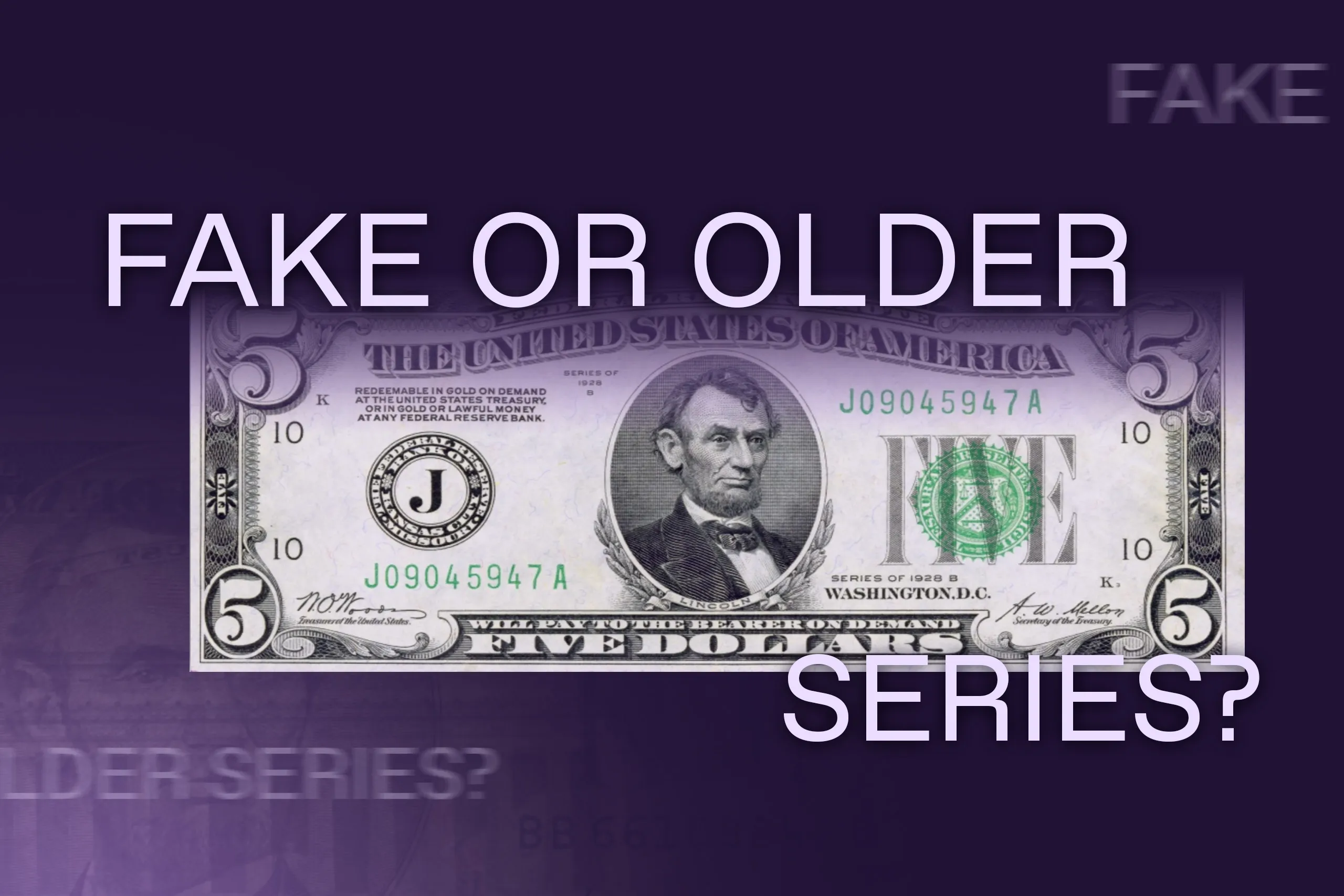
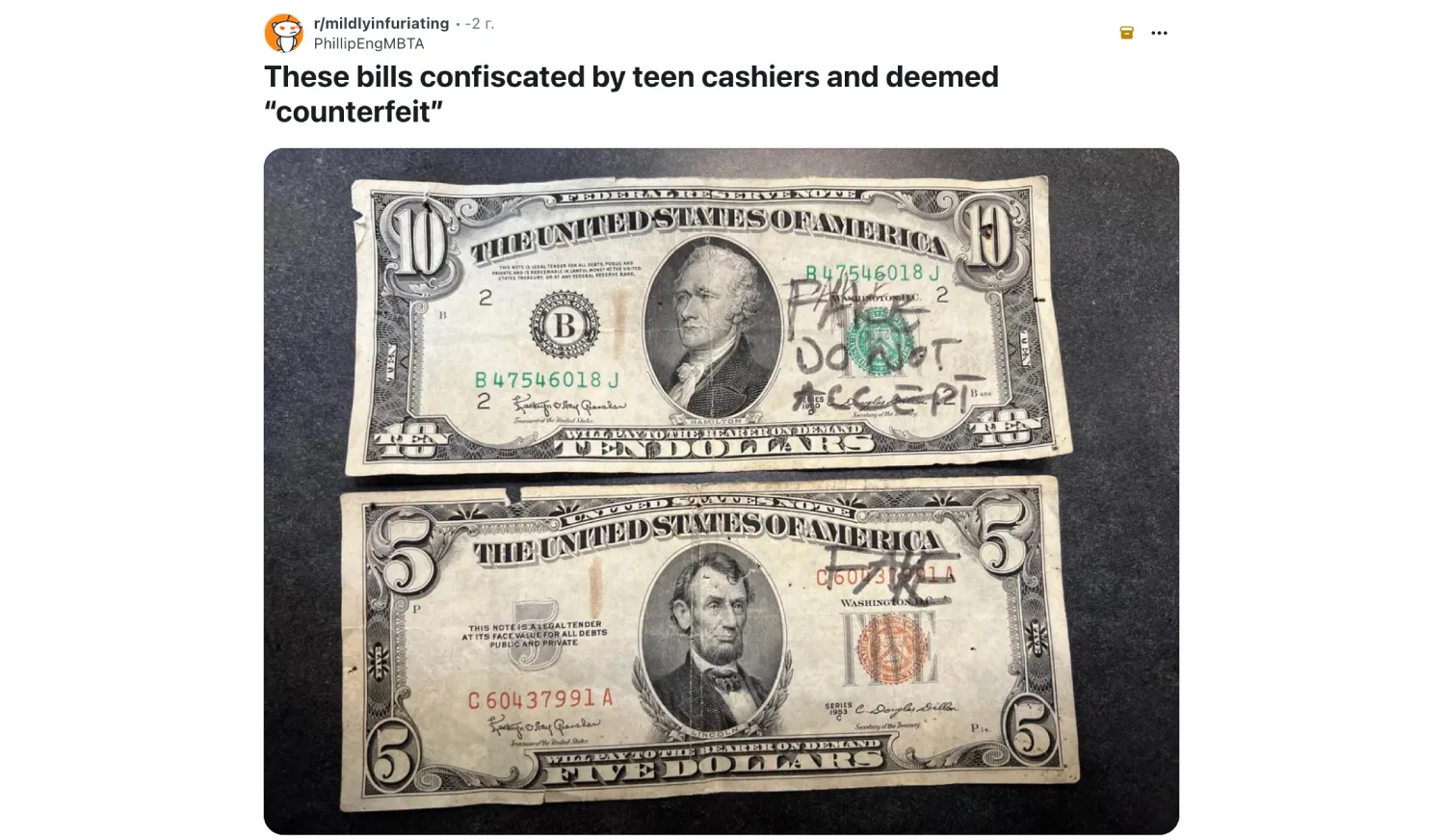
Newsweek made an article titled Gen Z Cashiers Can’t Recognize Real Cash, Think They’re ‘Counterfeit’ based on a reddit discussion. The story tells about a cashier from Florida who wrongly declared a customer's money as fake. Reddit users shared their own stories of being marked as fraudsters because they tried to pay with “vintage” series.
Yet, according to the U.S. government, all Federal Reserve note designs remain legal tender regardless of when they were issued. A $100 bill printed in 1950 is just as valid as one printed in 2013.
The same principle applies far beyond banknotes. Passports, driver's licenses, identity cards, visas, residence permits, and many other official documents often remain valid long after a newer series has been introduced. As a result, specialists responsible for document verification encounter multiple generations of the same document or banknote.
What happens to existing series of documents when new ones are introduced?
Banknotes and identity documents follow different life cycles, but they have one thing in common: older series often remain in circulation for years.
When a new banknote design is released, central banks typically follow one of two approaches. In some countries, older series are gradually withdrawn from circulation through commercial banks and eventually cease to be legal tender. In others, multiple series remain legal tender indefinitely. The U.S. dollar is not the only example. The Egyptian pound, for instance, also has multiple series of the same denomination that remain legal tender and can still be used for payment today.
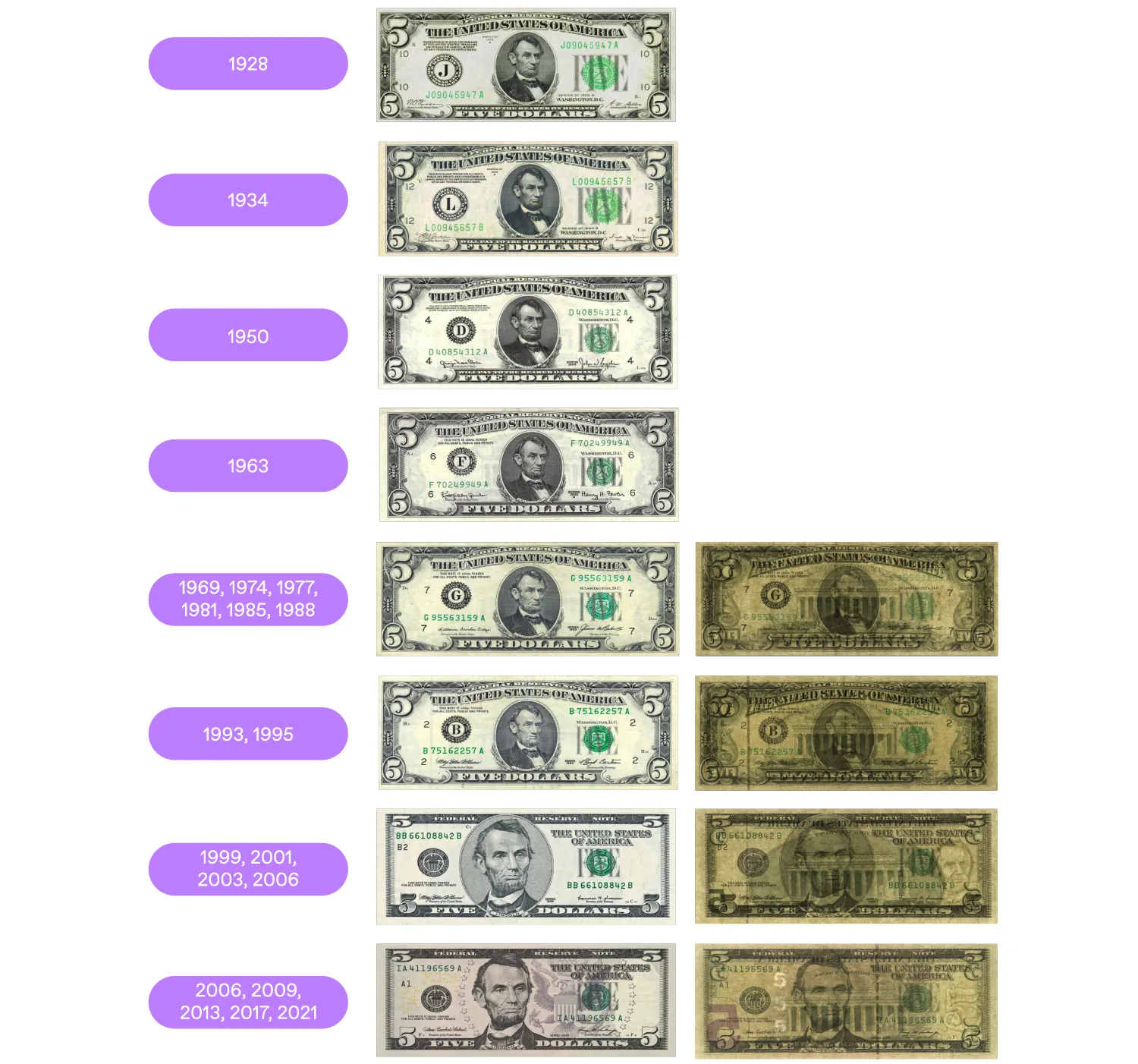
All of the $5 banknote series shown remain legal tender regardless of when they were issued. Some of the banknotes are presented under both white and transmitted light. Images captured under transmitted light reveal differences between series that otherwise look very similar, such as different watermarks and security threads.
Identity documents follow a different pattern. When a country introduces a redesigned passport or national ID card, existing documents are rarely replaced overnight. Since they remain valid until their expiration date, millions of people continue using previous generations for years — sometimes for a decade or longer.
The transition can last even longer when a country introduces biometric passports. Rather than replacing traditional passports immediately, many governments issue both biometric and non-biometric versions in parallel. Citizens may be allowed to choose either option, meaning multiple generations of the same passport continue to coexist.
And of course, different passport types and versions with extra pages only increase the number of possible passport variations that verification specialists may encounter.
Let's take the Japanese passport series as an example.
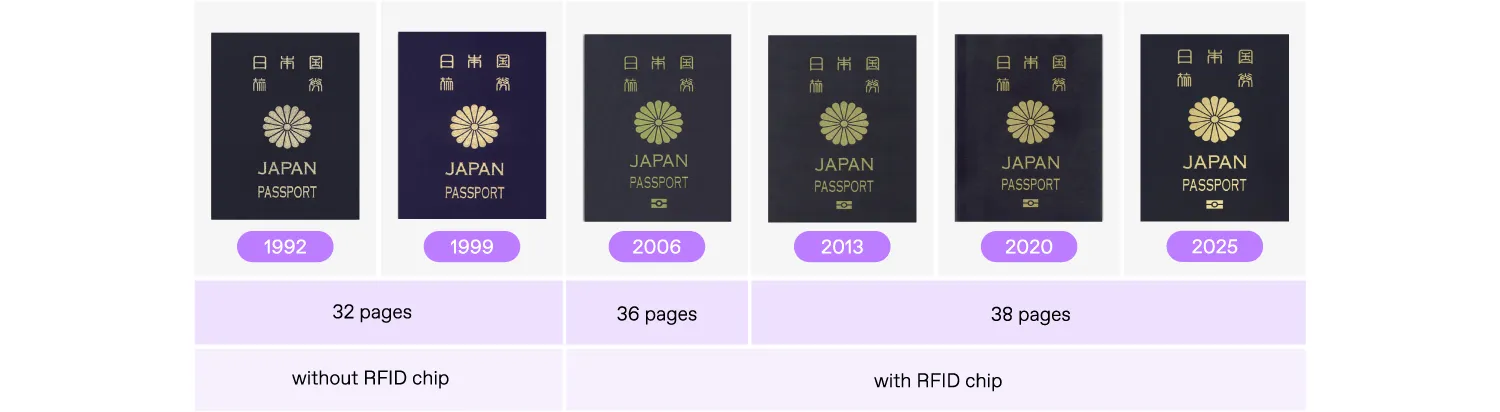
There is also a version of the Japanese ordinary passports with an extended number of pages. It has a red cover and includes 16 additional pages. If you’re interested in learning nuances of the Japanese ID documents verification, don’t hesitate to visit Top-Notch ID Document Processing Worldwide: Japan
Let's compare the data pages under white, ultraviolet (UV), and infrared (IR) light to see how their designs have changed over the years.
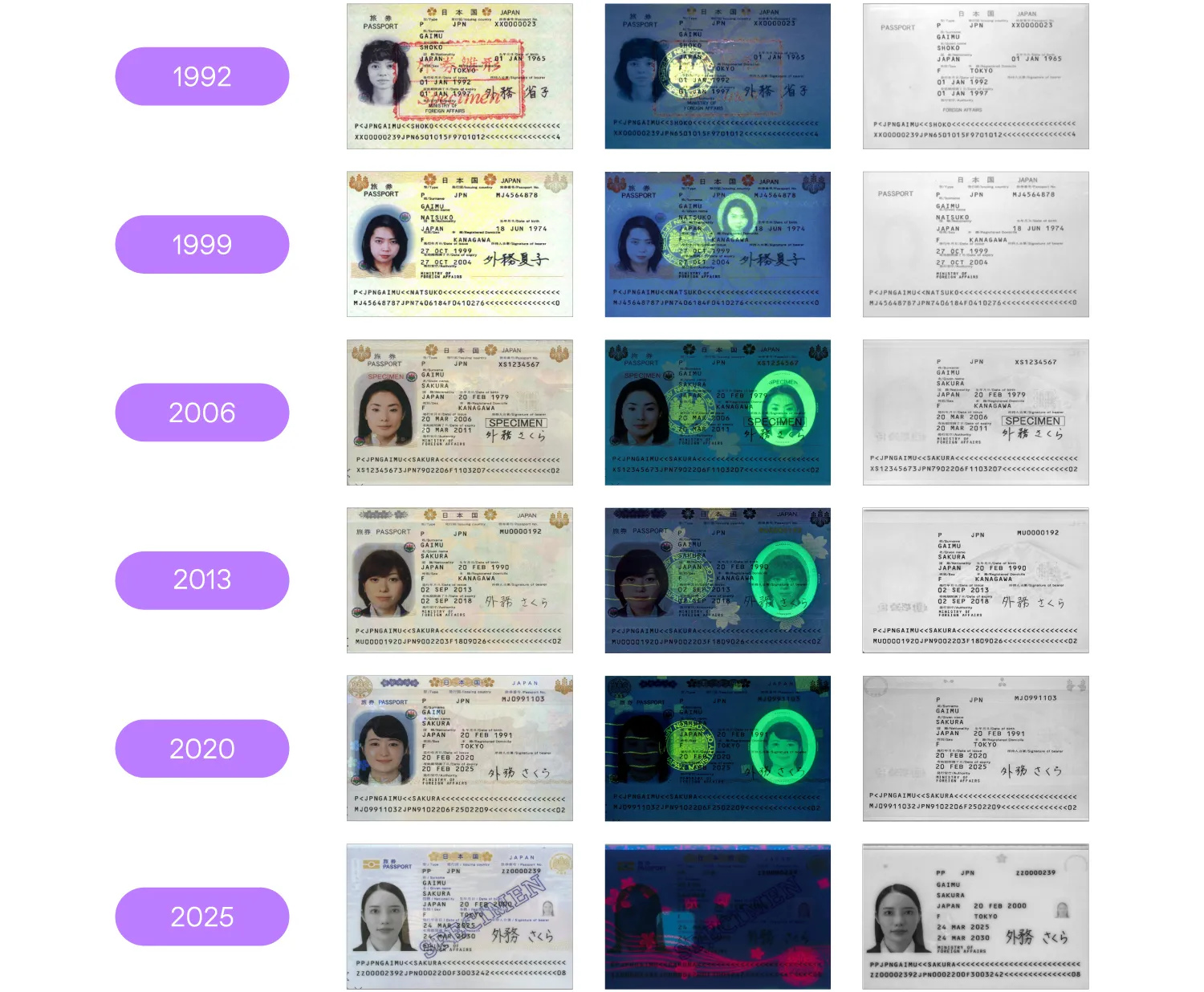
The images were taken from the Information Reference Systems (SDU version).
As we can see, the design has evolved gradually rather than changing dramatically. Many background patterns and security features were carried over from one series to the next, making adjacent generations appear very similar.
The 2025 series is the only one that stands out as significantly different. It is the first Japanese passport to feature a polycarbonate data page and introduces a completely redesigned UV pattern. In addition, because the holder's portrait is laser-engraved into the polycarbonate page, it becomes visible under IR light — another distinguishing feature of this generation.
As of 2026, at least four ordinary Japanese passport variants are in circulation: the 38-page and 54-page versions from both the 2020 and 2025 series. The total number of valid passport variants is even higher because there are diplomatic, official, emergency and other passports and travel documents.
Subscribe to receive a bi-weekly blog digest from Regula
When does maintaining old documents and banknote series become critical?
In short, having references of both old and current series of documents and banknotes become critical both during document authenticity verification and after a counterfeit has been detected.
As we've seen from the examples above, multiple generations of the same document or banknote often remain valid or remain in circulation at the same time. Plus, consecutive series usually evolve gradually rather than changing dramatically.
An examiner may be used to seeing a particular security feature printed using one technique on modern banknotes. However, on an older banknote, the same feature may have been produced using a different printing technique. If the examiner is unfamiliar with that older version, this difference may cause confusion and lead to an incorrect conclusion. Let's look at an example.
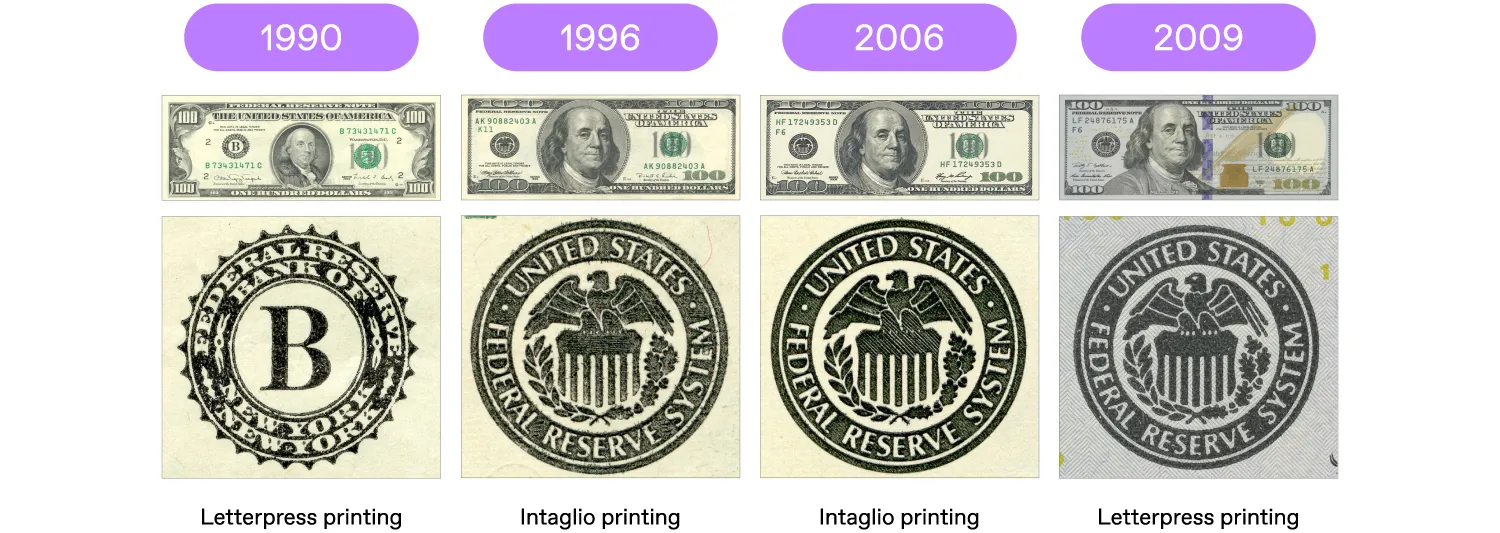
The Federal Reserve seal on U.S. banknotes was printed using either intaglio or letterpress printing, depending on the banknote series. This can be particularly challenging when examining banknotes from different series.
For document examiners, border officers, bank employees, and forensic experts, relying solely on memory is simply not practical. And in day-to-day work, a reference sample may not always be available. Even experienced professionals may encounter document series that were issued decades ago or foreign documents they have never seen before.
Without access to references, authenticity verification becomes more difficult and the risk of mistakes increases. A genuine document may be treated as suspicious simply because it belongs to an unfamiliar series, while a counterfeit may be based on an older series that the examiner has never encountered.
References of previous generations of document and banknote series become even more valuable during counterfeit investigations.
Let's take a counterfeit identity document as an example. Counterfeits can be created using genuine passports from withdrawn or expired series, or even stolen genuine documents. Whether a document data page is paper-based or made of polycarbonate, fraudsters can alter it in several ways. For example, they may change the dates of issue and expiry, replace the whole data page, or combine covers and pages from different passports into a single document.
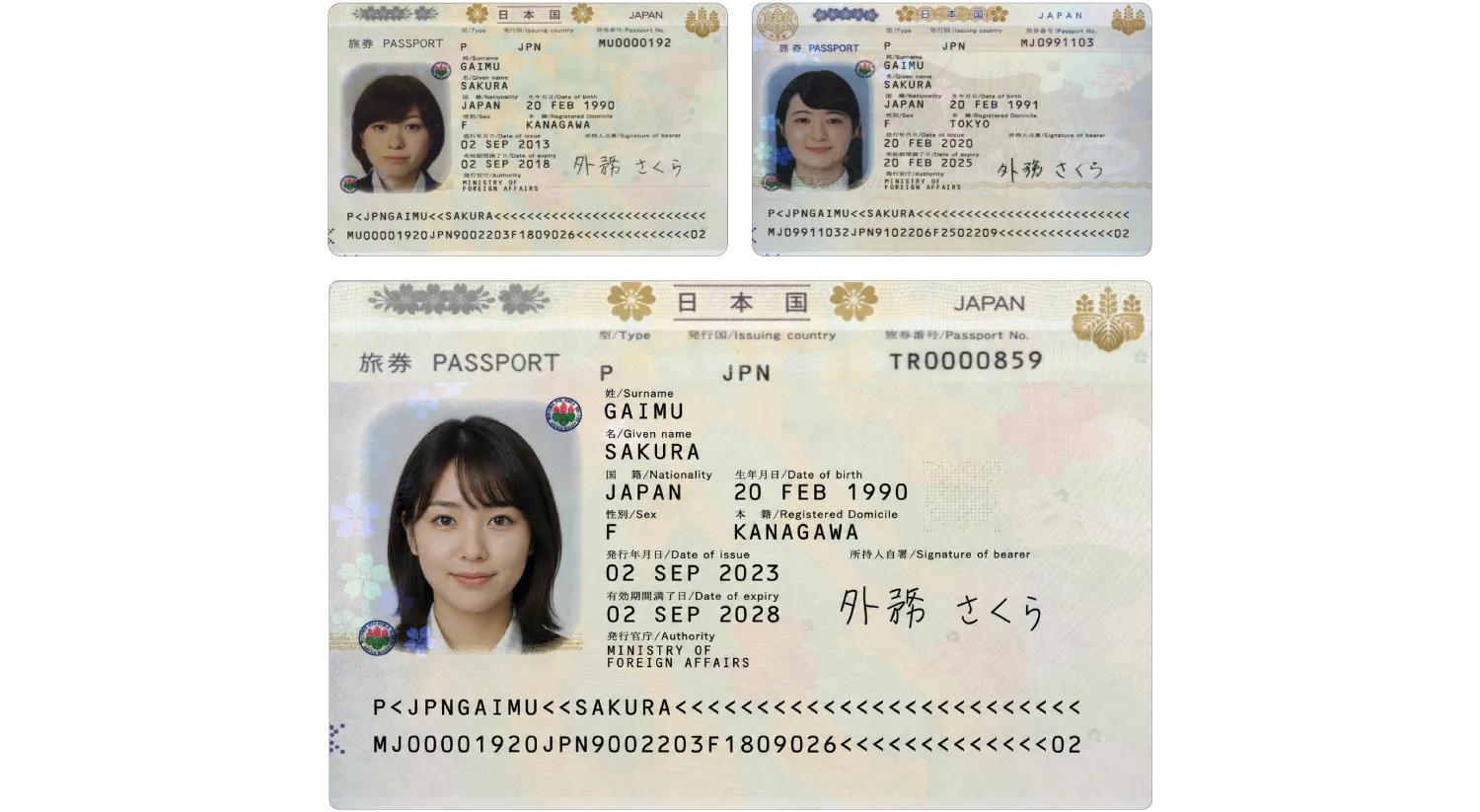
The image below shows a counterfeit based on an older passport series, in which fraudsters changed the dates of issue and expiry and applied a holographic film to imitate the holographic pattern found in the newer series of the document. This image is for illustrative purposes only and does not represent an actual counterfeit (AI generation).
When such counterfeits are detected, forensic document examiners must determine exactly how the forgery was produced and reflect their findings in an expert report.
In these investigations, especially when several document series are involved, including withdrawn ones, Information Reference Systems (IRS) becomes an invaluable reference tool. It allows experts to compare current and withdrawn document specimens, examine security features and printing techniques, and support their conclusions with clear visual evidence.
Another reason for preserving withdrawn document series is their value in identifying people in exceptional circumstances. These include individuals living in remote areas with limited access to government services, as well as people who have been captured, imprisoned abroad, reported missing, or become victims of trafficking or other crimes.
In such situations, people often have no opportunity to obtain new identity documents. As a result, whatever documents they already possess are used to establish their identity, regardless of how old those documents are.
This is exactly why comprehensive reference databases are needed.
How Information Reference Systems help document and banknote examiners
Information Reference Systems (IRS) is like an electronic catalog containing more than 12.500 reference items, including passports, ID cards, visas, banknotes, coins, vehicle documents, and other document types, both current and withdrawn from circulation.
The most comprehensive version of the catalog, Secure Documents Ultimate (SDU), provides access to different document types and banknotes from countries around the world. Selecting a particular item opens a complete reference record with images captured under various forensic light sources, including white light, UV 365 nm, UV 313 nm, UV 254 nm, IR 870 nm, as well as IR luminescence, anti Stokes, and magnetic visualization (for banknotes).
These reference images, captured under different forensic light sources and at high magnification, help examiners authenticate documents even when no physical specimen is available for comparison.
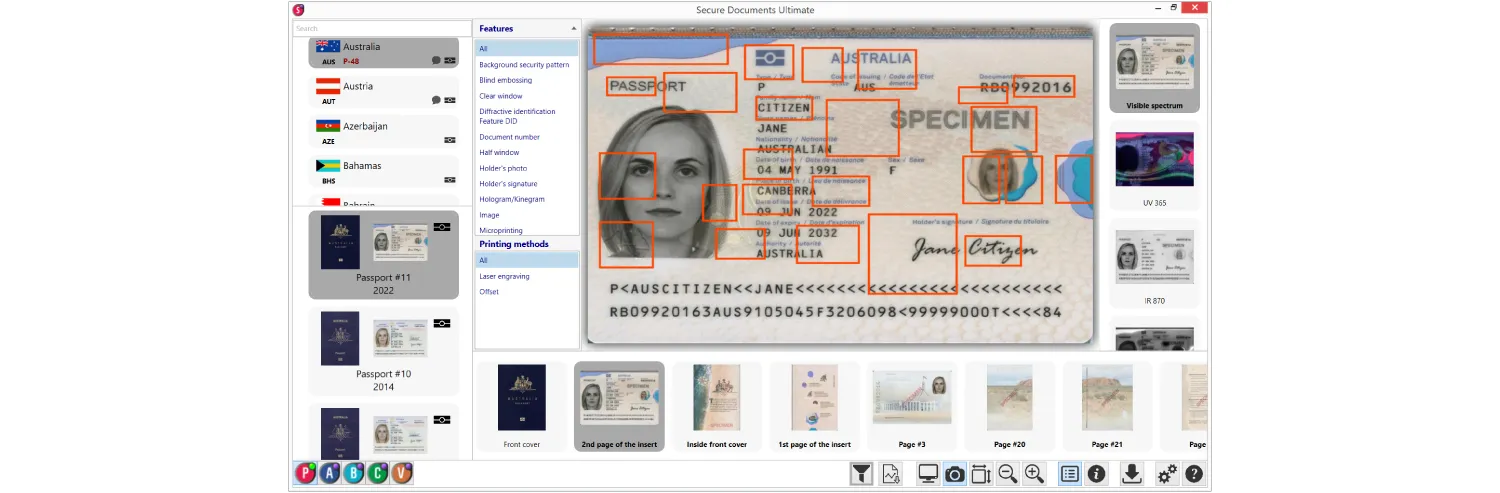
IRS can exist as an independent program or can be integrated into RFS — the operating software of Regula forensic devices
Comprehensive visual references
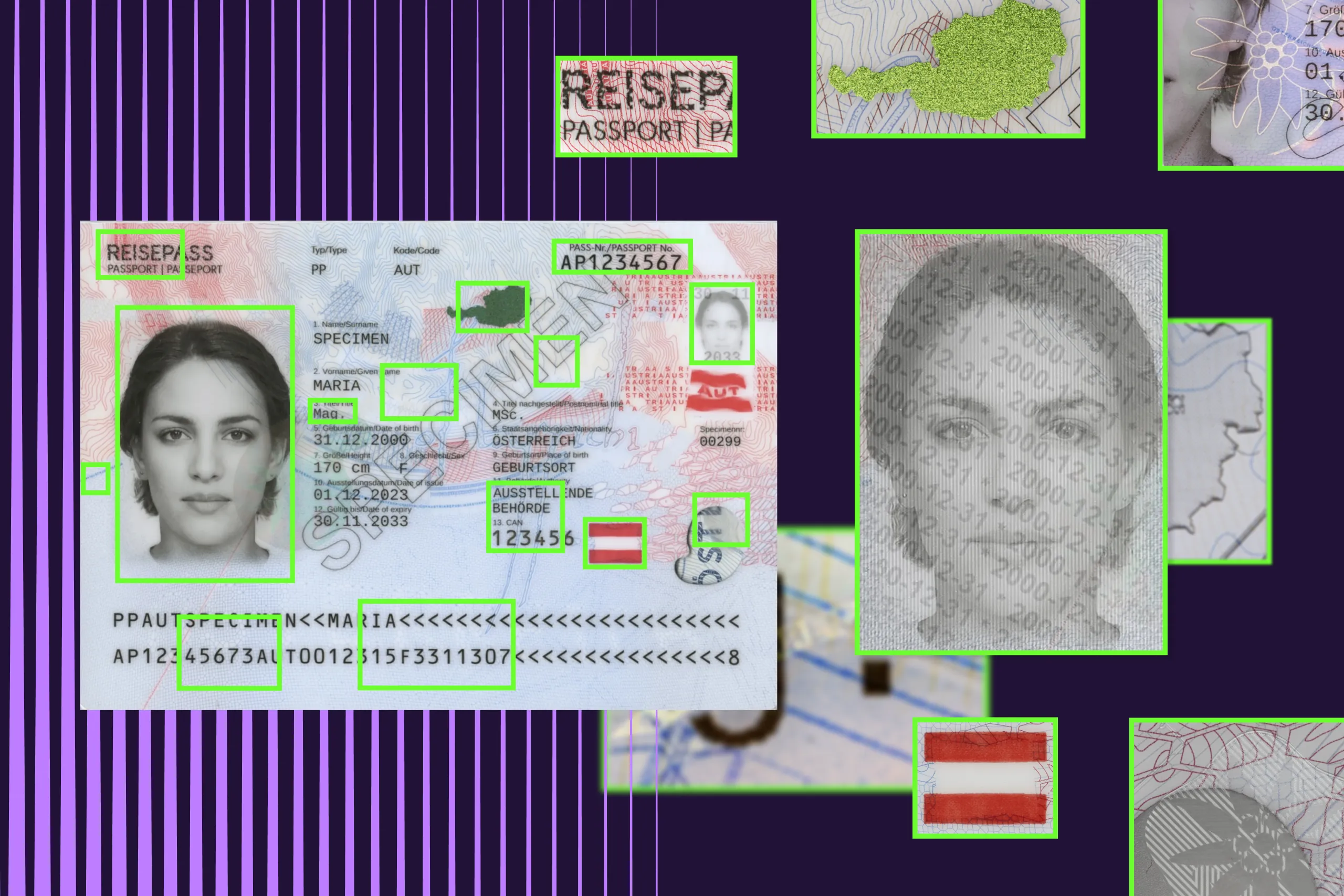
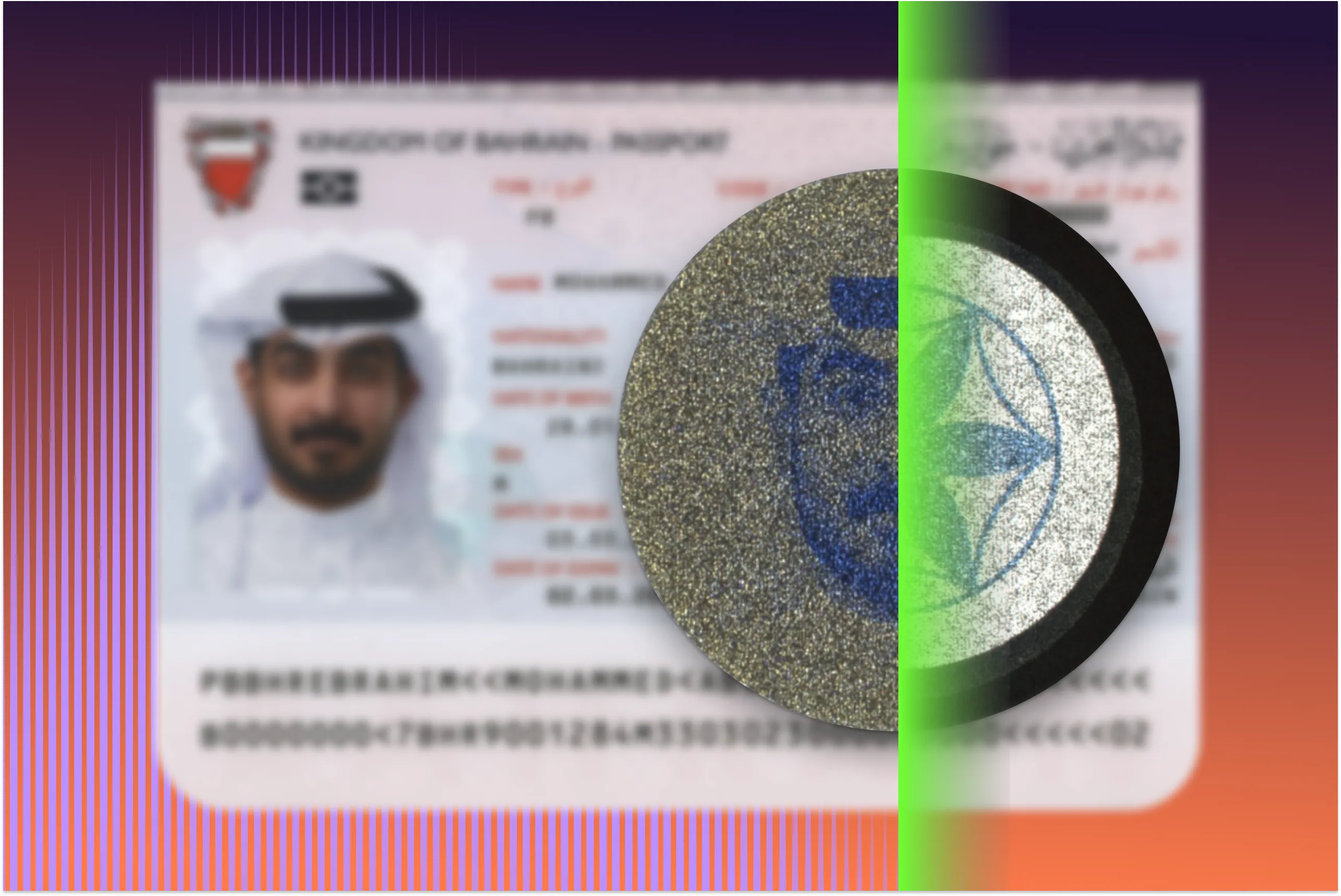
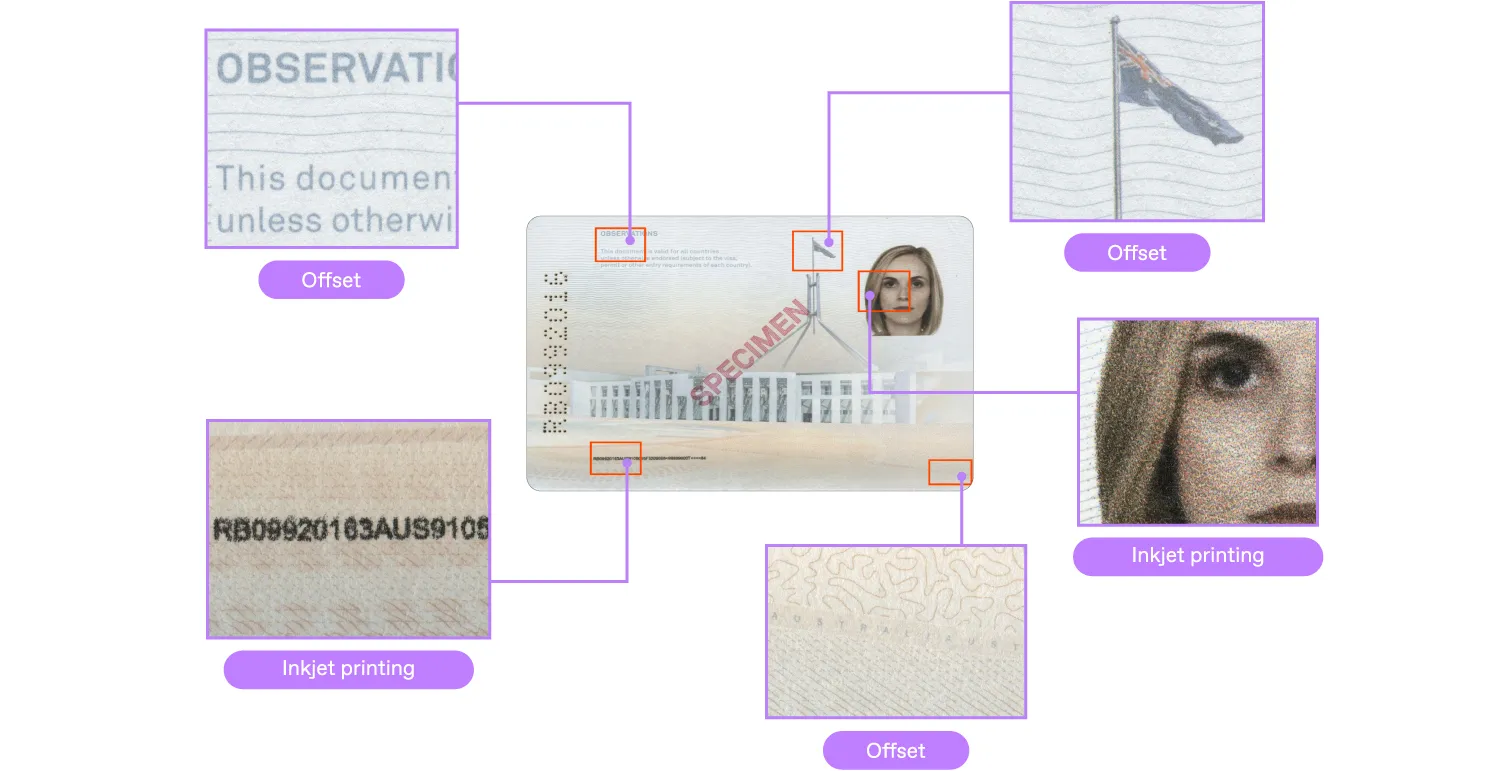
The passport data page displayed under white light contains interactive markers that provide access to close-up images of individual security features and printing techniques captured at high magnification. Dynamic and optically variable security features are available as animated GIFs, which can also be viewed frame by frame for detailed examination.
In addition to the data page, the catalog includes images of document covers and other pages captured under forensic light sources, along with detailed close-ups of their security features and printing techniques.
Technical document and banknote information
Besides visual references, IRS also provides comprehensive document metadata, including the issuing country code, circulation status, number of pages, page-binding method, cover description, data page description, page descriptions, and other technical characteristics.
Search and navigation
For specific searches, the system offers a variety of filters, allowing users to narrow results by security feature, printing technique, circulation status, and other criteria.
Bottom line
Document authentication is about much more than recognizing the latest passport or banknote design. Since multiple generations of documents and banknotes often remain valid or continue to circulate simultaneously, effective examination requires access to the whole list of reference documents and banknotes.
That is why Information Reference Systems are continuously maintained and expanded. Today, it contains one of the world's most comprehensive collections of document and banknote references. The database is regularly updated as new document generations are introduced.
Behind the IRS is a dedicated team of document experts who continuously research new documents and banknotes, capture their security features and printing techniques using specialized forensic equipment, and prepare detailed descriptions for every item.
Whether you are examining the latest passport, an obsolete banknote series, or a sophisticated mimic counterfeit, having access to accurate reference specimens can make all the difference.
If you have any questions about Information Reference Systems or would like to learn more about its capabilities, feel free to contact us. Our experts will be happy to help.