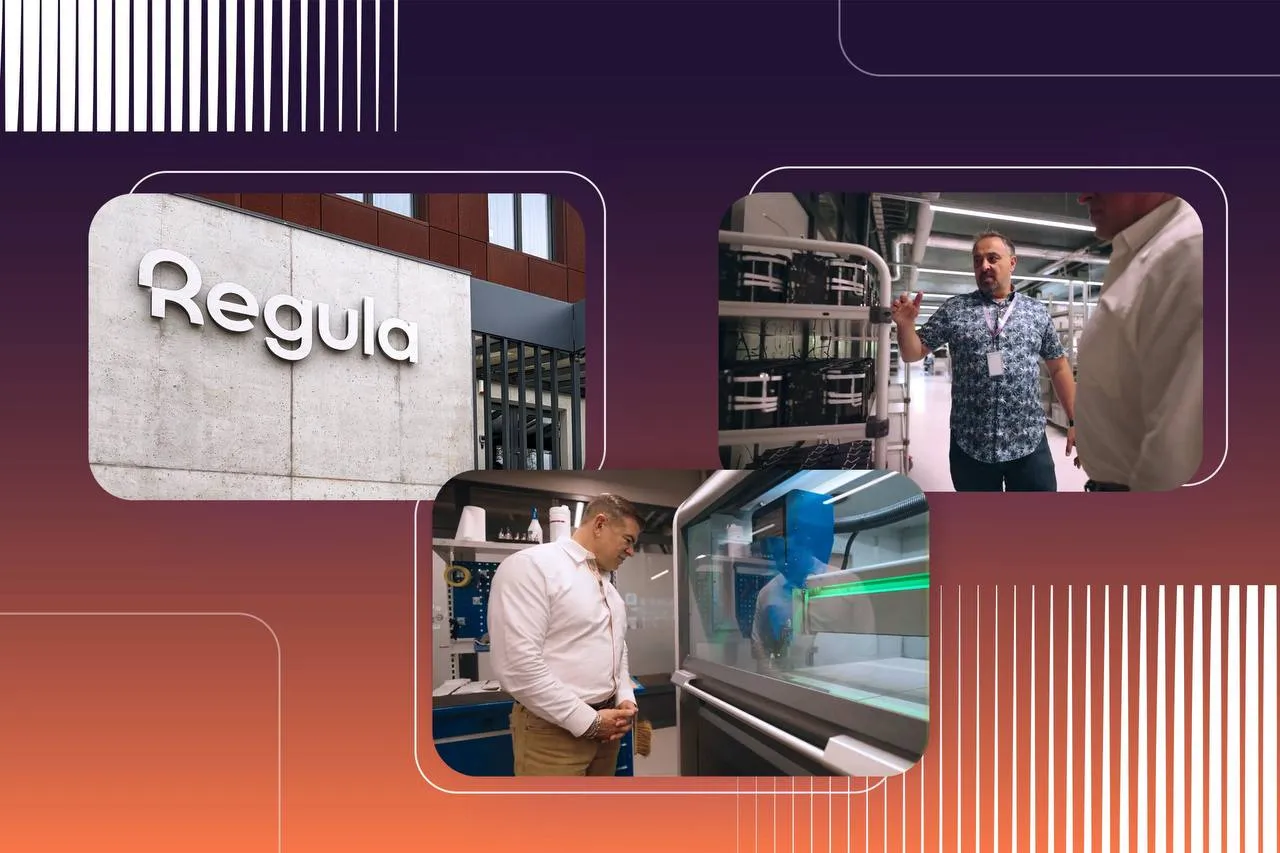
In brief: During the visit to Regula’s production facility in Latvia, Chairman of Border Commerce & Security Council Nelson Balido got a firsthand look at the people, engineering, and manufacturing processes behind Regula’s solutions.
When a border officer examines a suspicious passport or a forensic expert investigates a potentially forged document, the technology they use must deliver reliable results. Behind that technology are countless engineering decisions, carefully manufactured components, sophisticated optical systems, and extensive testing.
But where does all this actually happen? For Regula, the answer lies in Daugavpils, Latvia. Here, the company brings together engineers, designers, forensic document experts, manufacturing specialists, quality assurance teams, software developers, and logistics professionals to develop, manufacture, test, and deliver forensic equipment used worldwide.
Nelson Balido, Chairman of the Border Commerce & Security Council, visited Regula’s production facility for a firsthand look at its operations. The Council is a US nonprofit organization that promotes collaboration between government and the private sector on national security, border trade, and commerce.
His visit offered a rare opportunity to follow the journey of forensic technology from the engineering department to the production floor, and ultimately to the organizations that depend on it.
Global presence, Latvian foundations
Regula operates internationally, serving organizations across different industries and regions, with subsidiaries and sales offices in Poland, the United States, Germany, the Netherlands, and Brazil. Yet Latvia remains the heart of the company's development and manufacturing operations.
At its Daugavpils facility, Regula develops and manufactures its forensic equipment in-house, rather than outsourcing production to third-party manufacturers. Hardware and software development, manufacturing, assembly, and quality assurance all take place under one roof.
Regula continues to invest in these capabilities. As described in an earlier article about the expansion of its development center, the move to a larger facility provided more space for R&D, manufacturing, and collaboration between teams.
Having these departments together allows engineers to work directly with manufacturing and assembly specialists, address technical challenges, and improve equipment throughout its development and production. It also gives Regula detailed knowledge of its devices, which supports technical assistance, troubleshooting, and future product improvements.
It all starts with the people who use the technology
Developing forensic equipment requires a clear understanding of the challenges faced by those who use it.
These challenges vary considerably depending on the task and working environment. At a busy border checkpoint, officers need equipment that supports fast, consistent document checks. In a forensic laboratory, experts rely on advanced optical capabilities to uncover subtle signs of alteration or forgery. Portable devices, meanwhile, must offer sufficient examination capabilities without compromising mobility or ease of use.
To account for these differences, Regula brings practical forensic expertise into the development process. Specialists with experience in document examination work alongside developers and designers, helping them understand not only what a device needs to do, but also how it will be used in practice.
This approach extends beyond the development of individual forensic devices. Regula aims to provide a comprehensive range of technologies and expertise that support organizations at different stages of document examination and identity verification.
From expert feedback to engineering drawings
In Regula's R&D departments, insights from forensic experts and customer feedback are translated into technical designs. Here, the company's hardware takes shape through mechanical designs, electronic circuits, printed circuit boards (PCBs), engineering drawings, and detailed production documentation.
Regula's engineers work directly with the specialists who will manufacture and assemble the equipment. This allows technical questions to be addressed as they arise, whether they concern the dimensions of a mechanical part, the positioning of an optical component, or the configuration of an electronic system.
For complex forensic equipment, even minor adjustments can affect how different components interact and, ultimately, how the finished device performs. Keeping engineering and manufacturing within the same operation allows these details to be considered throughout development and production.
Precision manufacturing, not just assembly
The next stage of the tour offers a closer look at Regula's manufacturing capabilities, showing how individual components are produced before they reach the assembly department.
Inside the Daugavpils facility, raw materials such as aluminum and plastics are transformed into parts for forensic devices. CNC milling machines, cutting and bending equipment, and other machining tools are used to achieve the required dimensions and mechanical characteristics. Some of these components form the external housing of a device, while others support internal electronics, optical systems, or moving mechanical assemblies.
Manufacturing precision is particularly important for forensic equipment, where mechanical, electronic, and optical components must work together as an integrated system. Certain internal parts require machining accuracy of up to 0.01 mm, leaving little room for error.
Achieving this level of precision depends not only on advanced machinery but also on thorough technical preparation, correctly configured machining programs, suitable materials, and the expertise of manufacturing specialists. To meet its quality standards, Regula combines automated machining with manual operations, each suited to different production tasks.
Inside the assembly of advanced forensic equipment
Manufacturing individual components is only part of the process. The next challenge is bringing them together into a fully functioning forensic system. For complex instruments such as video spectral comparators, this work is performed manually by skilled assembly specialists.
Video spectral comparators combine multiple technologies to help forensic experts examine security features and detect possible signs of document alteration. Each instrument integrates mechanical structures, electronic control systems, optical components, specialized light sources, filters, and computing capabilities.
Bringing these elements together requires more than installing components in a predefined sequence. Specialists must carefully position and align optical elements, connect electronic systems, and perform the necessary adjustments and calibration. Given the complexity of these operations, manual assembly allows specialists to work with the precision and attention to detail that each instrument requires.
Quality assurance: every device must pass
A forensic device may combine advanced optics, precision-manufactured components, and sophisticated software, but its value ultimately depends on how reliably these elements perform together. This makes quality assurance a critical stage of Regula's manufacturing process.
At Regula, quality checks are not limited to occasional samples from a production batch. Every completed device, regardless of its size or complexity, undergoes inspection by the facility's quality assurance department. Approval is a mandatory step in the production workflow: without it, the equipment cannot proceed to final dispatch.
Such controls are particularly important for equipment used at border checkpoints, in forensic laboratories, and in other security-sensitive environments. These devices may operate under demanding conditions, while their examination results can inform decisions with significant consequences. Verifying their performance before shipment is therefore an essential part of Regula's responsibility as both the developer and manufacturer of its forensic equipment.
From production to customers worldwide
Once a device has passed quality assurance, it enters the final preparation stage. Before shipment, the equipment is cleaned, labeled, assigned a serial number, registered, and accompanied by the required documentation. It is then carefully packed to protect it during transportation.
From the packing department, finished devices move to logistics, returning to the same part of the facility where their production journey began.
At the beginning of the production cycle, the warehouse receives and stores the materials needed for manufacturing, including optical elements, electronic components, and metal and plastic parts. When a production order is issued, warehouse specialists select the required items and supply them to the relevant departments.
After manufacturing, assembly, and quality assurance, these materials and components return to logistics as finished forensic devices. From Daugavpils, international shipping partners deliver the equipment to customers across Europe, the Americas, Africa, Asia, and other regions.
What began as separate components at Regula's Latvian facility may ultimately become an instrument used at a border crossing, an airport, or a forensic laboratory thousands of kilometers away.
Final thoughts
For our customers, having development and manufacturing under one roof means working with a team that knows the technology inside and out. More than three decades of experience in forensic document examination have given us a deep understanding of the practical challenges our customers face and the expertise to address them.
With our development and manufacturing operations based in the European Union and an international network of offices, we combine a strong European foundation with support for customers around the world.
Developed, manufactured, tested, and shipped from Latvia. Used by forensic professionals worldwide.