
At the end of 2024, Singapore reported having 182,954 active casino self-exclusions and 115,439 exclusions by law, bringing the resident probable pathological and problem gambling rate to 1.1 percent. Those figures alone help explain why identity checks at physical casinos are a must: there simply needs to be strong gating and exclusion screening to only let the right people in.
And while casino identity verification can take several forms, more operators are opting for automated checks in an attempt to stay both efficient and compliant.
How exactly are they benefiting? And what specific measures do they put in place? Read further to find out all about the current state of offline identity verification for gambling.

Subscribe to receive a bi-weekly blog digest from Regula
Why operators are putting more money into casino identity verification
Casinos are putting more money into ID verification for two different but related reasons, resembling a carrot-and-stick situation. The carrot is the practical benefits to be gained once a competent ID verification system is implemented. The stick, on the other hand, is the real danger of non-compliance with the latest gambling and AML laws, and subsequent legal scrutiny.
Thus, modern gambling identity verification is becoming a visible part of broader casino identity compliance, as opposed to only a front-desk courtesy check.
How can casinos benefit from ID verification?
While it’s possible to expand on this list, our experience suggests that the core, most notable gains for casinos can be summed up as follows:
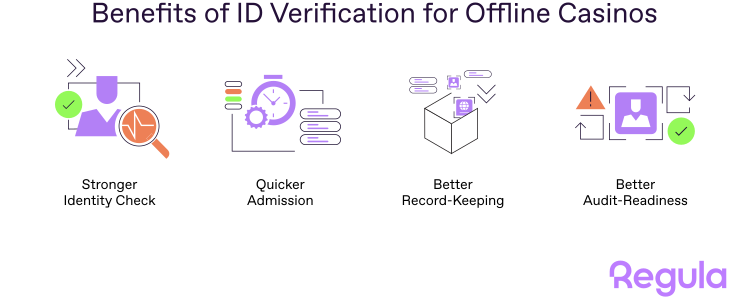
Stronger identity check. The most immediate value of IDV is that it helps casinos make better decisions about who should and should not be allowed in. Instead of relying only on a visual glance, the venue can check age, document validity, exclusion status, or other entry conditions in a more consistent way.
Quicker admission. A good IDV setup can shorten the time staff spend inspecting documents by hand, rechecking birth dates, or asking for the same information twice. It especially helps during peak hours, when long queues at the entrance create friction for guests and extra pressure for staff.
Better record-keeping. Once identity has been captured properly, the result can be reused when the same person signs up for a player card, returns on a later visit, or triggers a safer-gambling review. That saves time, reduces duplication, and makes later checks less fragmented.
Better audit-readiness. A robust casino ID verification process leaves a clearer record of what was checked, what was flagged, and what staff did next. That becomes valuable when a venue later has to explain an admission decision, a refusal, or a missed warning sign to compliance teams, internal investigators, or regulators.
These are almost universal for every use case.
What casino AML compliance now requires
There is a lot of day-to-day pressure to running a casino, from multiple legal angles. At the door, the venue has to prove that it is not admitting a minor or a barred patron. Later, it may have to explain why it accepted a customer at all, how that customer was risk-rated, and what staff did once the paperwork or spending pattern stopped making sense.
For example, in Great Britain, from August 30, 2024, all land-based licensees, including casino operators, must carry out age-verification test purchasing, and staff must check anyone who appears under 25 rather than under 21. That is a front-of-house rule, but it pushes operators toward cleaner document handling, better refusal records, and tighter casino compliance around admission.
Moreover, there is a lot to consider after the patron is already inside. In October 2025, the Gambling Commission said some casinos were building customer risk profiles too late and relying too heavily on spend thresholds. It also said source-of-funds details for the relationship need to be established on a risk basis at the start, and pointed to large third-party deposits, outgoings higher than income, and false or fraudulent documents as examples of things staff should have caught. That essentially makes the first ID check the opening record in a file that may later be tested under casino AML compliance review.
New Zealand is another example: from June 1, 2025, reporting entities, including casinos, must keep a record of the customer’s risk rating, review it during ongoing due diligence and account monitoring, and update it where appropriate. Importantly, there have already been public cases of penalties: The Christchurch Casinos were fined NZ$5.06 million by the High Court after DIA identified deficiencies in account monitoring, enhanced customer due diligence, suspicious activity reporting, record keeping, and the overall effectiveness of the AML/CFT program.
ID document verification at the door
At a physical casino, document checking is easy to underestimate because most guests see only a short interaction at the reception desk. For the venue, though, this answers at least two separate questions: whether the credential is genuine enough to rely on and whether this person is allowed to gamble there at all.
In this context, document verification (usually powered by a casino ID scanner like Regula 70X7) tends to follow a short sequence:
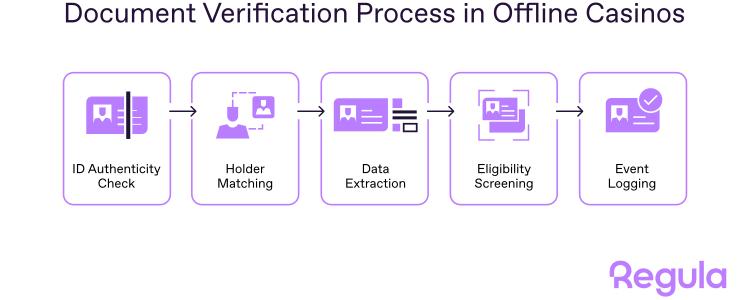
Staff inspect or scan a credential and check whether it appears genuine, readable, and suitable for identity and age verification.
The venue checks whether the person presenting the document matches the portrait and biographic details well enough to rely on it for admission.
Once the credential has passed that first trust test, the key fields are extracted for records and downstream checks.
The result is then passed into another system, such as an exclusion screen, an AML review, or a player-card file.
If the patron is admitted, that same verified record may later be reused for due diligence, transaction review, or card-based gambling controls.
A casino does not gain much by collecting clean data from a document that was altered, borrowed, or falsely presented in the first place. This is also why manual visual inspection on its own is becoming less attractive. Staff can still catch some obvious issues with a quick glance, but subtle tampering, document substitution, chip-level inconsistencies, or small mismatches between the person and the credential are much harder to handle reliably by eye alone.
Just as important, a visual check leaves a weak trail for later review and does not move the result into the next operational step very well.
INSPIRE Resort’s case
One case worth mentioning is the successful modernization of INSPIRE Entertainment Resort in South Korea. In August 2025, Regula helped INSPIRE implement document-reading technology for deployment at six casino admission stations. Regula Document Reader SDK was introduced to extract and validate passport data, then send fields such as name, date of birth, nationality, and document number to the AML platform for compliance screening.
The results show that the setup cut manual rescans, lowered staff workload, and moved guests through admission more quickly during busy periods. It is also a good example of where a reader-based setup starts functioning as part of a fuller casino identity verification chain.
Ohio’s commercial casinos’ case
Another case comes from Ohio: in December 2024, the Ohio Casino Control Commission approved the acceptance of mobile driver’s licenses for age and identity verification at the state’s four commercial casinos: Hard Rock Casino Cincinnati, Hollywood Casino Columbus, Hollywood Casino Toledo, and JACK Cleveland Casino.
A patron can present a phone-based credential in person, authenticate it on their device, and show only the needed data. However, this setup doesn’t necessarily answer AML or barred-person questions by itself, as its primary job is to reduce friction at a very busy checkpoint and gives casinos a better option than relying only on plastic cards and visual inspection.
As for online gambling and gaming ID verification…
… Grand Casino Luzern is a good example of a traditional Swiss casino group expanding into the digital space in the most compliant and efficient way. Their online brand, mycasino, integrated Regula Document Reader SDK to automate document recognition, authenticity checks, and data extraction during remote onboarding, while escalating suspicious documents to trained staff for review.
The result was faster onboarding, lower manual workload, stronger verification security, and support for checks on age, residence, and other eligibility factors in the online flow.
Face verification for barred patrons and fraud controls
Just like document checks, face verification tends to be double-purpose: broad selfie-style identity proofing at entry plus matching against a watchlist of self-excluded, barred, or blacklisted people.
The most commonly observed pattern can be summed up as:
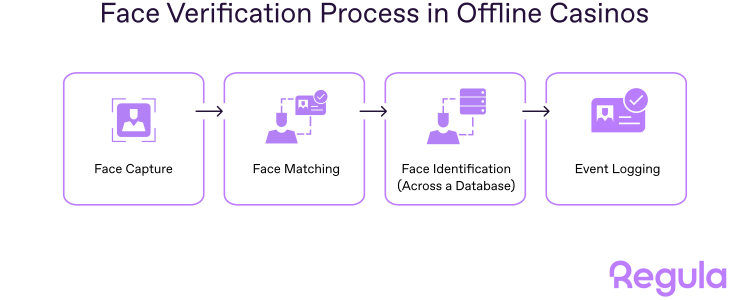
At the entrance or reception desk, the system captures a live facial image of the person presenting for admission.
The system verifies the face against the ID photo, confirming it’s the same person.
The system checks the live facial image against a watchlist of self-excluded, barred, or otherwise restricted individuals.
The event is logged so the venue can later show what happened, who acted, and when.
MERKUR Casino Milton Keynes’ case
MERKUR Casino Milton Keynes started using real-time biometric matching of people entering the casino against a watchlist of self-excluded individuals in 2025.
Importantly, they explicitly state that there is no lawful basis to process the biometric data of non-registered individuals beyond real-time comparison and immediate deletion. In practice, it means they do not perform open-ended live face identification of the gaming floor, as this particular use and retention of biometric data clashes with the UK’s Data Protection Act: retention logic and staff response are all defined in advance.
MERKUR’s related FAQ adds that the venue uses secure storage and encryption, restricted access, audit trails, and regular privacy impact assessments.
Genting Casinos UK’s case
Genting Casinos UK also uses live facial recognition in all of its UK casinos, with cameras at reception and cash desks comparing incoming faces against a database of “persons of interest.” According to the operator, the database is limited to people who are suspended or barred for responsible-gambling reasons, including SENSE self-exclusion, and people barred for crime, unlawful acts, or disorder. If the system produces a match, staff are alerted and a manager then interacts with the customer.
Similarly to MERKUR, Genting says non-matches are not kept, biometric templates are deleted immediately after the check, and alerts are manually reviewed by staff before any decision is made.
Staying both efficient and compliant in casino identity verification
An IDV stack truly helps a casino stay efficient and prepared for audit only when it is set up for a defined purpose, with tight access control and a clear data-handling policy. Not every solution can support that kind of narrow setup, along with both ID and face verification capabilities. However, Regula IDV Platform can.
Regula IDV Platform can support all your identity verification needs in an offline casino. It can:
Validate passports, national IDs, and driver’s licenses for domestic and international patrons at the door against more than 16,000 document templates from 254 countries and territories, with NFC checks (where supported). In practice, the platform can take its input from a compact desk reader such as Regula 70X7, which is built for business use as a source of document images, extracted data, RFID data, and authenticity-check results.
Compare the live person at the desk to the portrait on the document, including the RFID-chip portrait where available, so staff can spot impostor use before admission is granted.
Run different verification flows for walk-in admission, VIP signup, repeat-guest review, and manual escalation instead of forcing every customer through the same sequence.
Reconnect later checks to the same patron profile on return visits so the casino does not start from zero every time a known guest comes back.
Pass verified identity data into AML, watchlist, or player-account systems through API-based integration so the front-desk result carries straight into the next operational step.
Restrict what front-desk, surveillance, compliance, and VIP teams can view through roles and permissions, which is especially useful once document and biometric data sit in the same system.
Keep a profile history with linked documents, biometrics, attachments, and later changes, which helps when the venue has to explain an admission decision or a disputed intervention after the fact.
Deploy the system on premises or in a hosted setup, depending on how tightly the operator wants to control where patron ID and biometric data are processed and stored.