

Each week, we look at the latest news in identity verification. We cover new technologies, fraud trends, regulations, and changes that matter to businesses and their customers.
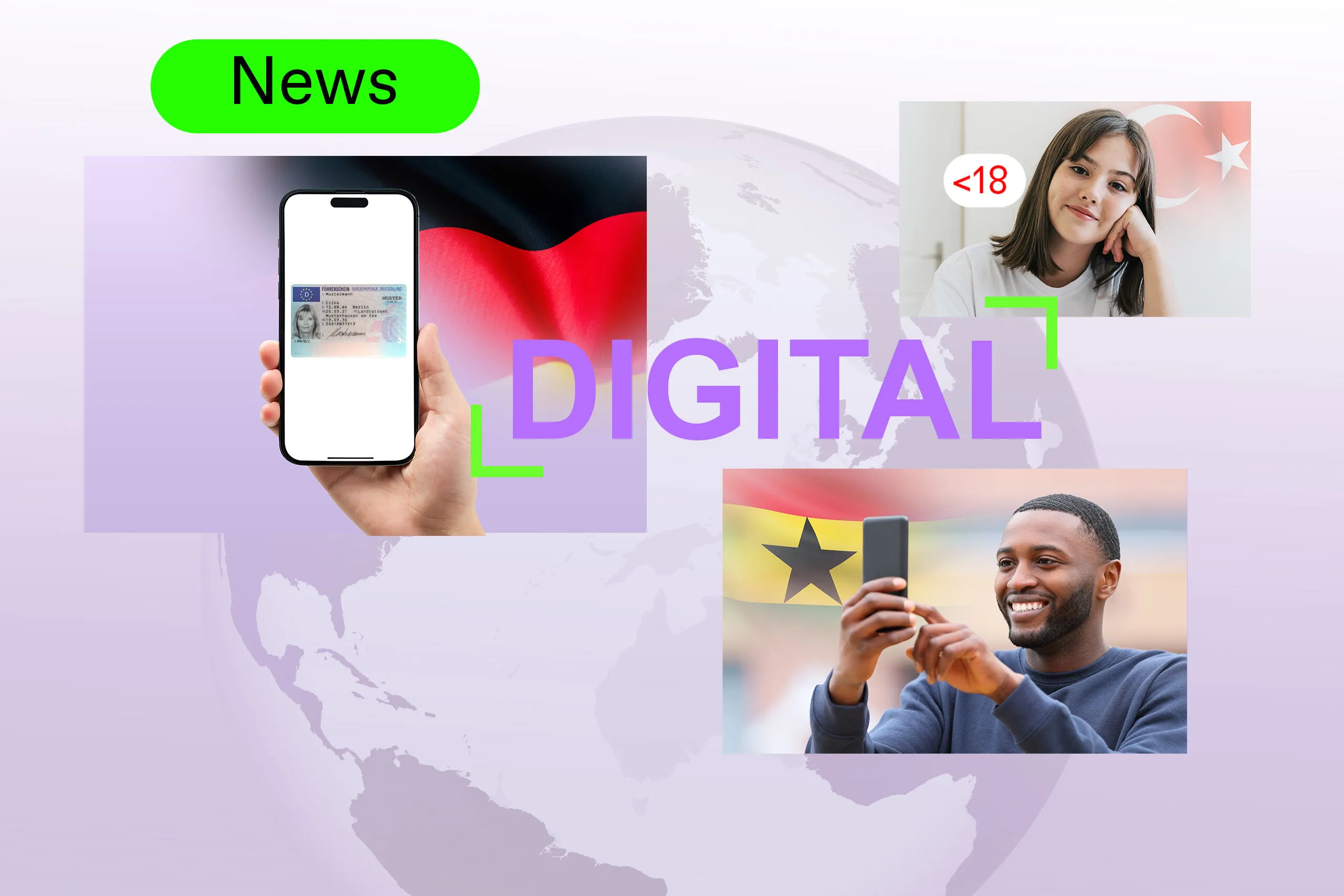
Last week brought new developments in digital identity and biometric verification across Europe, the Middle East, and Africa. Germany announced a November rollout for its digital driver's license, Türkiye introduced age verification for social media users, and Ghana began enforcing mandatory biometric identity checks.
Here are three news items worth knowing as the week begins.
Germany prepares to launch digital driver's licenses in November
Germany is preparing to introduce its digital driver's license through the existing i-Kfz mobile app at the end of November 2026.
The digital credential will be available to holders of valid physical driver's licenses. To activate it, users will need an NFC-enabled smartphone and a German national ID card with its online identification function enabled. The digital version will supplement the physical license rather than replace it, and drivers will still need their physical cards when traveling abroad.
Why it matters: Digital driver's licenses are moving from pilot projects into everyday services, creating new requirements for organizations that need to verify them.
A digital credential may be more convenient than a physical card, but businesses still need to establish that it comes from a trusted issuer, has not been altered, and is being presented by its legitimate holder. And while more countries introduce mobile IDs through different apps and wallets, consistent verification across systems and jurisdictions becomes increasingly important.
Read more: Learn how to verify German ID cards and what to look for when checking their authenticity.
Türkiye introduces digital age checks for social media users
Türkiye has introduced new social media restrictions for children under 15, with the rules taking effect in November 2026.
Under the new system, users must verify their age using digital tokens generated through e-Devlet, the country's government services portal. Social media platforms receive confirmation that a user meets the relevant age threshold without receiving their name or other identifying information.
Age checks are mandatory for new accounts, while existing users have until March 31, 2027, to complete verification. Children under 15 are prohibited from holding social media accounts, and users aged 15 to 17 are subject to additional protections, including restrictions on personalized advertising and livestreaming.
Why it matters: Age assurance is becoming a regulatory requirement for online platforms, but proving eligibility does not always require revealing someone's full identity.
Türkiye's token-based approach illustrates how governments can use existing digital identity infrastructure to confirm age thresholds while limiting the personal information shared with service providers.
For platforms, the challenge is to implement reliable age checks that meet legal requirements without unnecessarily collecting sensitive data or creating barriers for legitimate users.
Read more: Learn about identity verification requirements in Türkiye and what businesses need to know to stay compliant.
Ghana begins enforcing mandatory biometric identity verification
Ghana's National Identification Authority (NIA) has started enforcing compulsory biometric verification for institutions providing public and private services.
The nationwide enforcement campaign began on November 3, 2026. Under the regulations, organizations can no longer rely solely on visually inspecting, photocopying, or scanning the Ghana Card to verify a customer's identity. Instead, they must use approved biometric verification methods linked to the national identity database.
The NIA has deployed a task force to monitor compliance, and organizations that fail to follow the rules may face fines or lose access to the national verification platform.
Why it matters: Ghana's approach highlights a growing distinction between checking an identity document and verifying the person presenting it.
A genuine-looking ID card, or even an accurate copy of one, does not necessarily prove that the person using it is the rightful holder. Biometric verification adds another layer of assurance by comparing a live biometric sample with a trusted reference.
However, stronger identity checks also require secure access to reference data, reliable biometric matching, and safeguards against spoofing and other attempts to manipulate the verification process.
Read more: Learn how biometric verification works and why it is most effective when combined with other identity checks.
.webp)