
Age verification software is often compared as if every provider solves the same problem. In practice, the market often mixes different tools under the same label — and while all of them can help restrict access by age, they do not provide the same level of proof.
This guide separates the main age assurance methods before comparing vendors, so you can build a shortlist around the level of confidence your business actually needs.
In brief: This shortlist compares Regula, FaceTec, Incode, Yoti, Jumio, Entrust, Identomat, and iDenfy by method, deployment, and best-fit use case.
What counts as age verification software?
Age verification software refers to tools that help businesses determine whether a user meets a required age threshold. The key distinction is the source of confidence:
-
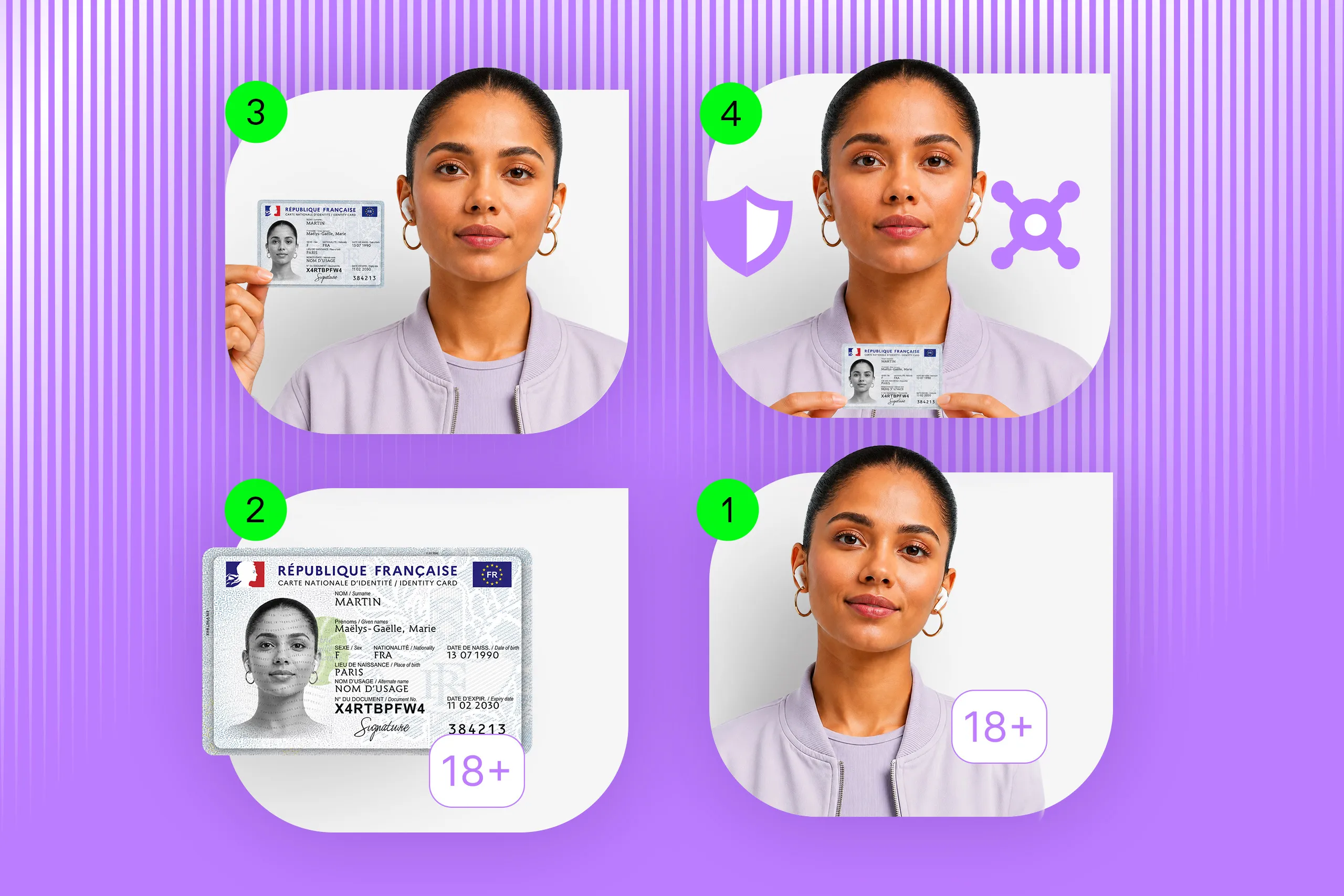
Document-based age verification provides stronger evidence because it relies on an official government-issued ID. However, it may add more friction than a selfie-based check.
-
Age estimation provides a lower-friction assessment by estimating likely age from a selfie photo or video. However, it doesn’t confirm legal identity or the exact date of birth.
These methods can also be combined in a step-up flow: start with a lower-friction check, then escalate to document verification, selfie matching, liveness detection, or manual review when confidence is low, or risk is higher.
Best age verification software: quick comparison
This comparison is designed to help businesses build a vendor shortlist. It doesn’t claim that one provider is universally “most accurate,” “fastest,” or “best,” because those claims depend on the test setup. Instead, we compare providers by fit: supported age assurance methods, document and biometric capabilities, age estimation options, and orchestration flexibility.
Where a provider offers several products, we focus on the capabilities relevant to age assurance.
| Provider | Primary method | Deployment | Choose this if… |
|---|---|---|---|
| Regula |
|
On-prem or private cloud | You need to match the depth of age verification to the use case, from straightforward age checks to high-assurance identity verification. |
| FaceTec |
|
On-prem or private cloud | You need face-based age checks powered by a specialist biometric provider |
| Incode |
|
Cloud-based | You prioritize low-friction selfie age checks |
| Yoti |
|
Cloud-based | You want age checks that reduce identity data exposure, support reusable proof of age, or avoid document upload when possible |
| Jumio |
|
Cloud-based | You need a standard document + selfie flow for regulated onboarding or age-restricted access |
| Entrust | Document verification | Cloud-based or on-prem | You need age-restricted access tightly integrated into a broader identity-and-credential platform |
| Identomat |
|
Cloud-based, private cloud, or on-prem | You need a straightforward ID-based age decision with traceable outcomes and limited workflow complexity |
| iDenfy |
|
Cloud-based | You need to add configurable age checks for consumer journeys without building a custom verification flow from scratch |
Who owns the biometric layer?
In practice, “verifies age” doesn’t always mean the same thing. Some vendors develop their own biometric technology. Others license liveness, face matching, or age-checking technology from specialized providers and embed it into a broader identity verification workflow.
This doesn’t make one model automatically better than another. However, buyers should understand who controls the core technology behind the age decision, not just what the final user flow looks like.
For example, Regula develops its own document and biometric technologies, so businesses can combine ID-based age verification and age estimation with biometric checks within the same product ecosystem. Other vendors in this list, such as iDenfy, Yoti, and Entrust, use a mixed model where some age assurance or biometric capabilities are delivered through licensed, partner-supported components.
For a deeper explanation of age verification methods, regulations, and implementation trade-offs, see our Age Verification Hub →
Regula
Worth noting: In the current NIST FATE AEV results, Regula ranks first on age estimation and among the top algorithms in the Challenge 25 and Child Online Safety scenarios.
Regula supports age assurance flows with different levels of proof. Businesses can use selfie-based age estimation for a lower-friction check, verify the date of birth from an identity document, or add face matching and liveness detection when the person presenting the document must also be verified. The checks and thresholds can be configured by market, product, and risk level in the Regula IDV Platform.
Regula also checks whether the evidence behind the age decision can be trusted. It verifies that the selfie comes from a live person, authenticates the identity document, matches the presenter against the document portrait, and checks whether the data is consistent across sources.
One example is document-photo age consistency. Regula can estimate the approximate age of the person shown in the document portrait and compare it with the stated date of birth and document issue date. This can reveal inconsistencies that date-of-birth extraction alone would miss.
That depth comes from Regula’s in-house biometric and document technologies, biometric attack testing, decades of ID document forensics expertise, and experience with border control use cases.
Capabilities snapshot
-
Age checks: selfie-based age estimation, ID-based age verification, and configurable step-up workflows
-
Proof layer: date-of-birth extraction, document authenticity checks, face matching, and liveness detection. All biometric checks are performed on secure servers to avoid tampering on the user’s device
-
Configuration: custom thresholds such as 13+, 15+, 18+, 21+, 25+, or business-specific rules
-
Scale and deployment: 16,000+ ID templates from 254 countries and territories; API and SDK integration; private cloud and on-premises deployment
FaceTec
Worth noting: FaceTec is a specialist biometric technology provider, not a classic identity verification or age verification platform.
FaceTec is strongest when biometric security is the main requirement. Age checks are built around their 3D FaceMap technology. During a 3D liveness session, the user records a short video selfie, and FaceTec creates a 3D FaceMap from the device's standard cameras. The same biometric capture can support liveness detection, face matching, and anonymous age estimation without requiring a photo ID by default.
For full age assurance and identity verification workflows, it may need to sit alongside document verification, policy orchestration, and market-specific compliance logic.
Capabilities snapshot
- Age checks: face-based age estimation (can be completely anonymous or, optionally, can be used to corroborate the date of birth shown on a photo ID)
- Proof layer: 3D liveness detection, 3D FaceMaps, 3D face matching, anti-spoofing
-
Scale and deployment: SDKs for iOS, Android, and web; available directly or through FaceTec partners

Incode
Worth noting: Incode recently launched on-device facial age estimation, where age analysis and liveness checks run locally on the user’s device. This can reduce the amount of biometric data transmitted outside the device, but it also places more of the verification logic in a user-controlled environment. Buyers should assess how the solution protects against application, capture, and result manipulation, as well as the impact of local age-estimation and liveness models on SDK size and device performance.
Incode focuses on dynamic age assurance. Its flow starts with the least invasive method, then escalates only when necessary. The product page describes three main methods: facial age estimation, document verification, and DOB data verification.
For lower-friction checks, Incode estimates age from a facial image without requiring an ID. For stronger proof, it can extract and validate the date of birth from an identity document, verify the document's authenticity, and compare the user’s selfie with the ID photo. It can also verify DOB data against authoritative sources or client-owned data.
Yoti
Worth noting: Yoti combines ID-free age estimation with reusable Digital ID and age-token options designed to reduce repeated collection of identity data.
Yoti is best known for facial age estimation, which lets users prove they are likely over a threshold without showing an identity document. This makes it relevant for businesses that need an age decision but don't require the user’s full identity.
Its broader age assurance offering also includes Digital ID, document-based checks, and reusable age tokens. A user can complete an age check once and reuse the resulting proof where supported, allowing a business to confirm an age threshold without repeatedly collecting the underlying identity data.
This makes Yoti especially relevant for businesses that need an age decision but don’t necessarily need to know the user’s full identity: adult content, social platforms, online communities, retail, and other age-restricted services.
Capabilities snapshot
-
Age checks: facial age estimation as the primary method, plus Digital ID, identity documents, mobile number checks, and age tokens
-
Proof layer: liveness detection, anti-spoofing, document authenticity checks, and age-result sharing
-
Configuration: dynamic step-up flows
-
Scale and deployment: APIs and SDKs
Jumio
Worth noting: Jumio can use selfie-based age estimation as a front-end filter, then trigger full ID-based age verification when the user appears near or under a threshold, such as 30.
The core age verification process starts with a government-issued ID. Jumio extracts the birth date from the document, uses it to verify age, compares the document portrait with a selfie, and runs liveness detection to confirm the person is physically present.
For returning users, Jumio’s broader product set also includes ongoing authentication, where users take a fresh selfie that is compared to the original identity record. That can matter when age checks are part of a repeat-access journey, not just a one-time onboarding event.
Capabilities snapshot
-
Age checks: ID-based age verification, with selfie-based age estimation available as a first step
-
Proof layer: birth-date extraction from government IDs, face matching, and liveness detection
-
Configuration: predefined risk tolerances and repeat authentication for returning users
-
Scale and deployment: web and mobile identity verification flows, with over 5,000 supported global ID types
Entrust
Worth noting: Entrust’s age verification page puts workflow configuration front. That makes Entrust more of an enterprise workflow provider.
Entrust combines document verification, date-of-birth extraction, facial biometrics, liveness checks, and trusted data-source checks within its Workflow Studio. Teams can configure which evidence to request in each scenario rather than forcing every user through the same flow.
For example, a lower-risk journey may rely on a trusted data check or document-derived date of birth, while a higher-risk case can trigger biometric verification, liveness detection, or additional fraud checks. This makes Entrust more relevant to enterprises managing several age-restricted journeys under different regulatory and risk requirements.
Capabilities snapshot
-
Age checks: ID-based age verification
-
Proof layer: ID verification, facial biometrics, liveness checks, fraud assessment, and spoof/tamper detection, trusted data source checks
-
Configuration: no-code Workflow Studio, geo-specific workflows, and step-up verification
-
Scale and deployment: online age verification across over 2,500 documents worldwide, with web/mobile smart capture SDKs, and API-based result handling
Identomat
Worth noting: Identomat keeps age verification simple and practical: ID capture, date-of-birth validation, and pass/fail decisions.
Identomat is a good fit for businesses that need a direct, document-based age decision without having to build a complex verification workflow.
Its age verification flow centers on extracting and validating the date of birth from a government-issued identity document. For stronger assurance, Identomat can add document authenticity checks and an optional liveness check. This matters when the business needs to show that the age decision was based on verified ID evidence rather than a self-declared birth date.
Capabilities snapshot
-
Age checks: ID-based age verification from a government-issued document
-
Proof layer: date-of-birth extraction, document authenticity checks, and optional liveness
-
Configuration: minimum-age rules by product, region, or risk level
-
Scale and deployment: API and SDKs; supports identity verification across 193+ countries
iDenfy
Worth noting: iDenfy positions its age verification product around age-gated consumer journeys: iGaming, online dating, and restricted purchases, such as tobacco, alcohol, vaping, and cannabis.
iDenfy’s age verification positioning is being implementation-friendly: businesses can configure age limits in the dashboard or API and flag underage users based on verification data. That makes it feel built for teams that want age checks added to an existing digital journey without a huge custom project.
Teams can set age limits, then verify age using customer-provided data and checks connected to document verification, face matching, and liveness. This is a practical compliance layer for onboarding, checkout, or restricted access.
Capabilities snapshot
-
Age checks: facial age estimation, ID-based age verification
-
Proof layer: document checks, face matching, and liveness detection
-
Configuration: configurable age-limit rules
-
Scale and deployment: API, iFrame, SDK, plugin, or direct-link integrations
How to choose the best age verification software
Age verification software is usually compared on two dimensions: how much proof the business needs and how much friction the user journey can tolerate. A third question is now just as important: who can access the data involved in the check?
The answers determine not only which verification method to use, but also how the flow should escalate and where the solution should be deployed.
To choose the best age verification solution, start with the decision you need to defend:
-
Do you only need to know whether someone is likely over a threshold? Or do you need a verified date of birth from an official document?
-
What’s the risk if a minor uses someone else’s ID?
-
Do you need to handle different rules by market, product, or risk level?
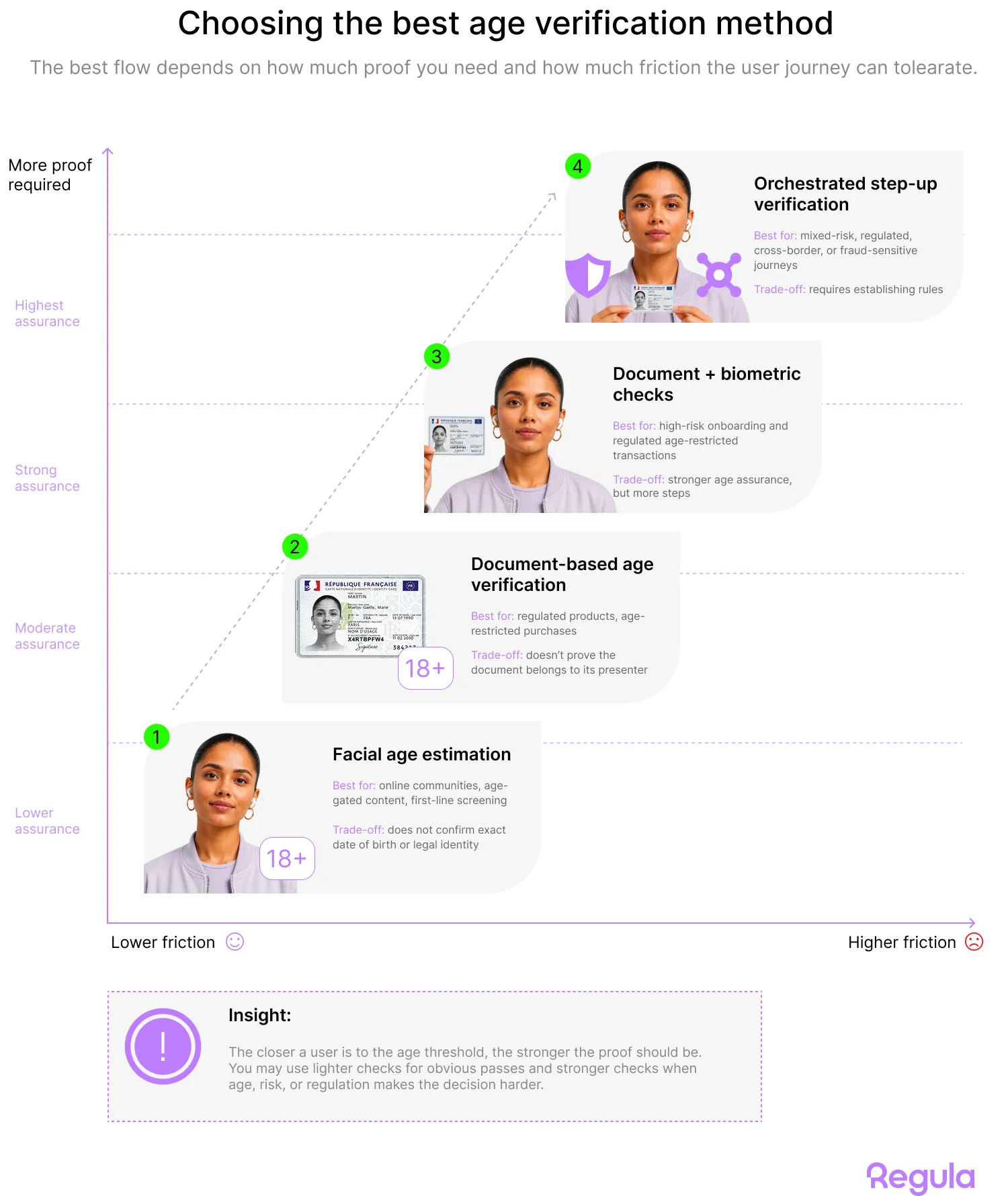
If you work in a regulated space, you’re most likely obliged to use the document + biometric verification combination.
The right vendor should fit that decision route. In low-risk cases, that may mean age estimation. In higher-risk cases, it may involve document verification, biometrics, liveness detection, and step-up logic.
These stronger checks also involve more sensitive data, which makes the deployment model part of the decision. Cloud services are usually faster to launch and easier to maintain. Organizations with strict security, confidentiality, or data residency requirements may prefer on-premises deployment, where verification data remains within their infrastructure and is not received or stored by the provider.
The goal is to make the age decision defensible without collecting more data, exposing it to more parties, or adding more friction than the use case requires.
If your team already knows what it needs and wants to discuss specific document types, fraud risks, age thresholds, or deployment requirements, talk to Regula. We can help you assess fit based on your actual verification scenario.