
As a travel document and passenger profiling specialist working at Istanbul Airport, I rarely had the luxury of a long document examination. The passenger flow was constant, time was limited, and every document had to be assessed quickly. The first decision was simple, but not easy:
Can this document pass, or does it need a deeper look?
In this article, I’ll share three field cases from my work and explain why physical passport and visa checks still matter, even when digital systems are part of the process.
What suspicious documents look like in the field
Document forgery has moved beyond amateur printing shops. In the field, suspicious documents usually fall into three broad categories:
-
Counterfeit documents, created to imitate genuine documents
-
Altered documents, where a genuine document has been changed in some way
-
Impersonated documents, where a genuine document is used by someone other than its rightful holder
At airline check-in and boarding gates, altered documents can be particularly difficult to detect. Since they contain mostly genuine components, the whole document may not look fake. But if a document has been changed, the physical document is likely still carrying traces of that intervention.
My job was to find those traces. I needed to compare these physical signs with what should be present in an authentic document. Its paper, ink, lamination, stitching, perforation, and fluorescent response can show whether the document has been changed after issuance.
At boarding gates, this work happened under a strict time limit: usually 15 to 30 seconds per passenger. The goal was to confirm that the passenger had the documents required for the destination and could be accepted for travel.
Subscribe to receive a bi-weekly blog digest from Regula
Why do airlines check documents before boarding?
Airlines perform these checks because the carrier is responsible for the passengers. If a passenger is later refused entry at the destination, the airline may face fines, removal costs, return transportation obligations, and operational disruption.
This responsibility becomes especially important on connecting routes. At a transit airport, the passenger may not pass full border control before the onward flight, and the airline cannot assume that every previous check was performed with the same equipment, expertise, or operational context. The boarding-gate document check is the airline’s opportunity to catch a problem before the passenger is carried further.
But the gate is not a forensic laboratory. That’s why our check had to be fast and practical: touch the document, tilt it under available light, focus on the critical zones, and decide whether to escalate the case to the specialized border police unit for deeper examination.
Let me show some examples.
Case 1: When a substituted page passed the chip check
One case involved a passenger traveling with an older series UK passport with a paper-based, laminate-coated data page. At first glance, the document looked alright. The chip was read successfully, and the system didn’t flag any problem with the electronic data. The printed text and MRZ on the data page also matched the data retrieved from the chip.
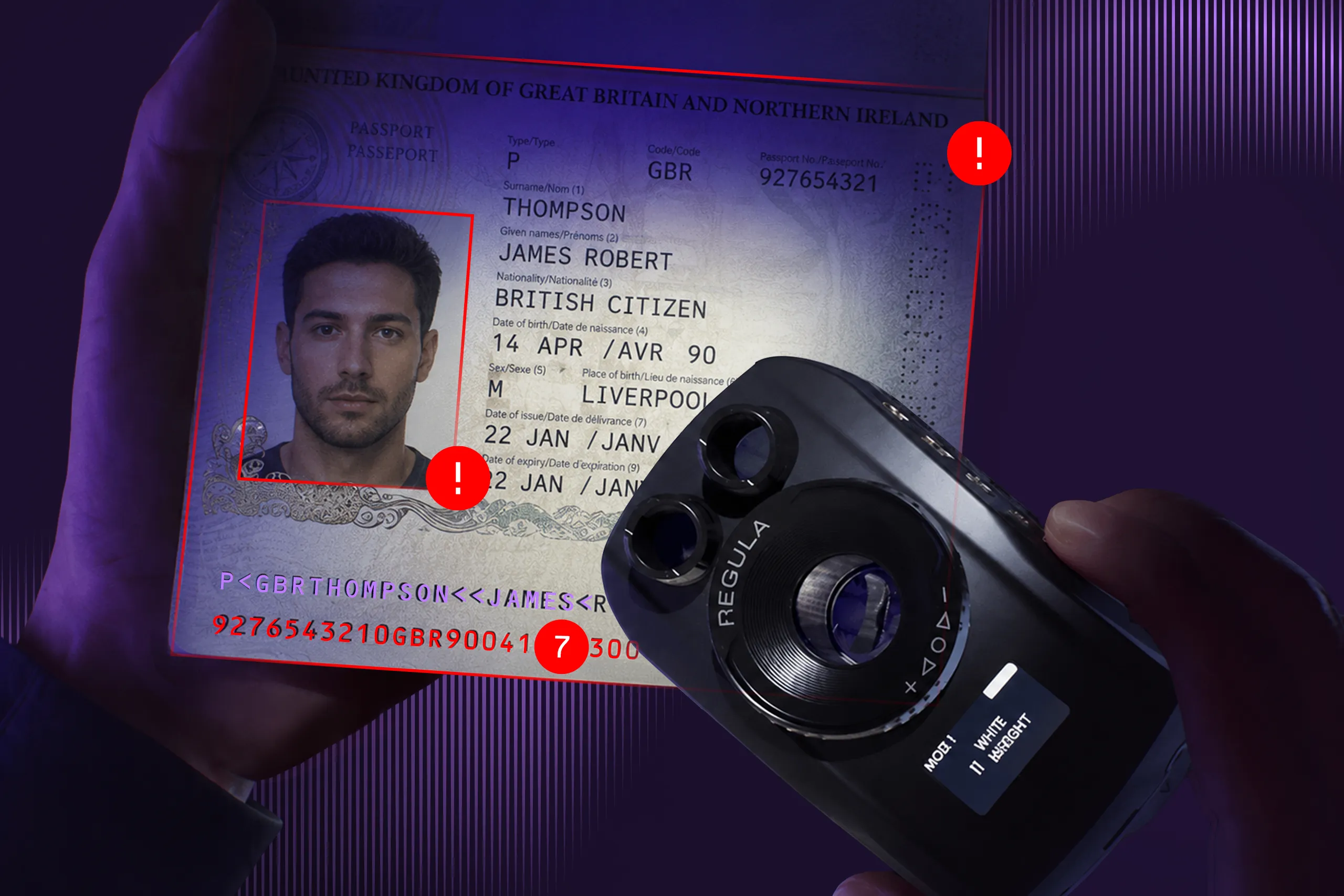
However, while opening the cover and turning the pages, I felt a slight looseness along the stitching line. It wasn’t enough to draw a conclusion yet, but it was enough to take a closer look. I used Regula 1031 at the counter to test that suspicion.
On a genuine high-security passport, the binding thread should be tight and uniform. The thread should sit cleanly, and the stitching holes shouldn’t show signs of repeated mechanical stress.
In this particular passport, under oblique light and magnification, small anomalies became visible around the stitching line: slight damage to the thread and deformed paper fibers around the stitching holes. All of it suggested that the passport booklet had likely been unstitched and resewn.
Further examination showed what had happened. The original paper-based data page had been removed and replaced with one made from scratch. The counterfeiters attempted to reproduce the genuine data page, so the textual data and MRZ matched the chip data. The difference was in the portrait: the image printed on the substituted data page was changed to match the impostor.
The entire strategy was built on the assumption that a valid chip check would induce a false sense of security in the officer, causing them to overlook the physical details.
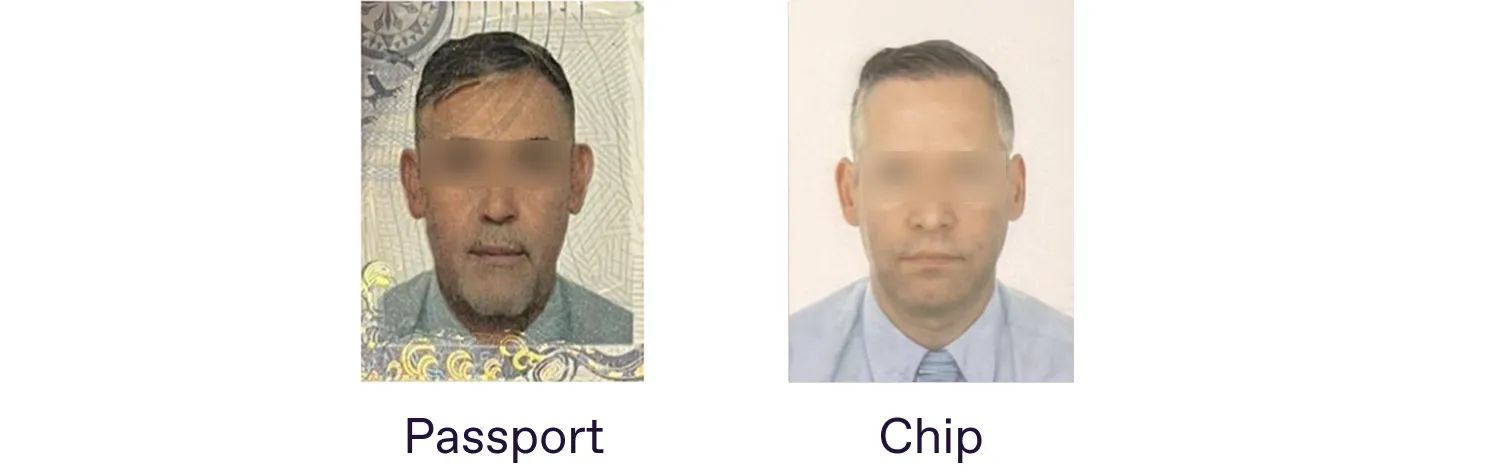
The impostor resembled the original document owner, making the case more dangerous.
Case 2: When a genuine passport carried an altered photo
Another case involved a German polycarbonate passport. Its chip was genuine and readable. But the first alarming sign was tactile. As I ran my thumb near the edge of the main portrait area, I felt a tiny step: a slight change in thickness and rigidity that didn’t belong there.
I used Regula 1029-15 at the counter to examine the photo area more closely. The signs suggested localized physical interference. The surface layer of the main portrait area had likely been scraped or milled away, and a counterfeit printed image had been applied over it.
Under UV light and magnification, the manipulation became even clearer. In a genuine document, security graphics such as microtext and UV-fluorescent lines should continue smoothly across the page and the portrait area. Here, the lines on the modified section didn’t align with the surrounding pattern, and the altered area reacted differently under UV light.
A closer examination then confirmed the suspicion. The main portrait on the front of the data page showed the passenger standing before me. But the secondary portrait on the reverse part of the data page still showed the rightful holder. The chip portrait also showed the rightful holder.
This case illustrates a classic method: instead of fabricating an entire passport from scratch, the fraudsters attempted to piggyback on a genuine document by altering only the photo. However, the tactile sign pointed to the manipulated area, while the additional portraits showed that the identity evidence no longer matched.
Case 3: When a visa date was altered
Another case involved a Schengen visa in an Iranian passport. I reviewed the document before the passenger boarded a connecting flight to their final destination.
In this case, the suspicious area was the visa validity date. Under normal light, there were no obvious erasure marks. On closer inspection, the area under the digit showed signs of physical disturbance, and the paper fibers appeared damaged. All of it implied the original date was different.
The alteration went beyond the visible validity date. The corresponding date in the machine-readable zone had also been changed. This type of synchronized alteration is something we often intercept: fraudsters change both the visual and the MRZ data so that basic readers at the gate don’t immediately trigger a mismatch alert.
In this case, one digit changed the meaning of the visa. Detecting that alteration prevented an ineligible passenger from continuing the journey.
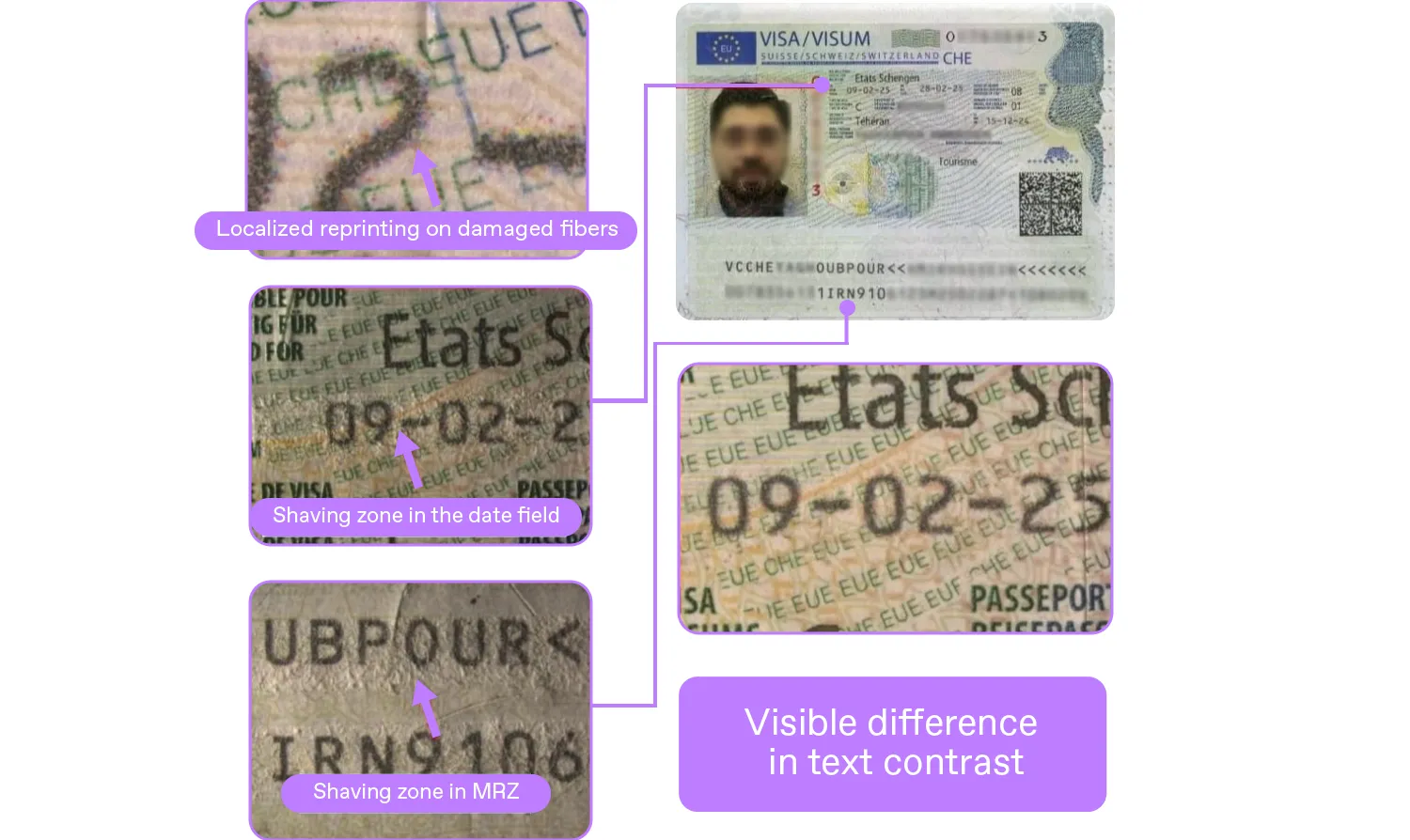
The manipulated visa in an Iranian passport.
Which inspection methods reveal which document fraud signs
The cases above point to the same issue: a suspicious document doesn’t always look suspicious. Some signs remain invisible until the document is turned, lit, or magnified properly.
Magnification helps officers understand how the examined document was produced. Different printing techniques leave different signs: line structure, ink distribution, relief, dot pattern, and edge behavior. For passports and visas, the expected combination of printing techniques is one of the document’s key protections.
Microtext is checked the same way. In genuine documents, it is usually continuous, clear, and readable at its intended scale. In forged or simulated documents, it may appear pixelated, blurred, merged, or produced in a way that does not match the expected template.
UV examination is important when chemical erasure is suspected. Even if an altered area appears clean under normal light, chemical treatment may disrupt the paper’s fluorescent balance. Under UV light, these areas can appear as dark spots, show unexpected luminescence, or reveal residual traces from the original entry.
Page manipulation requires a different kind of attention. The officer has to examine the document’s physical structure: the binding, stitching, page alignment, and the way the data page is attached to the cover. Magnification can make small irregularities easier to see.
Digital checks are also an important part of modern border control. Chip reading, biometric systems, and database checks help officers verify data and identity links faster. But they don’t answer every question about the document itself. For me, physical document examination remains the final control point.
The tools I relied on at the passport counter
At a passport counter, a device had to be light, quick to use, and practical enough not to disrupt workflow.
During my tenure at Istanbul Airport, Regula 1029 was one of the field tools I trusted most. Its compact design gave me enough freedom of movement in a narrow workspace, but it didn’t feel like a compromise in examination quality.
Magnification helped identify printing techniques, a key part of physical document examination. Different light sources then helped reveal signs of physical or chemical intervention, resewing, surface damage, and other small changes. In hundreds of examinations with this device, I detected photo substitution attempts that were too subtle to notice with the naked eye.
I also used Regula 1031, a more advanced field examination device, when a document required a closer look. It offered higher available magnification, a broader set of light sources, and optics that kept the image clear and undistorted. With that level of magnification, microscopic details became something I could actually see and assess.
It’s important to add that any field device must also be usable for long shifts. Passport officers can work for up to 12 hours, and even the best technology fails operationally if it slows them down, tires their eyes, or requires too many adjustments.
That’s why ergonomics mattered as much as technical capability. A clear field of view, simple controls, and an easy-to-use interface helped me keep my attention on the document inspection rather than the device.
Conclusion
At first-line document checks, many important decisions begin with doubt. Technology helped me examine that doubt before the moment was gone: it provided the right light, angle, and magnification to see whether the document contained physical evidence of intervention.
But technology is only part of the decision. The rest comes from experience: knowing what should be there, recognizing what does not belong, and deciding when the document must be escalated for deeper examination.
Of course, the gate check wasn’t the final forensic investigation. But it was the point at which the case attracted further attention. Without that first observation, the document could have continued through the process as if nothing was wrong.
We’ll deliver hand-picked content from Regula’s experts into your inbox