
In brief:
-
Self-declared age is increasingly insufficient.
-
Requirements for age verification on adult sites differ by market, so a single static global flow rarely works.
-
Platforms may use facial age estimation, digital credentials, document verification, or account-based signals, depending on the market and required level of assurance.
-
Most adult platforms need flexible verification rather than maximum verification: usually the lightest defensible method for each market, with stronger options available when requirements change.
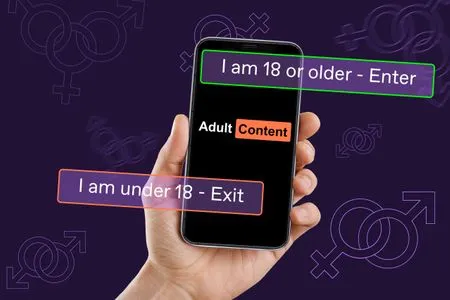
A checkbox asking “Are you 18?” takes seconds to add and seconds to bypass. For years, that was enough for many adult websites. In a growing number of jurisdictions, it no longer qualifies as meaningful age assurance.
However, stronger checks come with an uncomfortable trade-off: lawful adults may have to reveal their identity to access highly private content. Adult platforms, therefore, need the least intrusive method that still produces a defensible result under the applicable rules and risk level.
This article explains how to choose and apply that method in practice.
What level of age assurance does an adult platform actually need?
Adult content isn’t yet governed by one clear, uniform age assurance standard. That doesn’t mean regulators are ignoring the sector, but requirements, accepted methods, and enforcement still vary widely by market.
This uneven landscape leaves platforms with considerable room for interpretation. In practice, many adult sites aim for minimum viable compliance: meeting local requirements without adding more friction or collecting more personal data than necessary.
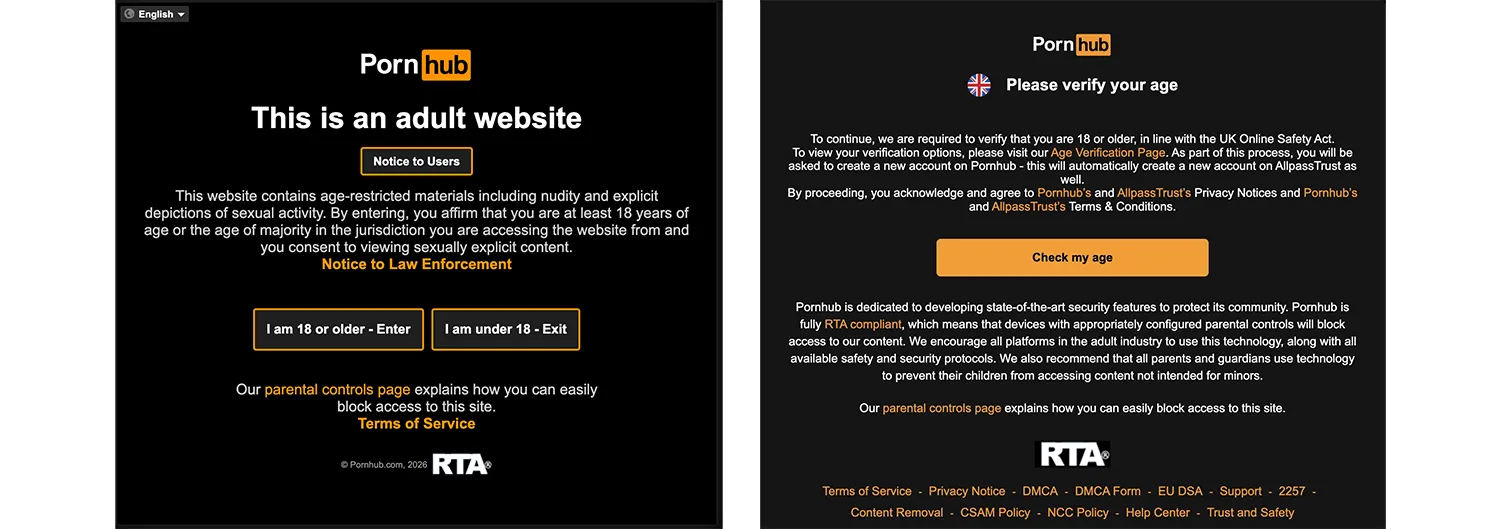
The same resource may offer stricter or lighter methods depending on a user’s jurisdiction. To access Pornhub content, one user may only need to click I’m 18, while another, for example, from the UK, can be prompted to complete age verification.
Subscribe to receive a bi-weekly blog digest from Regula
Which age verification methods can adult platforms use?
The main options trade off assurance, friction, coverage, and privacy in different ways.
Method #1: Facial age estimation
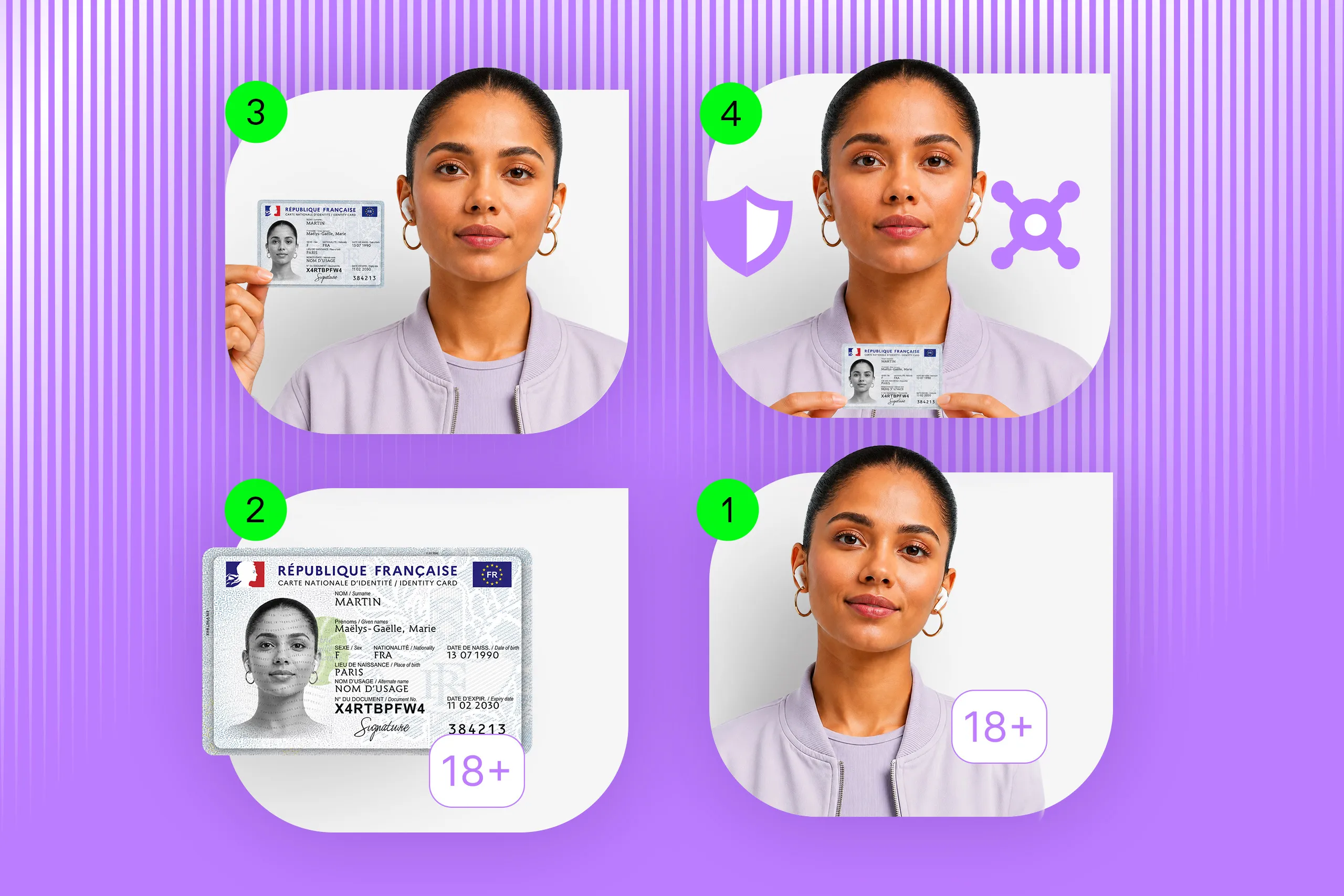
Facial age estimation analyzes a person in front of the camera and predicts an age or age range, usually from a selfie. Since it doesn’t require submitting a government-issued ID, it’s a natural privacy-conscious option for adult content.
The method’s limitation is uncertainty. Facial age estimation doesn’t provide an exact date of birth. A model may confidently recognize that someone is clearly over 18, yet struggle to distinguish a 17-year-old from a 19-year-old. More conservative thresholds reduce the risk of admitting minors, but they also send more lawful adults into a fallback flow.
Performance may also vary across age groups, genders, ethnic groups, image conditions, and devices. NIST’s FATE Age Estimation and Verification program evaluates these differences across multiple datasets and demographic groups. It also measures the trade-off that matters most in practice: how often minors pass without an extra check and how often adults are unnecessarily challenged.
Implementation matters as much as model accuracy. Platforms seeking more than a compliance checkbox may also need to confirm that:
-
A live person completed the check through liveness detection
-
The image or video feed was not injected or manipulated
-
An on-device result was not altered before it reached the backend
Regula has performed strongly in NIST’s evaluations. In the latest published results, its algorithm ranked among the top performers across six geographic regions and placed in the top three for the Challenge 25 and Child Online Safety scenarios.
Method #2: Digital identity and reusable age proofs
Digital identity can provide strong proof of age without disclosing the user’s full identity to the adult content platform.
A mobile driver’s license, digital ID wallet, or reusable credential can confirm a simple attribute such as age over 18. The credential is cryptographically protected to confirm that it comes from a trusted issuer and hasn’t been altered.
The underlying identity checks are still rigorous. The credential may have been issued only after the user’s document, biometrics, and eligibility were verified. But those checks happen upstream. The adult website receives only the age claim, without collecting the user’s name, address, or ID scan. Solutions such as Regula can support both sides of this flow: verifying a person’s identity before a digital credential is issued and validating that credential when it is later presented to an adult content provider.
Reusable credentials for age verification are particularly well-suited to adult content because they combine:
-
High assurance
-
Minimal disclosure
-
No direct handling of identity documents by the platform
Their main limitation is availability. Not every user has a supported digital credential, and interoperability between issuers, wallets, and relying services remains uneven.
Some local ecosystems already support reusable digital proofs. In Louisiana, US, residents can use the official LA Wallet app and its Remote Verify You feature to present a state-issued mobile ID online for age-restricted access
In the EU, the Digital Identity Wallet is designed to support selective disclosure, including proof that a user is above a required age without revealing their full identity. However, rollout, wallet availability, and acceptance by private services still vary by country.
In many other markets, users have no compatible digital credential at all. Adult platforms, therefore, still need fallback methods for users whose jurisdiction or credentials are not supported.
Aylo — the parent company of adult sites like Pornhub, YouPorn, RedTube, and Brazzers — supports age verification at the device or operating-system level. Users would verify their age once, while adult services would receive only an eligibility result. According to Aylo, this model offers stronger privacy and broader coverage than requiring users to submit an ID separately to every adult website.
Method #3: Document-based age verification
A government-issued ID provides authoritative evidence because it contains an official date of birth. However, simply extracting that date isn’t enough, because the document may be forged, altered, or presented from a screen. A minor may also submit a parent’s passport or an older sibling’s ID.
A reliable document-based flow may therefore need to:
-
Recognize the document type and version
-
Extract and validate the date of birth
-
Check the document for signs of forgery or alteration
-
Read and authenticate an RFID chip where available
-
Add biometric verification when the platform must confirm that the document belongs to the person requesting access.
At that point, the flow begins to overlap with full identity verification. With a solution such as Regula, these checks can be applied in stages: first, verify that the document is genuine and that the age requirement is met; then add biometric verification only when the platform also needs to confirm who is presenting it.
That level of assurance comes at a cost. Asking viewers to submit an ID and biometric evidence can reduce completion rates, especially in such a privacy-sensitive context. Even so, some well-known platforms accept that trade-off to meet local requirements.
OnlyFans, for example, requires both creators and fans in certain jurisdictions to complete ID-based verification. These include the United Kingdom and selected markets in Brazil and the United States, where stricter adult-content laws apply. In other locations, fans may face lighter checks, such as payment-method verification.
Method #4: Payment, mobile, and account-based signals
Some platforms may also use existing accounts or third-party signals, such as:
-
Payment card ownership or banking data
-
Mobile operator records
-
App store accounts
-
Previously verified user accounts
These methods can reduce friction because users may not need to capture a face or document.
The evidence, however, is often indirect. These signals are therefore better suited to particular jurisdictions, established ecosystems, or supporting evidence rather than as a universal age verification for adult content.
Which regulatory patterns shape age verification requirements for adult content sites?
| Country/jurisdiction | Adult content age verification laws | Required methods | Effective date |
|---|---|---|---|
| United States | State-level adult-content age-verification laws | Methods may include government-issued ID, transactional data, commercial age-verification systems, or digital credentials. No single nationwide method. | As of the date, 25 US states have enacted age verification laws targeting pornography websites, including California, Florida, and Texas. |
| United Kingdom | Online Safety Act 2023 | Ofcom allows several approaches, including facial age estimation, photo-ID matching, digital identity services, mobile network checks, credit card checks, and open banking checks. Self-declaration is insufficient. | July 25, 2025 |
| France | France's SREN Law (Law No. 2024-449) | Effective age verification before access. Users must have access to at least one privacy-preserving option based on double anonymity. Self-declaration is insufficient. | Implementation started in 2024 |
| Italy | AGCOM’s Resolution No. 96/25/CONS | The use of certified, independent third-party age verification providers. The system mandates “double anonymity,” so neither the site nor the age verifier knows the user's full identity. | November 12, 2025 |
| European Union | Digital Services Act | Implementing “appropriate and proportionate” measures to ensure youth safety. This may include: digital identity wallets, document-based verification, and biometric and behavioral age estimation. Self-declaration is insufficient. | DSA is fully applicable from February 17, 2024 |
| Australia | Online Safety Act | The methods may include facial age estimation, document-based verification, third-party accredited digital IDs, and payment method verification. Self-declaration is insufficient. | Key expansion in 2025–2026 |
| Brazil | Digital Child and Adolescent Statute (“ECA Digital,” Law No. 15,211/2025) | The methods may include facial age estimation, document-based verification, and AI-driven age estimation. Self-declaration is insufficient. | March 2026 |
What should adult platforms look for in an age verification provider?
For most adult platforms, the immediate goal is to meet applicable requirements without adding unnecessary friction. That makes flexibility more valuable than maximum verification.
A provider should support different levels of assurance within one technology stack, so the platform can start with a lighter flow and tighten it where (or when) the market or use case requires.
With Regula, that may include:
-
Facial age estimation for low-friction access
-
Digital identity credentials for reliable yet privacy-preserving age proofs
-
Document-based verification where stronger evidence is required
-
Full identity verification with biometrics for creators, performers, payouts, or stricter jurisdictions
The goal is to avoid locking the platform into one method. A market that accepts facial age estimation today may require stronger assurance later.
Regula supports the full age assurance journey without forcing platforms to replace their verification infrastructure whenever requirements change. They can move between facial age estimation, digital credentials, document-based age verification, and full identity verification as needed, while configuring age thresholds for different markets, products, and user groups.
Need an age verification flow for a specific market or user journey? Talk to Regula’s experts about the right level of assurance for your platform.