
In Brazil, identity comes with its own alphabet: RG, CPF, CIN, and CNH. Behind these acronyms is a document system shaped by state-level issuance, national reforms, and formats that don’t always follow global conventions.
In this article, we take a closer look at Brazilian identity cards, driver’s licenses, and passports from a document processing perspective.
💡 If you’re new to this series, you may also like our other posts:
The challenges of processing Brazilian IDs
Most identity documents used in Brazil are still paper-based, including identity cards and driver’s licenses. Although plastic identity cards have started to appear, paper documents remain far more common in practice.
Paper documents are more vulnerable to wear, moisture, and accidental damage than plastic or polycarbonate cards. This can make both data extraction and authenticity checks less reliable. For example, washed or bleached paper may fluoresce under UV light and resemble the response of a counterfeit document.
Non-standard formats complicate document capture
Brazilian identity cards and driver’s licenses don’t always follow the dimensions or layouts commonly expected by document verification systems.
Legacy identity cards may measure around 6.4 × 19.3 cm, while driver’s licenses can be approximately 8.5 × 12 cm. These dimensions are larger than the standard ID-1 card format used for most modern identity documents, so capture systems must accommodate unusual document boundaries and layouts.
Additionally, driver’s licenses are designed to fold in the middle, resembling booklets rather than traditional cards. This unique design, combined with the fact that meaningful data is spread across two, sometimes three (like in the DLs below), or even four sides, poses significant challenges for automated document verification systems.
Interestingly, Brazilians often use an electronic version of their driver's license. It also includes three to four pages of information.
Some security features in Brazilian documents also depart from standard expectations. For example, the machine-readable zone on Brazilian driver’s licenses consists of three lines, even though that layout isn’t compliant with ICAO standards for documents of that size.

Brazilian driver’s license, 2022 series
Get posts like this in your inbox with the bi-weekly Regula Blog Digest!
Multiple document series remain in circulation
Older identity cards, driver’s licenses, and passports remain valid, so verification systems must recognize multiple generations simultaneously.
Legacy identity cards and driver’s licenses are especially challenging. Before Brazil introduced a unified national design, individual states issued their own versions. These documents could differ in layout, field placement, dimensions, and security features even though they served the same purpose.
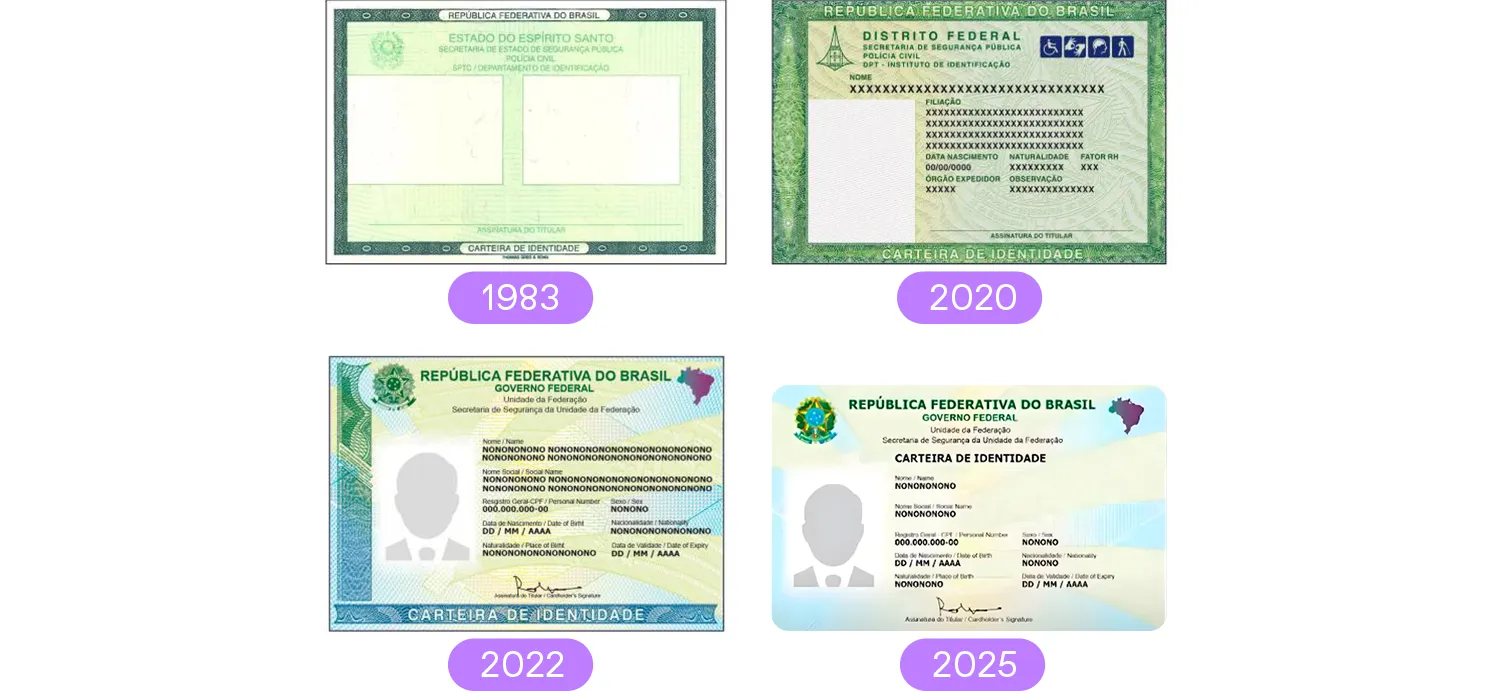
Brazilian ID cards issued in 1983, in 2020, in 2022, and in 2025.
Brazil is gradually replacing its traditional state-issued identity cards, known as RG cards (Registro Geral), with the standardized Carteira de Identidade Nacional (CIN), or National Identity Card.
Under the older system, individual states issued their own identity cards and RG numbers. The CIN introduces a unified national format and uses the holder’s CPF as a single identification number.
The transition is gradual. Paper CINs remain common, while a plastic version began appearing in 2025 and is still less widely used. Older RG cards are still in circulation, so document verification systems must support both the standardized CIN and the numerous legacy state-issued formats.
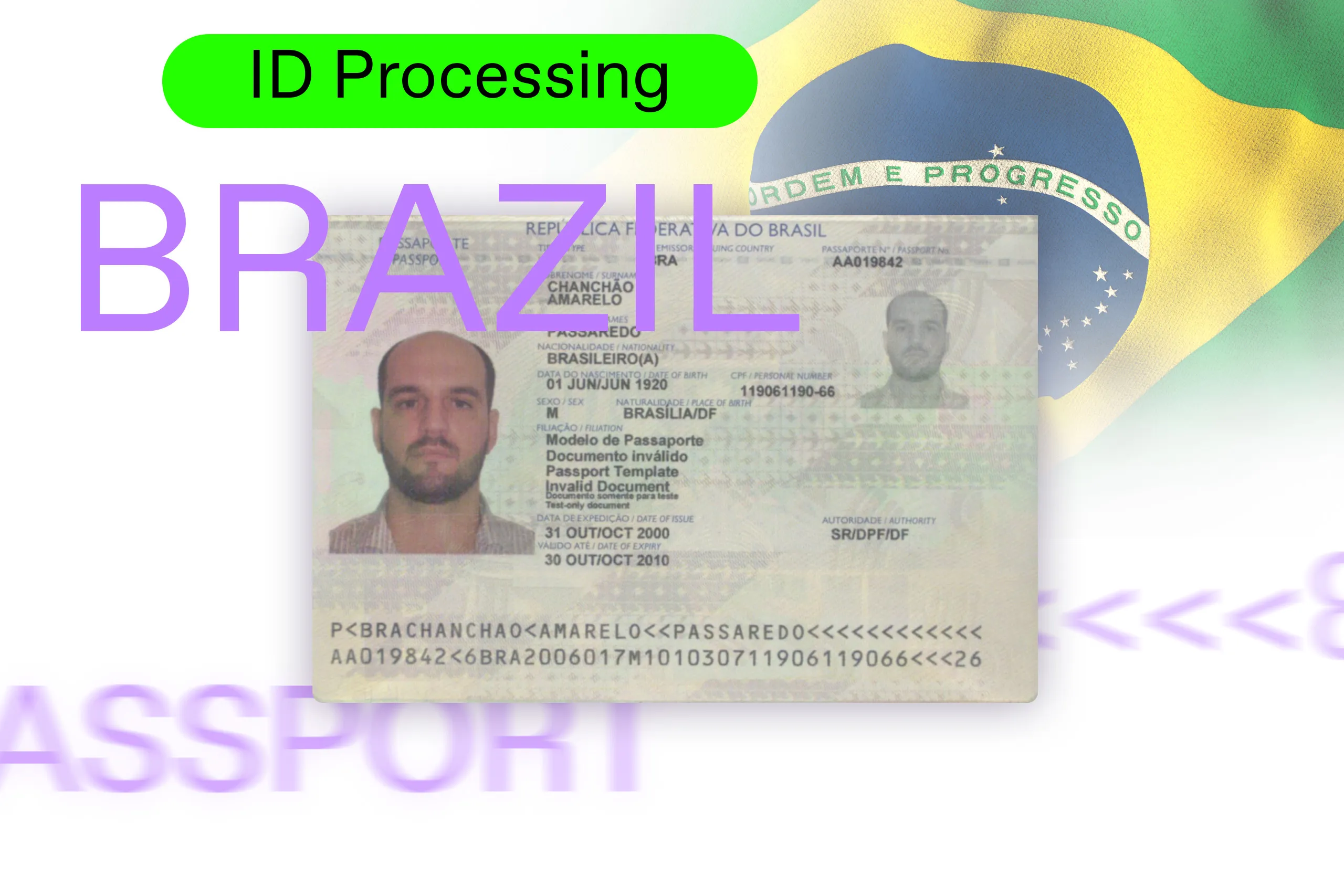
Brazilian passports have also undergone numerous design changes in recent years. The Brazilians witnessed updates in 2009, 2010, 2014, 2015, 2016, and the most recent in 2023.
Not every update, though, brought significant changes to the layman's eye: for instance, the 2016 series had a minor difference in the document number.
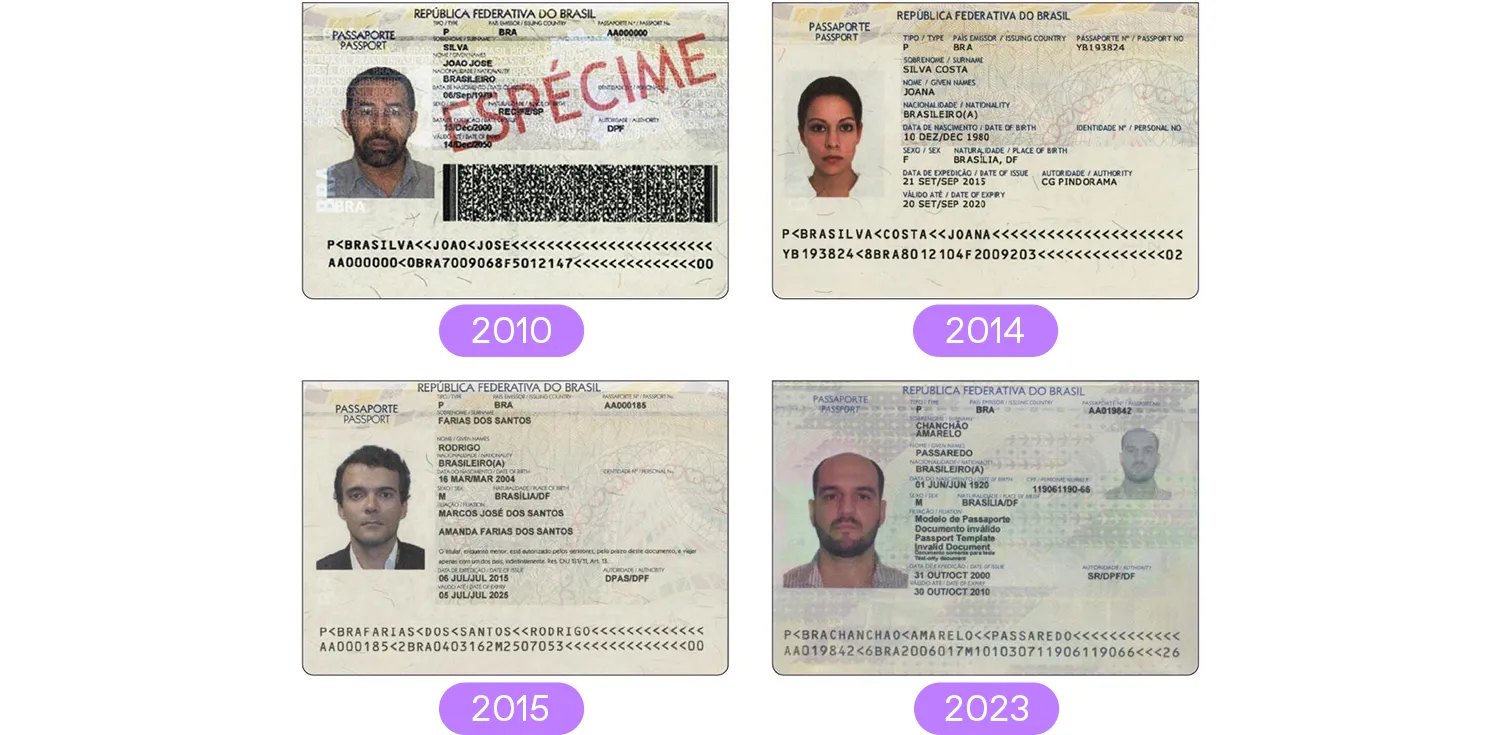
Brazilian passports issued in 2006-2010, 2014, 2015, and 2023
One of the most prominent features of the new Brazilian passport is a vibrant hologram across the entire data page. It strengthens protection against forgery but can also obscure printed data in photos or video frames, making remote capture and automated reading more demanding.
The passport also contains an RFID chip, which enables electronic data and authenticity checks.

The 2023 series is Brazil’s first thematic passport, with one visual concept unfolding across the entire document.
Brazil-specific data fields
Brazilian identity documents contain several fields that may be unfamiliar to systems built around more common international templates.
Most fields appear in Portuguese, so accurate processing depends on language support and template recognition.
Also, every Brazilian ID contains a CPF, an 11-digit taxpayer number used across banking, taxation, property transactions, and many online services. The CPF resembles the US Social Security Number (SSN) to some extent.
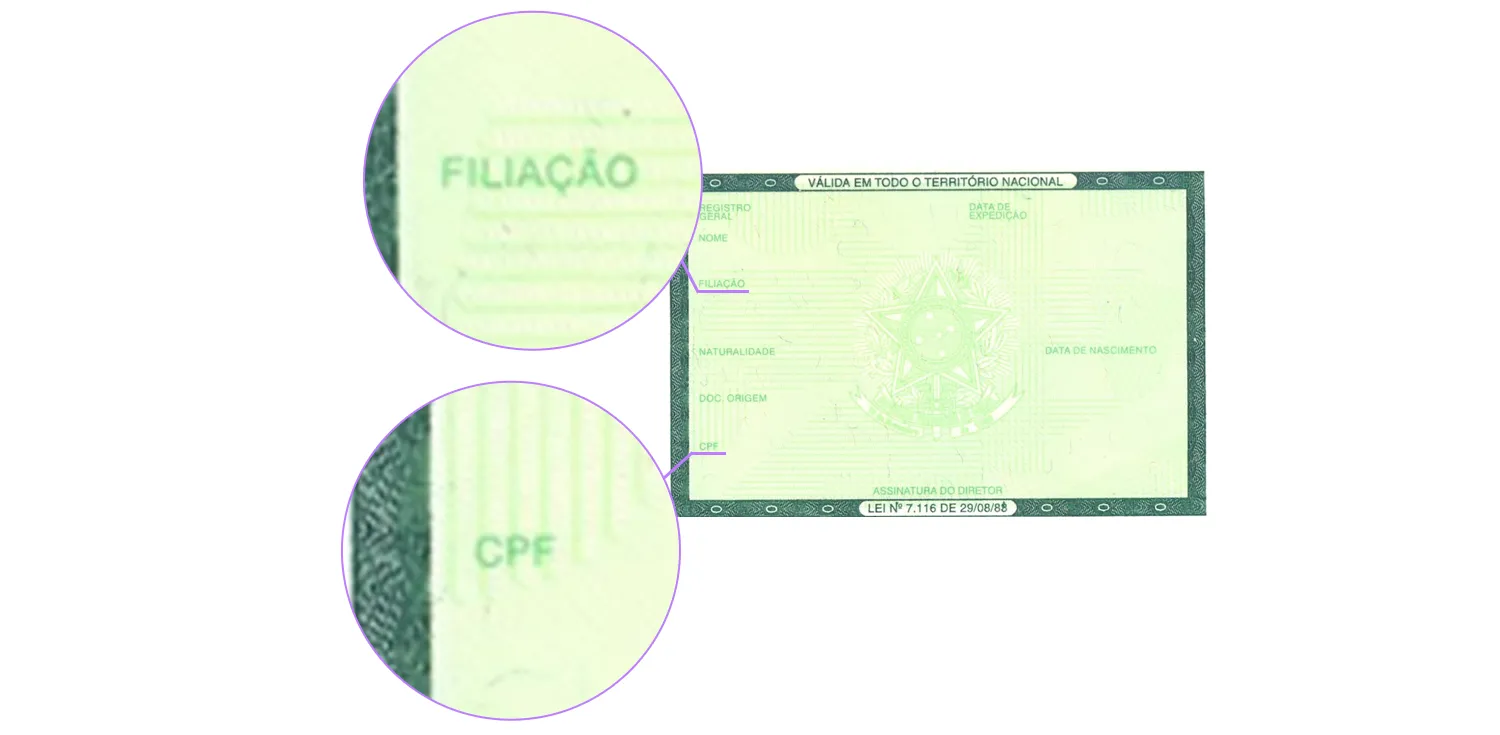
Another unique feature of Brazilian IDs is the inclusion of parents' names, which is uncommon in other countries' identity documents.
How to effectively process Brazilian IDs
Reliable processing starts with identifying the exact document type and series. A Brazilian identity card, driver’s license, or passport may be subject to different rules depending on when and where it was issued.
The system should then apply the checks appropriate to that document. These may include:
-
capturing all document panels or pages
-
comparing the document against the correct template
-
reading MRZs and QR codes where present
-
extracting data from Portuguese-language fields
-
checking visual security features
-
validating RFID chip data in biometric passports
-
recognizing both legacy RG numbers and CPF-based CINs
Support for legacy templates is especially important. Brazil is in a transition period, so businesses cannot assume that everyone will present the latest national identity card.
Regula's expertise in document authentication and verification, honed over years, is well-suited to this task. Our solutions are designed to handle Brazilian IDs' non-standard formats; also, we support multiple languages, including Portuguese, and authenticate various security features, even with the challenges posed by paper-based documents.
This expertise also extends beyond software development. Regula has conducted joint training with INTERPOL on travel document examination for Brazil’s National Institute of Criminalistics in Brasília, sharing practical knowledge with specialists responsible for investigating document fraud.
Need to verify Brazilian identity documents with confidence? Explore Regula solutions or talk to our experts about your document processing flow.