


In Brief: Gig worker identity verification links an applicant to identity evidence, and reverification helps check who is using an approved account later. These checks support decisions about access to work, customers, property, and earnings. Their value depends on reliable onboarding, checks that fit the action being requested, and a practical review process for legitimate workers whose results are inconclusive.
In December 2024, DoorDash reported that more than 150,000 Dashers were completing selfie checks every week. The platform already required identity verification and background screening before someone could start delivering.
Those initial checks apply to a particular person, so their value depends on who uses the account afterward. If a worker lends or rents it out, someone else may perform jobs under that person’s record.
In this article, we look at what gig platforms should verify at signup, when workers and customers need another check, and how to make those checks proportionate to the risk. We also explain how existing identity evidence can support a simpler process for returning workers, with practical retries and review.
Get posts like this in your inbox with the bi-weekly Regula Blog Digest!
Why should gig platforms care who performs the work?
Knowing the worker helps a platform apply the conditions under which it approved them.
It could become problematic if a home services provider was screened before receiving permission to enter customers’ homes — and then someone else took their place. The customer may experience immediate harm when something goes wrong, and the platform still has to handle the consequences.
Customers also choose a platform for what it organizes on their behalf, including access to suitable workers and help with problems. Repeated uncertainty about who turns up can create additional support work and give customers reasons to book elsewhere.
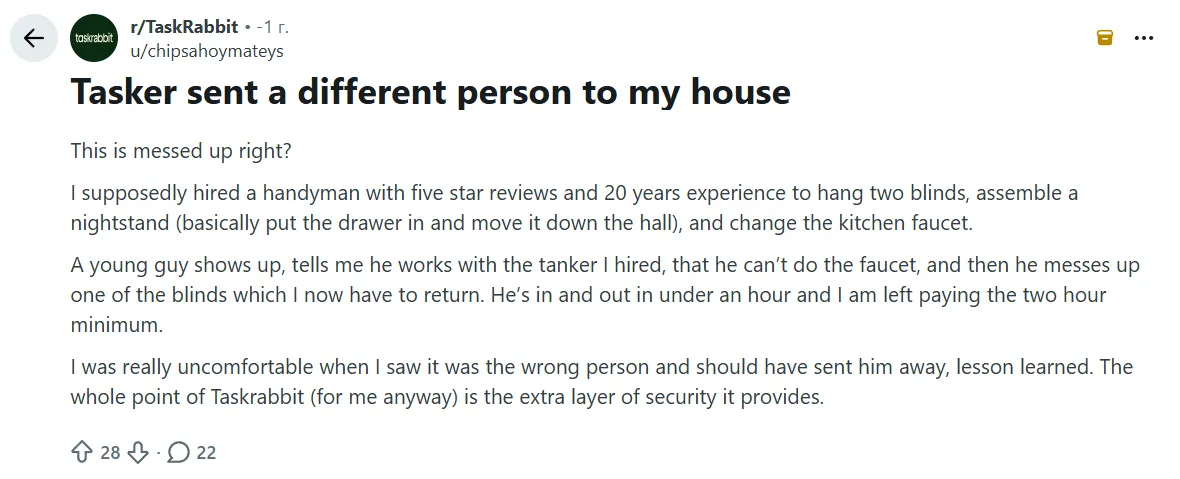
Customers on various subreddits report that the worker who arrived wasn’t the person shown in the app.
Overall, identity checks connect people to relevant screening and support accountability. Safety also depends on conduct, reporting, and the response to incidents, since a verified person can still behave badly.
Where does identity risk appear on a gig platform?
Identity risk arises when someone presents another person’s identity, uses their account, or requests access they aren’t entitled to. The purpose of verification changes with the person and the action involved.
Worker accounts
At signup, an applicant may use a stolen or altered document to obtain approval under someone else’s identity. If that identity then feeds into background or eligibility checks, the platform may end up screening one person while giving another access to jobs.
Later, an approved worker may lend or rent out the account, giving someone else access under their record. The owner may willingly provide login codes or help complete an identity check, so changing credentials alone does little to address the arrangement. The platform needs to establish whether the person accepting jobs has met its requirements, including any rules for approved substitutes.
Age verification plays a part as well when someone must meet a minimum age to join the platform or accept particular assignments. DoorDash, for example, requires Dashers delivering alcohol to be of legal drinking age in their market. Later identity checks can help establish whether the person accepting that delivery is the worker whose age was verified.
Lastly, an account takeover can create issues as an outsider may redirect earnings without performing any jobs. Recovery needs to establish who is entitled to regain control, particularly when the requester approaches support using the worker’s personal information.
INCIDENT | Worker earnings stolen through account takeover
In July 2026, the US Department of Justice reported guilty pleas in a scheme involving impersonation of DoorDash workers to support staff, account takeovers, and redirected wages. The defendants admitted stealing from at least 138 workers.
This only illustrates why protecting earnings should also include checking who is requesting access through support, alongside securing the payout destination.
Customer accounts
Customer identity verification needs a similarly specific purpose. If a permitted pseudonym is enough for an ordinary order, payment and account controls may address the relevant risks. Stronger identity evidence can become useful when someone receives valuable rental property or purchases an age-restricted item.
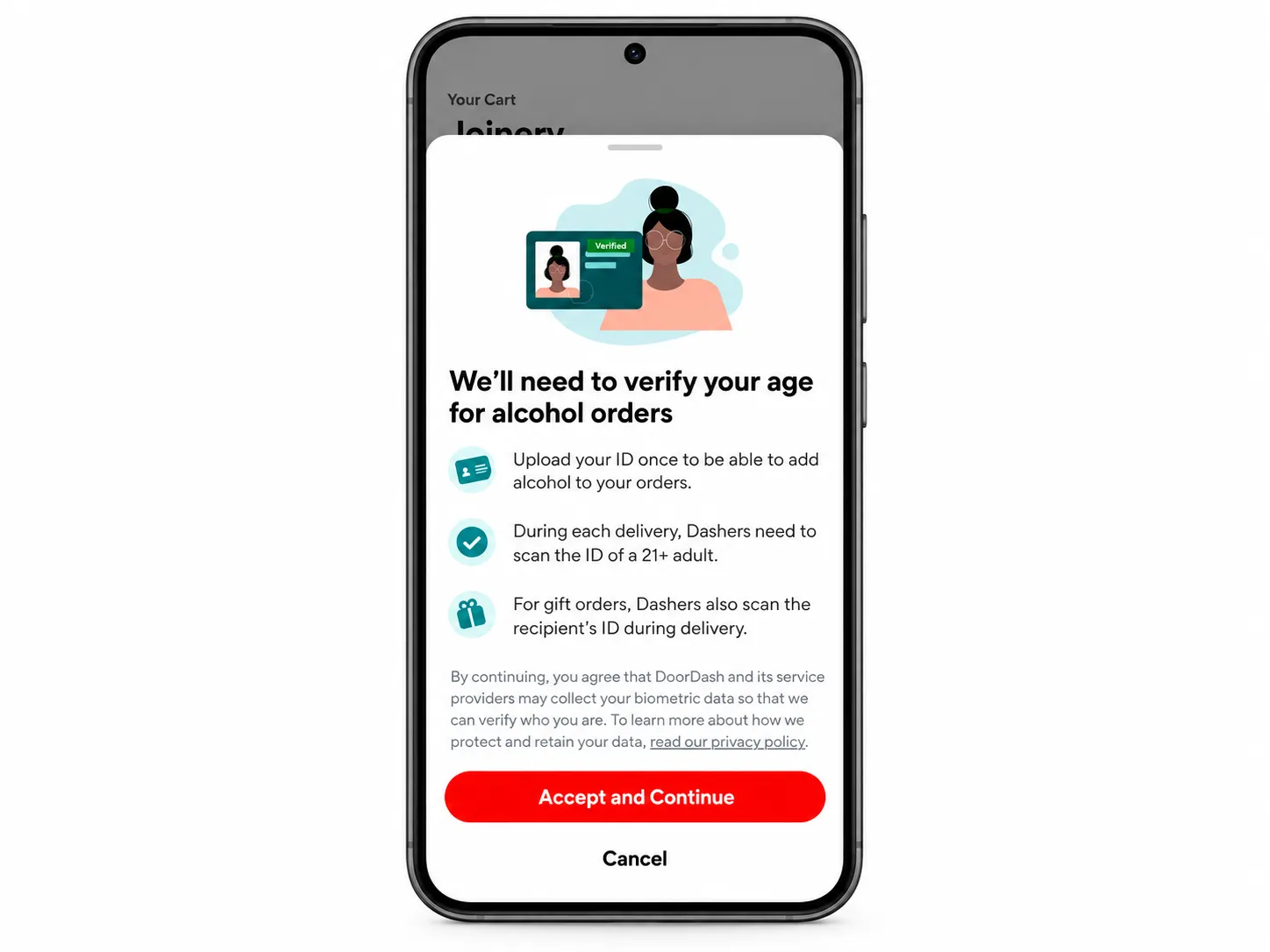
For example, DoorDash customers may only place alcohol orders after confirming their age through an ID scan.
In ride-hailing or home services, customer verification can also support accountability after a safety incident, although an identity document reveals little about someone’s intentions. The service’s rules need to distinguish a verified booking account from the person the worker actually meets.
This way, if a rental service allows someone to book a vehicle for a relative, the booking account’s verification needs to identify the person arranging the rental, and the platform also needs to establish who is authorized to collect and drive the vehicle. The platform can then apply its identity and license checks to that driver before granting access.
What should platforms verify at signup?
Signup should establish a dependable connection between the applicant and authentic identity evidence. Because this record supports later checks, the platform needs to know what was verified and which evidence remains suitable for reuse.
A remote onboarding process commonly brings together four checks:
-
Document authenticity: Identify the document type and examine its expected layout and security features (e.g., holograms, optically variable ink) for signs of alteration or forgery. The checks depend on the capture method and document. For a supported electronic passport and compatible phone, reading the chip through NFC can also allow verification of the issuer’s digital signature and checks for altered chip data.
-
Data consistency: Compare identity details across available sources, such as printed text, the machine-readable zone, a barcode, or chip data, and check them against submitted information. Discrepancies need investigation because they can arise from alteration, reading errors, or differences in how names are written.
-
Liveness: Assess whether the capture involves a physically present person and examine signs of presentation attacks, such as a printed photo or screen replay. Depending on the implementation, the person may need to pass passive liveness (take a selfie) or active liveness (follow movement prompts).
-
Face matching: Compare a freshly captured selfie with the document portrait, including a chip portrait where available. This helps address a different problem from document forgery: someone presenting a genuine document that belongs to another person. Image quality affects the comparison, so an uncertain result needs an appropriate retry or review.
Capture quality comes first: glare covering a portrait or a cropped document can make later checks unreliable. Regula Document Reader SDK guides a user to get the best possible image, assesses image quality, reads identity data, and performs authenticity and consistency checks. Regula Face SDK supplies face comparison and liveness assessment, with the platform using the results to decide whether the applicant can proceed.
Permission to perform the job may require additional evidence. A genuine driver’s license helps establish identity; driving entitlement, work eligibility, and background screening need their own checks. Later face matching reconnects someone to that record, and expiring qualifications or permissions still require updates.
CASE STUDY | Regula powers FREENOW’s driver checks in Poland
FREENOW verified drivers in person at 25 offices in Poland with Regula's help, asking them to bring an identity document and a driver’s license.
Regula Document Reader SDK examined the documents and compared their data, and Regula Face SDK compared a captured face image with both document portraits. FREENOW also checked the driver’s criminal record separately as part of its approval process.
When should platforms request reverification?
Reverification is useful when the platform needs fresh evidence about someone requesting work or making a sensitive account change. Timing should reflect both signs of misuse and the consequences of letting an unauthorized person proceed.
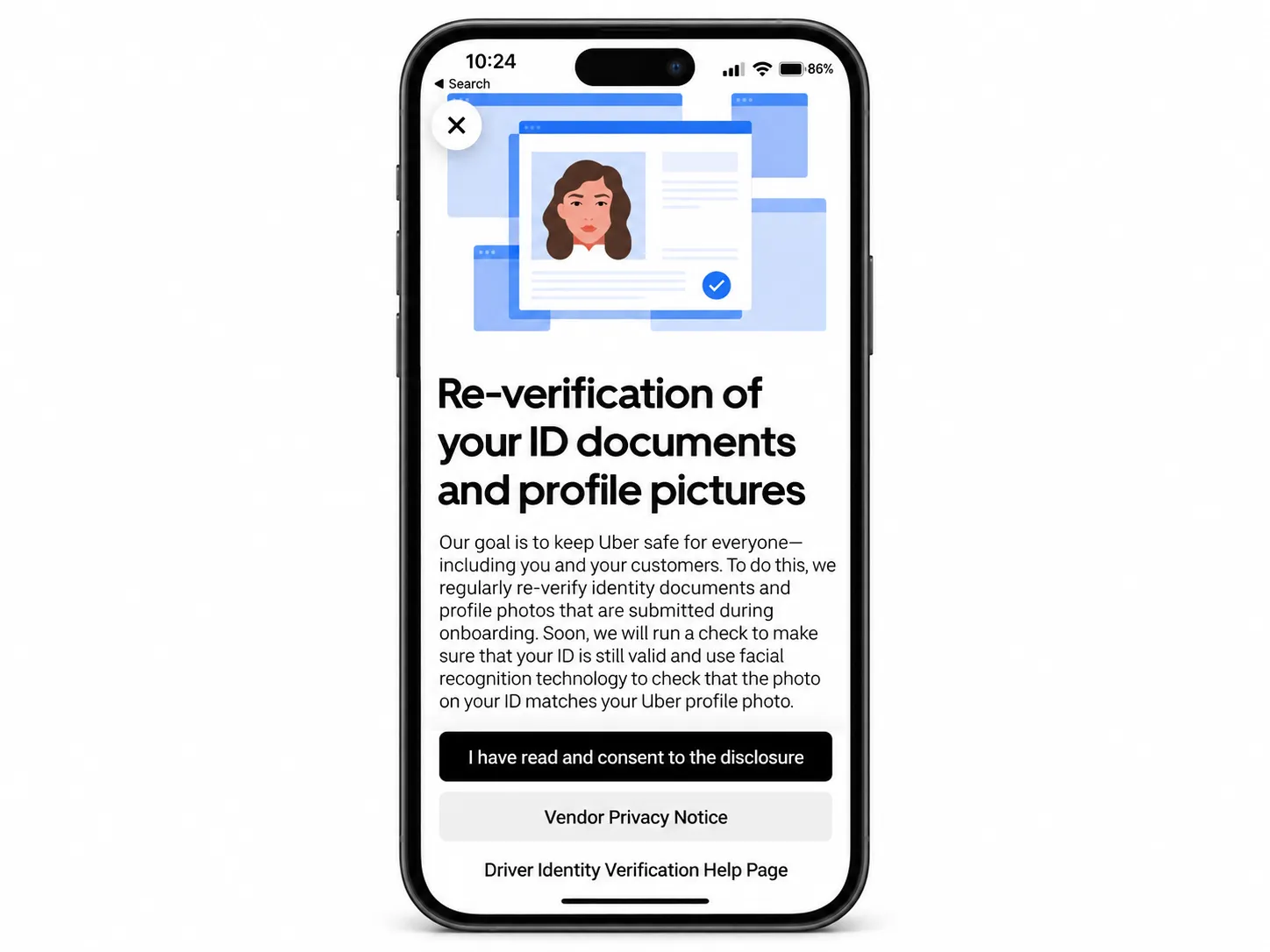
Uber notifies drivers that their ID documents and profile photos will be checked again after onboarding.
For example, voluntary account sharing may produce few unusual signals, especially when the owner lends their phone to someone working in the same area. Where the risk justifies it, periodic or less predictable checks tied to work activity can provide fresh evidence about who is using the account.
Platforms also need to define whom they authorize to work. Deliveroo’s UK process allows registered substitutes who complete identity and right-to-work checks. They can access deliveries using their own email, with access to earnings information and bank-detail changes restricted. This separates permission to perform deliveries from control over the account’s money.
Customer reverification may also be needed when recovering an account or requesting access to valuable rental property. The platform can reuse trusted evidence if it belongs to the person requesting access, and it first needs to establish suitable evidence for someone whose identity hasn’t been verified.
That said, there is a caveat involving reverification — it should not be overwhelming for either party.
Avoiding unnecessary reverification
Platforms don’t need to request another identity check for every login or account change. Existing account-security controls may be enough for routine activity, while only sensitive actions or signs of unauthorized use can justify fresh evidence about who is using the account.
For example, legitimate workers also replace phones, travel, change their names, and take time off, so the decision to request another check should reflect the wider account activity and the consequences of unauthorized access.
Overall, a suitable reverification framework can look something like this:
| Event | Question to resolve | Possible response |
|---|---|---|
| New device | Does access remain with an authorized person? | Assess account signals and request a live face check if warranted |
| Unusual location or behavior | Does the pattern suggest unauthorized use? | Assess the activity in context, then request fresh identity evidence if warranted |
| Account recovery or changed contact details | Is the requester entitled to control the account? | Use a protected recovery process with appropriate identity evidence |
| Changes to name or verified portrait | Does the updated evidence belong to the worker? | Verify the change before updating the protected identity record |
| Changed payout details | Who requested the change, and where will earnings go? | Check the requester and assess the destination before approving |
| Return after prolonged inactivity | Are identity evidence and permissions still usable? | Reconfirm identity and update expired eligibility evidence |
| Reports of a different worker | Is the current worker authorized? | Investigate the report and check against the appropriate worker record |
How can returning workers verify with minimal friction?
A returning worker can often complete a face and liveness check against trusted evidence already collected. At the same time, requesting the document again is useful when that evidence needs updating, its authenticity is in doubt, or the circumstances require stronger verification.
This way, a returning-worker flow can:
-
Retrieve the protected reference associated with the worker’s verified identity
-
Capture a fresh selfie and assess liveness
-
Compare the new face image with the trusted reference
-
Apply rules for proceeding, guided retries, further evidence, or review
The same face match can answer different business questions, too. Before work, it may confirm the approved worker’s presence; before a payout change, it may confirm the account holder making the request. Payment controls still need to assess the destination and circumstances of the change.
How can platforms keep identity checks proportionate?
Proportionate checks give the platform enough evidence for the action being requested, with stronger verification where the likely consequences justify it. The process also needs to fit how workers use the service.
Match the check to the action
A routine login may be handled through account authentication, a question about the current worker may justify a live face check, and compromised identity evidence may require document verification or review.
A gradual approach often helps, although some situations warrant stronger checks immediately. Recovery followed by a new payout destination deserves attention before funds are released, even if the requester provides a convincing explanation.
Regula IDV Platform can combine document and biometric verification with device, geolocation, and IP checks in configurable, risk-based workflows. Persistent profiles keep a worker’s identity evidence and verification history available across sessions, along with device and location history when tracking is enabled. Configured rules can use that context to request further verification, for example when a session uses an IP address the service has flagged.
Before a payout change, a workflow could request a live face check against the worker’s existing identity evidence. If the verification result needs human review, the workflow can create a case for review. Case management then gives the reviewer access to the related profile and session, with options to request additional checks and record the resolution.
Give workers a usable retry and review process
A new courier needs clear instructions, a safe place to complete the check, and a next step if the camera or connection fails. Specific guidance helps people correct capture problems. For example, Uber’s passenger verification shows instructions addressing document positioning, blur, and glare — the same kinds of problems a worker onboarding flow needs to handle.
If retries still leave the result inconclusive, give the worker a clear route to review and explain what happens to their access while the case is being resolved.
It’s also a good idea to track confirmed unauthorized use, completion, repeat attempts, and time awaiting review together. A faster average check can still leave a small group waiting long enough to miss jobs, so examine delays by device, document type, and market where useful.
Making onboarding and reverification work together
Identity verification helps gig platforms keep approvals connected to the people who earned them. Strong onboarding establishes the initial evidence, and later checks revisit it when account activity or the work itself justifies fresh confirmation.
The process works better when it accommodates authorized substitutes, protects recovery and earnings, and gives legitimate workers a practical route through uncertain results. To explore how those checks could fit your service, discuss an onboarding and reverification workflow with Regula.