



In identity verification, a deepfake is typically an AI-generated or manipulated face image or video used to impersonate someone or falsify a biometric sample. It may be presented to a camera, injected into the capture stream, or substituted elsewhere in the flow. Each route exposes different weak points and requires different defenses.
This article explains where deepfake attacks can happen during identity verification and which controls can help detect or block them.
Key takeaways:
-
Deepfakes can attack identity verification in two main ways: as presentation attacks shown to a camera or as injection attacks inserted digitally into the verification flow.
-
Liveness detection helps detect both presentation and injection attacks.
-
Trusted capture, source validation, and data-integrity checks add protection against injection attacks.
-
Electronic IDs provide another trusted source of identity data by allowing you to validate cryptographically protected data rather than relying solely on a camera-captured image.
-
As deepfakes improve, controls around capture, provenance, and data integrity provide a more durable defense.
Where can deepfakes enter an identity verification flow?
The online identity verification process usually has three key steps: data capture, analysis, and evaluation. It results in a “verified” or “not verified” decision.
Depending on the scenario — whether identifying a new user or authenticating a returning one — the analysis stage may involve comparing the presented identifier against a database of known individuals or performing specific authenticity checks, such as verifying the selfie against the portrait in the user’s ID document.
In all cases, fraudsters aim to exploit weak points in identity verification systems. The ISO/IEC 30107 standard on biometric presentation attack detection identifies at least nine vulnerable stages in the selfie verification process where attacks could occur.
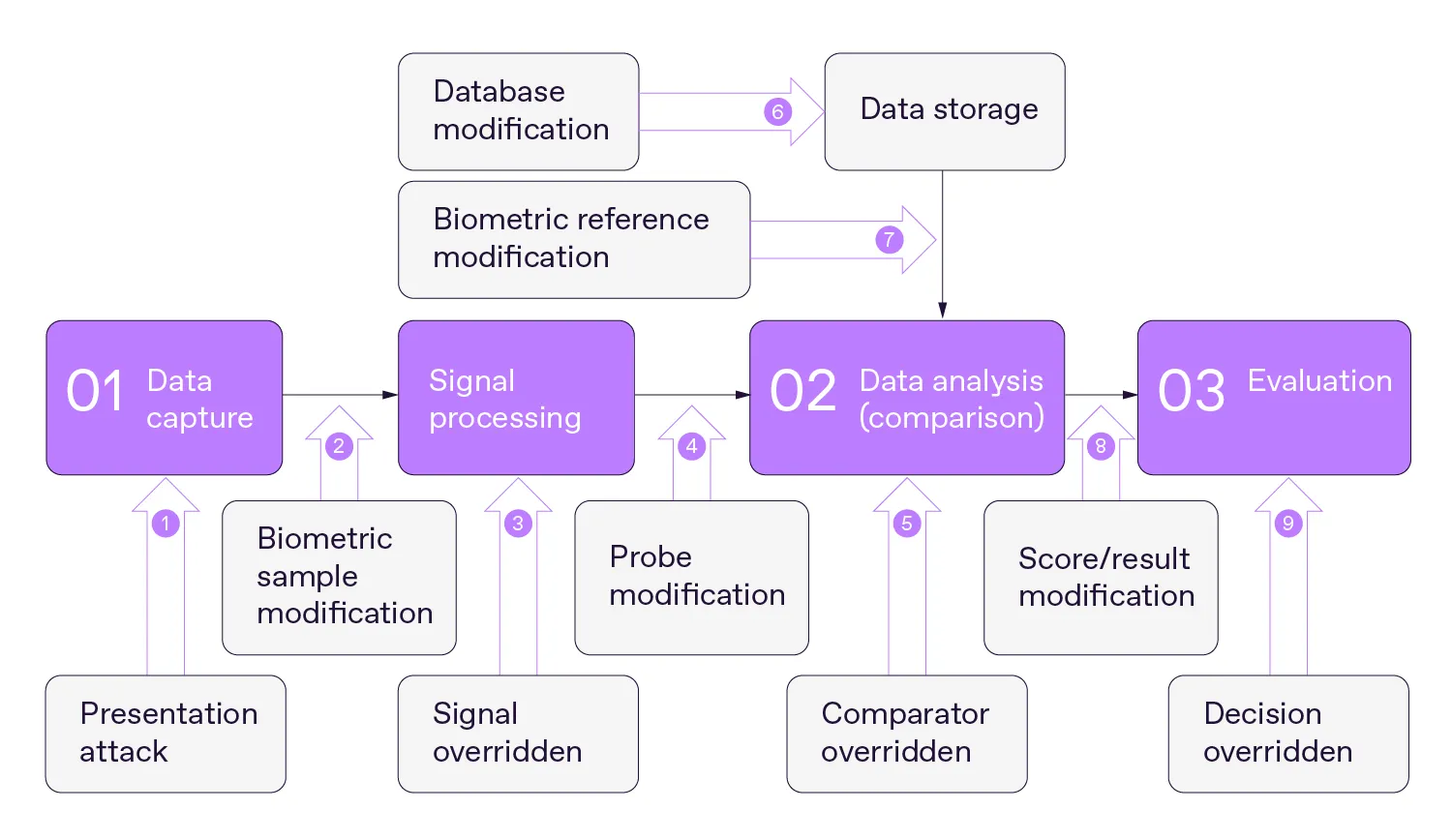
A map of potential deepfake attack points.
For deepfakes, these attack points largely fall into two groups: presentation attacks and injection attacks.
-
Presentation attacks: a fraudster presents the system with a deepfake (photo or video) as if it were a real person via the camera. The rest of the verification process works as usual (Point 1 in the diagram).
-
Injection attacks: a fraudster uses manipulated media that bypasses the camera capture and is inserted into the video stream to replace the real selfie within the flow (virtual camera, deepfake injection), before it reaches the system’s analysis stage (Points 2, 4, and 7).
Presentation and injection attacks share some detection mechanisms, but each also requires attack-specific controls.
Get posts like this in your inbox with the bi-weekly Regula Blog Digest!
How are deepfakes used in presentation attacks?
A presentation attack happens at the point of capture: the camera captures fake identity evidence rather than the genuine face of the person being verified.
With deepfakes, this typically means showing an AI-generated or manipulated face image or video on a screen in front of the camera. The verification system receives it through the expected capture channel.

How are deepfakes used in injection attacks?
In an injection attack, manipulated biometric data is inserted into the verification flow digitally rather than presented to the physical camera. This can happen at different points between capture and analysis.
One option is to manipulate the camera feed. The physical camera may capture the real scene while the verification system receives a modified stream instead. For example, a real-time face swap can replace the face in a live feed before that feed reaches the verification software.
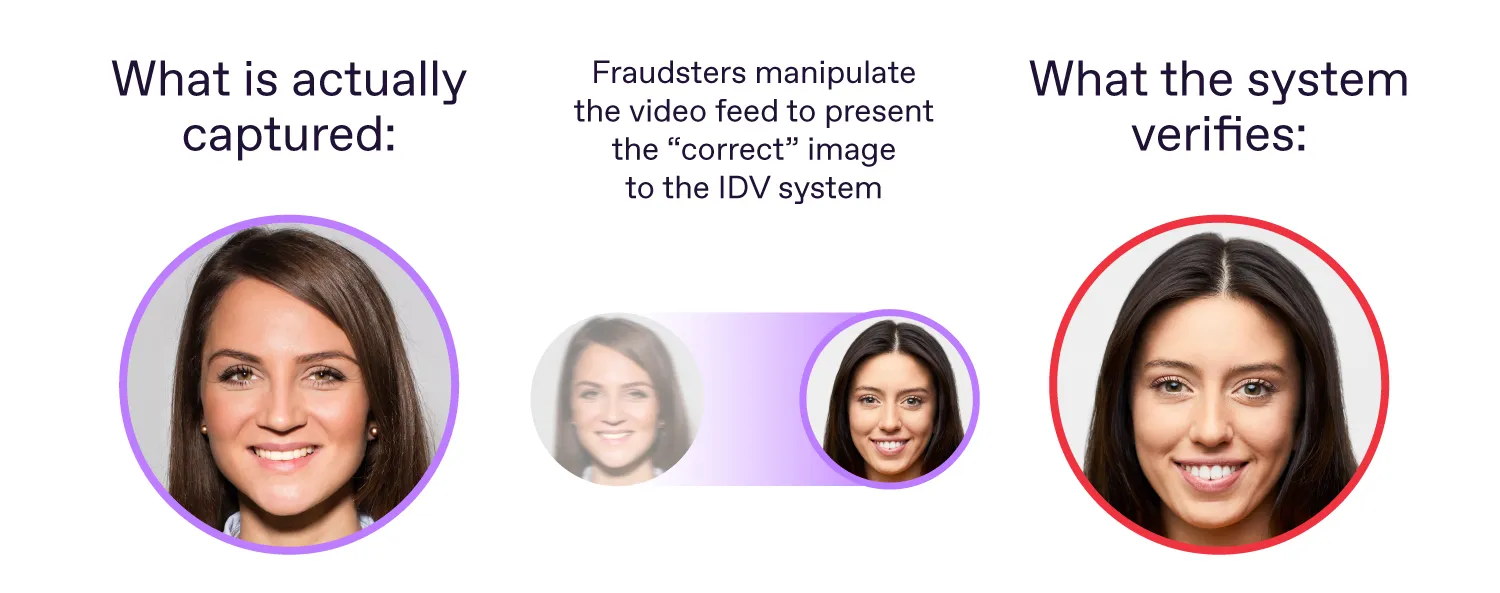
In a signal modification attack, fraudsters trick biometric verification software into seeing an injected image instead of the real one.
Another option is to modify or replace the biometric sample after capture. Here, the image or video is altered during transfer from the capture stage to the analysis stage.
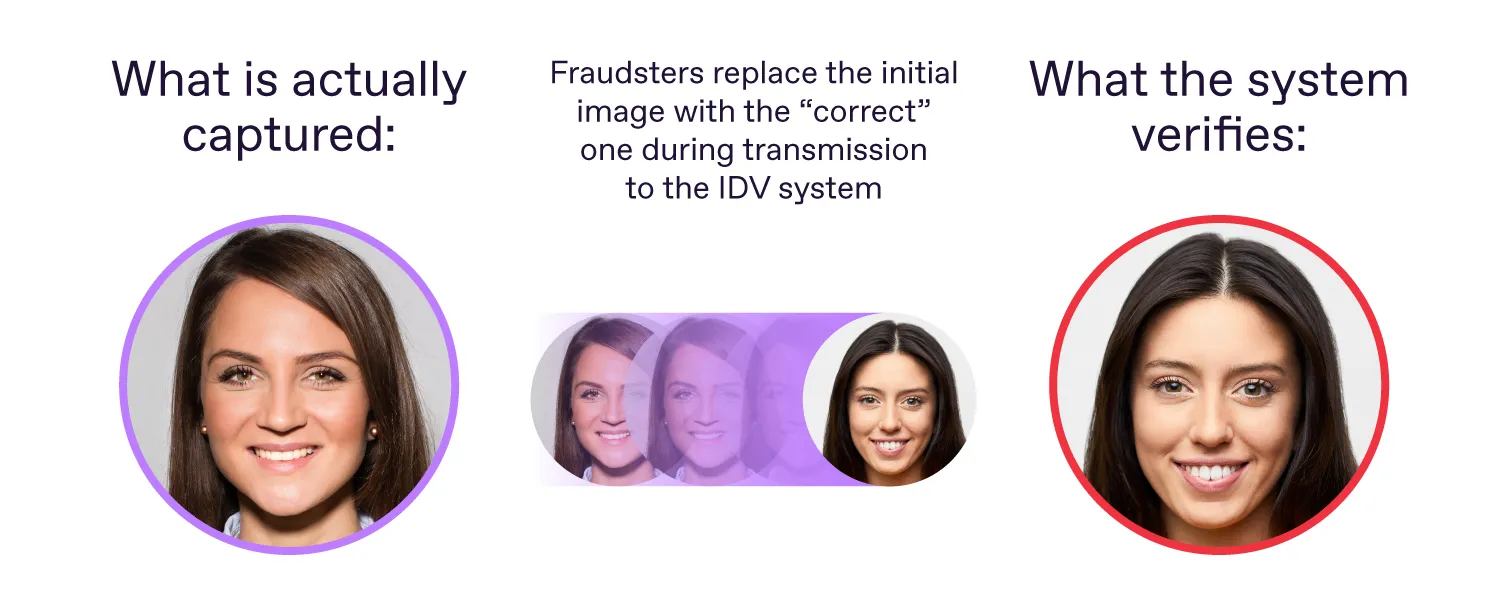
Biometric sample modification enables fraudsters to alter the presented image before it’s analyzed by the software.
How can identity verification systems detect deepfakes?
There's no single deepfake check that covers every attack path. That’s why identity verification systems typically rely on several layers of protection: liveness detection to identify presentation attacks, controls around the source of captured biometric data, and safeguards that protect data integrity between capture and analysis.
Liveness detection verifies that the camera sees a live person
When a deepfake is presented to the camera, the system typically sees a two-dimensional image or video rather than a live, three-dimensional face. Liveness detection can help identify that difference and reject the presentation before face matching takes place.
Liveness checks can be passive or active.
Passive liveness analyzes the captured sample without requiring the user to follow an explicit challenge and may use natural signals such as blinking or subtle facial movement.
Active liveness adds a challenge, such as turning the head or changing expression. For a deeper dive into the difference between the methods, read our guide on passive and active authentication.
Deepfakes may also introduce visual or behavioral inconsistencies, especially as the face moves: distorted details, unnatural transitions, or artifacts around features and accessories. Liveness checks also use these signals as additional evidence that the camera is seeing synthetic or replayed media instead of a live person.
Mobile-enabled verification can reduce the injection attack surface
Surprisingly, mobile devices provide better protection against injection attempts than desktop applications. Mobile apps can maintain tighter control over the camera and how the biometric sample is passed to the verification system.
But the device itself shouldn’t be treated as fully trusted. For higher-risk liveness checks, the final decision is safer to make server-side, inside the organization’s trusted infrastructure, rather than relying only on a result processed on the end user’s device.
Mobile operating systems also tend to offer stronger protection against unauthorized access and manipulation than desktop operating systems and browsers. Still, the verification system should validate the source and origin of the image or video rather than trust the device alone.
The same principle applies to hardware-controlled environments such as self-service kiosks with trusted cameras. Keeping capture inside a controlled environment reduces opportunities for substitution with a manipulated or virtual feed before the biometric sample reaches analysis.
Secure transmission protects biometric data from tampering
Secure transmission protects biometric data as it moves from capture to analysis. Encryption helps prevent interception, while integrity checks help verify that the image or video received by the verification system matches what was originally sent.
Trusted methods like Public Key Infrastructure (PKI) encryption, tamper-proof protocols, and real-time validation tools help mitigate deepfake risks, as well as more “conventional” threats. These measures align with the use of cryptographic hash functions, where unique data fingerprints are generated and verified to ensure the integrity of transferred data.
Can deepfakes be used to fake identity documents?
Yes, although the attack looks different from a biometric deepfake. AI-generated or manipulated document images can be used to fabricate or alter identity evidence, especially in remote verification flows where the system only sees a digital image of the document.
Standard authenticity checks, when document layout and the presence of security features are verified, are mainly designed for physical ID verification. During online flows, these can be enhanced with an active ID document liveness check that requires users to tilt the document in front of the camera to demonstrate dynamic security features such as holograms or OVI.
Biometric IDs with RFID chips offer an even more secure defense against deepfakes. In regions where electronic identity documents are prevalent, companies can use “biometric passport only” verification to defend against altered or fake IDs. This approach also enhances the customer experience, as NFC verification takes seconds.
CASE STUDY
UBS, the world’s largest private bank, requires customers in its mobile onboarding flow to use biometric passports. Using Regula’s solutions, their app reads the RFID chip and verifies its data on the server side, including checks for integrity, authenticity, and chip cloning. The portrait stored in the chip is then compared with the customer’s selfie.
This gives the bank a stronger source of identity data than a document image alone.
How can companies build more resilient deepfake defenses?
Deepfake generation will keep improving, and some of today’s visual cues used to detect deepfakes will become less reliable over time. Less likely to change is the need to integrate synthetic media into the verification flow. That makes the architecture of the flow itself a more durable line of defense: one that relies less on appearance alone and more on provenance, controlled capture, and data integrity.
Regula protects against deepfake attacks at three levels. Controlled capture helps prevent camera bypass and the injection of recorded or AI-generated media. Encryption and unique session keys help preserve data consistency and integrity. Multi-layered backend analysis then checks the collected data for deepfakes and other AI-generated content.
If you’re reviewing how well your current identity verification flow holds up against deepfake attacks, talk to our team.
.webp)
