
In brief: A smartphone is an excellent way to capture biometric evidence, but it should not be the sole source of truth when the same device may also be controlled by an attacker. In higher-risk age assurance, the device should capture the evidence while the final liveness, biometric and document verification decisions are made in a secure, independently managed server environment.
Age assurance is rapidly evolving into a regulated trust decision. Organizations are increasingly expected not only to determine whether someone meets an age threshold, but also to demonstrate that the result is reliable, resistant to spoofing and proportionate to the level of risk.
Many businesses now favor mobile-first, on-device age verification for convenience. But convenience has another side: when the final decision is made in a client-controlled environment, trust becomes harder to establish. In this article, we explain why.
What do on-device and server-side age checks mean?
On-device and server-side age verification are two different approaches to implementing age verification. The main difference lies in where the age assessment and related verification checks are performed: on the user's device or within infrastructure controlled by the organization.
The term on-device suggests a simple idea: biometric data remains on the user's device and is processed locally rather than being sent to a remote server. In practice, however, on-device is not a universally defined term and can refer to technically different approaches.
-
One interpretation is local biometric processing, where AI models running on a smartphone, tablet or laptop perform age estimation directly on the device.
-
In other contexts, on-device refers to digital credentials that are securely stored and presented from the user's device. In that case, the device acts as a secure wallet for trusted identity information rather than performing the biometric verification itself.
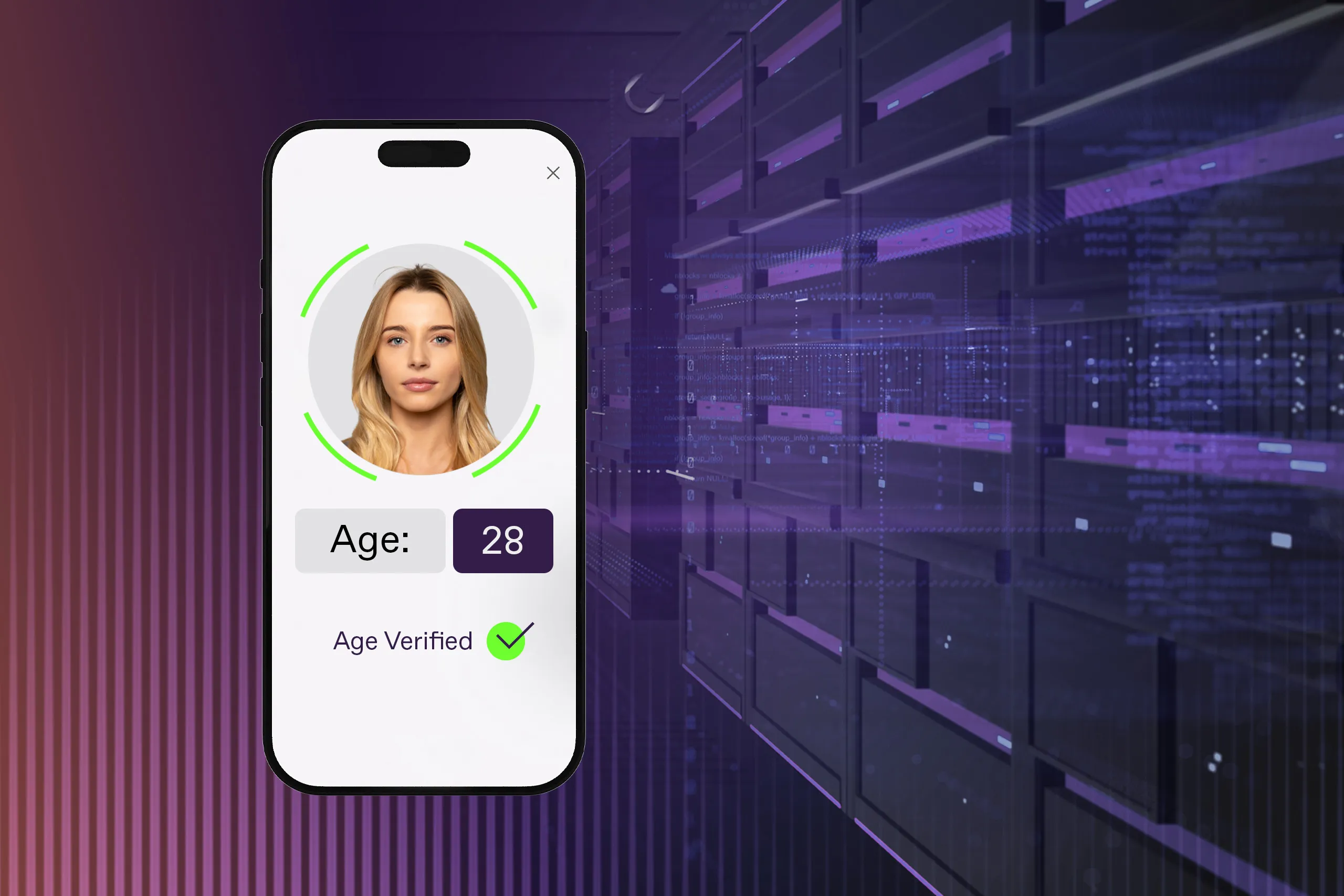
In a server-side flow, the user experience is largely the same. The user captures a selfie and/or identity document and receives the verification result within seconds. The difference lies behind the scenes: instead of being processed on the device, the captured data is securely transmitted to a server where age estimation, liveness detection, document authentication and other verification checks are performed.
Depending on the deployment model, that server may be operated by the verification provider as a cloud service or deployed within the organization's own protected infrastructure as an on-premises solution.
Looking to learn more about age verification? Explore our dedicated hub for key terms, regulatory guidance, common risks and implementation best practices.
Why on-device age checks are easy to like
The appeal of on-device age verification is easy to understand. The idea is simple and intuitive: biometric data stays on the user's device instead of being transmitted to a remote server. For many users, that alone is a compelling privacy benefit.
For organizations, however, the picture is more nuanced. Delivering reliable on-device verification across a diverse ecosystem of devices is far more complex than the concept itself suggests. More importantly, organizations need confidence that the verification result can be trusted. Whether an on-device solution delivers that assurance depends not only on the AI model, but also on how the entire verification process is implemented. Let’s see what it means in practice.
What critical issues does on-device age verification have?
On-device age verification promises a simple user experience, but delivering reliable verification entirely on the user's device introduces several technical and security challenges. These extend beyond AI accuracy and affect the overall trustworthiness of the verification result.
1. A client-controlled environment is harder to trust
Unlike a server, the user's device is outside the organization's control. Some devices may be rooted, run modified software or execute the application inside an emulator.
As a result, attackers do not necessarily need to defeat the age-estimation model itself. Instead, they may attempt to manipulate the verification process before the final decision is made. Common attack techniques include:
-
Digital injection: prepared images or video inserted directly into the capture pipeline.
-
Result tampering: modification of the application, verification responses or local decision logic.
-
Replay and session abuse: reuse of previously captured media when sessions are not cryptographically bound.
-
Model and rule extraction: analysis of locally stored models and thresholds to optimize future attacks.
2. Liveness becomes more difficult to establish independently
Estimating how old a face appears is only one part of age assurance. A robust verification process must also establish that the biometric sample originates from a genuine, live interaction rather than a printed photo, injection, replayed video or synthetic media.
While on-device liveness detection is technically possible, it is more challenging to establish the same level of independence when capture, analysis and the final decision all occur within the same client-controlled environment. This is partly due to the computing resources available on the device, which can limit the number and complexity of neural network models that can be run simultaneously for liveness and fraud detection.
3. Verification capabilities vary across devices
Different devices provide different processing capabilities, hardware acceleration, memory and support for specific AI operations. When verification is performed on-device, the analysis must therefore be adapted to a highly diverse technical environment rather than a standardized processing infrastructure.
To maintain broad device compatibility, on-device models may need to accommodate less capable hardware and different operating-system constraints. As a result, the complexity of the analysis that can be performed may vary from device to device, and the level of confidence in the verification result becomes dependent on the device on which the analysis was performed.
4. Resource constraints limit what can run locally
Running AI models directly on a device, particularly a smartphone, requires them to be lightweight and fast enough to operate within limited processing power, memory, battery and application-size constraints. This often means optimizing or compressing models for mobile deployment, which can limit model complexity and potentially affect verification accuracy and robustness.
The trade-off becomes even more significant for higher-assurance biometric verification. While age estimation can often be optimized for mobile devices, sophisticated liveness detection and fraud analysis may require more computational resources and continuously updated decision logic. Delivering these capabilities locally while maintaining speed, consistency and high verification performance across different devices introduces additional engineering challenges.
Get posts like this in your inbox with the bi-weekly Regula Blog Digest!
Is server-side age verification more reliable?
In short, yes. The architectural advantage of server-side verification is straightforward: it separates evidence capture from the final verification decision. The user's device captures the face and/or identity document, while the organization performs liveness detection, biometric verification and document authentication within the infrastructure it controls.
This architectural separation delivers three key advantages.
1. Independent verification
Instead of relying on a client-generated pass/fail result, the organization evaluates the submitted media using centrally managed models, fraud controls and decision logic that remain outside the user's control.
Every verification session is assessed consistently across devices, applications and channels, while models, fraud controls and security policies can be updated immediately without relying on application updates.
2. Better fraud detection
Because analysis takes place on the server, the verification process can combine signals that are difficult or impossible to evaluate reliably on the device alone, including:
-
unique, short-lived verification sessions
-
independent validation of submitted media
-
cross-session analysis of biometric, document, device and behavioral signals
-
replay and injection detection
-
centralized fraud rules and AI model updates
-
consistent audit logs across every verification channel
3. Stronger liveness assurance
For liveness in particular, this matters more than a local pass/fail flag. A trustworthy liveness decision must establish that the evidence came from a real interaction for this session and that neither the media nor the result was substituted on the way to the verifier.
Regula's liveness detection is built around this principle. The user's device captures the biometric data, while liveness analysis is performed on the server in the customer’s secure environment using unique session parameters. This enables the verification process to identify presentation attacks, replayed video and digital injection attempts, including those involving deepfakes, while preserving audit-relevant verification records.
4. Built for trust and auditability
Server-side architecture may appear more traditional than an edge-only approach, but for regulated and higher-assurance use cases that independence is precisely the advantage. The device provides a convenient way to collect evidence; the server provides the controlled environment where that evidence can be validated, correlated with other fraud signals and translated into a verification decision that organizations can defend.
Independent testing reinforces this approach. Regula was named the #1 performer in NIST's Age Estimation evaluation, demonstrating strong performance across age-estimation use cases.
Why server-side doesn’t necessarily mean sacrificing privacy
On-device processing has an intuitive privacy advantage: if biometric data never leaves the device, there is less information to transmit. However, privacy is determined by the entire data lifecycle — not simply by where AI models run.
In a well-designed server-side architecture, biometric data is transmitted only through an encrypted session, processed within a controlled verification environment and governed by strict data-handling policies. Organizations can minimize the data collected, define retention periods, restrict access based on operational roles and deploy processing entirely on premises to meet regulatory requirements.
Just as importantly, server-side processing does not mean every biometric sample must be permanently stored. Depending on the deployment and business requirements, biometric data may be retained only for the duration of the verification session or deleted immediately after the verification decision has been made.
In other words, choosing server-side verification does not require compromising privacy. It requires implementing technical and organizational controls that protect biometric data throughout its lifecycle while enabling independent verification.
Is using verifiable credentials a good compromise in age verification?
Potentially, yes, but only where the necessary ecosystem already exists. The term on-device is sometimes used to describe a different approach from local AI processing. Instead of running biometric analysis on the user's smartphone, the device acts as a secure wallet that stores and presents Verifiable Credentials (VCs) or another trusted digital identity credential.
A good example is a mobile driver's license (mDL) stored in Apple Wallet or another digital wallet. Once the credential has been issued by a trusted authority, the user can prove age or another attribute — such as being over 18 or over 21 — without repeatedly presenting a physical identity document or undergoing full identity verification.
This approach offers significant advantages. It minimizes the amount of personal data shared during each transaction, reduces friction for returning users and enables privacy-preserving age verification.
However, Verifiable Credentials are not yet universally available. Their adoption depends on a broader digital identity ecosystem, including government-issued digital credentials, trusted issuers, compatible digital wallets and relying parties capable of verifying those credentials.
Just as importantly, a Verifiable Credential is only as trustworthy as the identity proofing performed before it was issued. Before a credential can be trusted, the issuer must establish that the applicant is genuinely who they claim to be and that the supporting identity evidence is authentic.
This is where high-assurance identity verification remains essential. Solutions such as Regula Document Reader SDK and Regula Face SDK support the identity proofing process by verifying document authenticity, performing biometric face matching and confirming liveness before a credential is issued.
Once that trust has been established, a Verifiable Credential can be reused for future age checks with significantly less friction while preserving user privacy.
Which approach should a business use?
The right architecture depends on the level of assurance required. If the consequences of an incorrect decision are limited, organizations may prioritize speed, convenience and privacy. When age verification supports regulatory compliance, fraud prevention or access to age-restricted products and services, the priority shifts to independent verification, auditability and resistance to manipulation.
| Consideration | On-device age verification | Server-side age verification |
|---|---|---|
| Primary purpose | Perform verification locally | Perform verification in a controlled environment |
| User experience | Fast | Fast |
| Connectivity | Can support limited connectivity | Requires connectivity for verification |
| Privacy | Biometric data may remain on the device | Privacy protected through encryption, data minimization and governance |
| Verification environment | Client-controlled | Independently managed infrastructure |
| Fraud resistance | More susceptible to device compromise and local manipulation | Stronger fraud detection and cross-session analysis |
| Auditability | Limited visibility into the verification process | Centralized audit records and review evidence |
| Best suited for | Privacy-first and lower-assurance scenarios | Regulated and higher-assurance verification |
| Role in the verification architecture | Evidence capture and preliminary assessment | Independent verification and final decision |
When server-side verification makes the most sense
For organizations operating in regulated sectors, including gambling, financial services, telecommunications, regulated marketplaces and adult-content platforms, server-side verification provides a stronger foundation for age assurance. The device delivers a seamless user experience, while the server independently validates the submitted biometric and document evidence before a final decision is made.
In practice, higher-assurance age verification rarely relies on a single signal. Instead, it combines several verification methods that answer different questions.
| Question | How it is verified |
|---|---|
| Is the person old enough? | The date of birth is established from a verified identity document or, where appropriate, estimated using AI age estimation. |
| Is the identity evidence genuine? | Document authentication and liveness detection confirm that the document is authentic and that the biometric sample originates from a genuine, live interaction rather than a replay or injection. |
| Is this the legitimate document holder? | Face matching verifies that the live person matches the portrait stored in the identity document. |
Many organizations implement these checks as a risk-based or step-up verification workflow. A selfie-based age estimate can provide an initial assurance, while users whose estimated age falls close to the required threshold, or whose transaction presents a higher fraud risk, can be seamlessly escalated to document authentication, liveness detection and face matching. This allows organizations to balance user experience with the level of assurance required for regulated environments.
Final thoughts
Some ideas sound compelling because they are simple. "Your biometric data never leaves your device" is one of them. For many users, that promise addresses an important concern about privacy. But for organizations, it raises another question that is just as important: can the verification result itself be trusted?
The answer depends less on where AI models run than on how the verification process is designed. Age estimation is only one part of age assurance. In regulated environments, organizations also need confidence that the evidence is genuine, the interaction is live and the final decision can withstand fraud attempts, audits and regulatory scrutiny.
At Regula, we believe evidence capture and trust-critical verification should remain separate. Mobile devices provide an excellent way to collect biometric and document evidence, while independently managed server-side verification provides the level of control, consistency and fraud resistance required for higher-assurance use cases.
That said, technology continues to evolve. We also support architectures built around Verifiable Credentials, where trusted identity proofing is performed once and the resulting credential can be reused for future age checks with greater privacy and convenience.
There is no single architecture that fits every business. The right approach depends on your users, regulatory obligations and fraud risk. Whether your priority is privacy, user experience, regulatory compliance or a combination of all three, the goal should remain the same: choosing an architecture that delivers the level of assurance your business actually needs.