
In brief: The infrared spectrum is widely used in forensic examination, from verifying the authenticity of identity documents and banknotes to analyzing handwritten notes and examining evidence at crime scenes and laboratories.
A cheque for $21,000 turned out to have a different story to tell. Infrared luminescence revealed that the original amount was just $1,000. The alteration was difficult to spot under incident white light.
Like checking UV luminescence, infrared (IR) examination is a routine part of many banknote and identity document authenticity checks. It helps experts detect alterations and verify security features that are invisible to the naked eye. IR examination is also widely used to analyze handwritten notes, distinguish between pen inks, and reveal changes to original content.
To effectively examine evidence in the IR spectrum and interpret the results correctly, forensic experts need to understand how infrared radiation interacts with different materials. This includes the principles of IR transparency, absorption, and luminescence, which we'll explain in this article.
What is IR radiation, and how is the IR spectrum divided?
IR radiation is a type of electromagnetic radiation with wavelengths longer than those of visible red light. According to ISO 20473:2007, infrared radiation starts at 780 nm and extends to 1 mm (1,000,000 nm). However, some scientific sources place the boundary between visible light and infrared radiation at approximately 700 nm. Both definitions are acceptable, as the transition between visible and infrared radiation is not a sharp physical boundary.
Forensic document examination typically uses the near-infrared (NIR) range, particularly wavelengths between approximately 700 and 1000 nm. Common illumination wavelengths include around 780, 850 and 950 nm, although the exact range depends on the equipment and examination task.
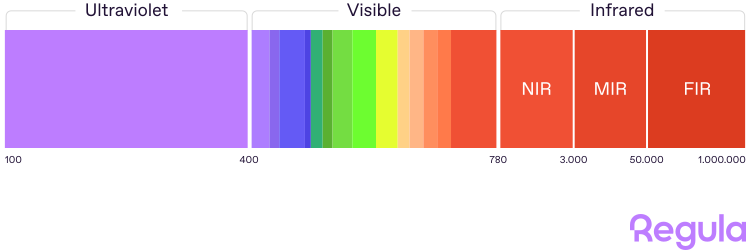
ISO 20473:2007 also divides near-infrared (NIR) into two sub-bands: IR-A (780 – 1400 nm) and IR-B (1400 – 3000 nm).
The human eye can detect light at wavelengths of approximately 380–780 nm, meaning infrared radiation falls outside the visible spectrum and cannot be seen directly. However, specialized cameras and sensors can detect certain IR wavelengths and turn them into images that forensic experts can examine on a screen.
Subscribe to receive a bi-weekly blog digest from Regula
How is the IR spectrum used in forensic document examination and crime scene investigation?
Infrared techniques are used in forensic examination for a variety of purposes, including:
-
Authenticity verification: Examining IR security features in identity documents, banknotes, and other security-printed materials.
-
Handwritten text analysis: Differentiating inks, identifying additions and alterations, and revealing obscured or original document content.
-
Crime scene investigation: Detecting and examining evidence such as bloodstains and gunshot residue.
In forensic document examination, infrared spectrum helps experts check IR security features and detect differences between inks that may look identical under normal lighting. For example, two blue inks may appear the same to the naked eye, but one may absorb infrared radiation while the other allows it to pass through and reflect off the underlying substrate.
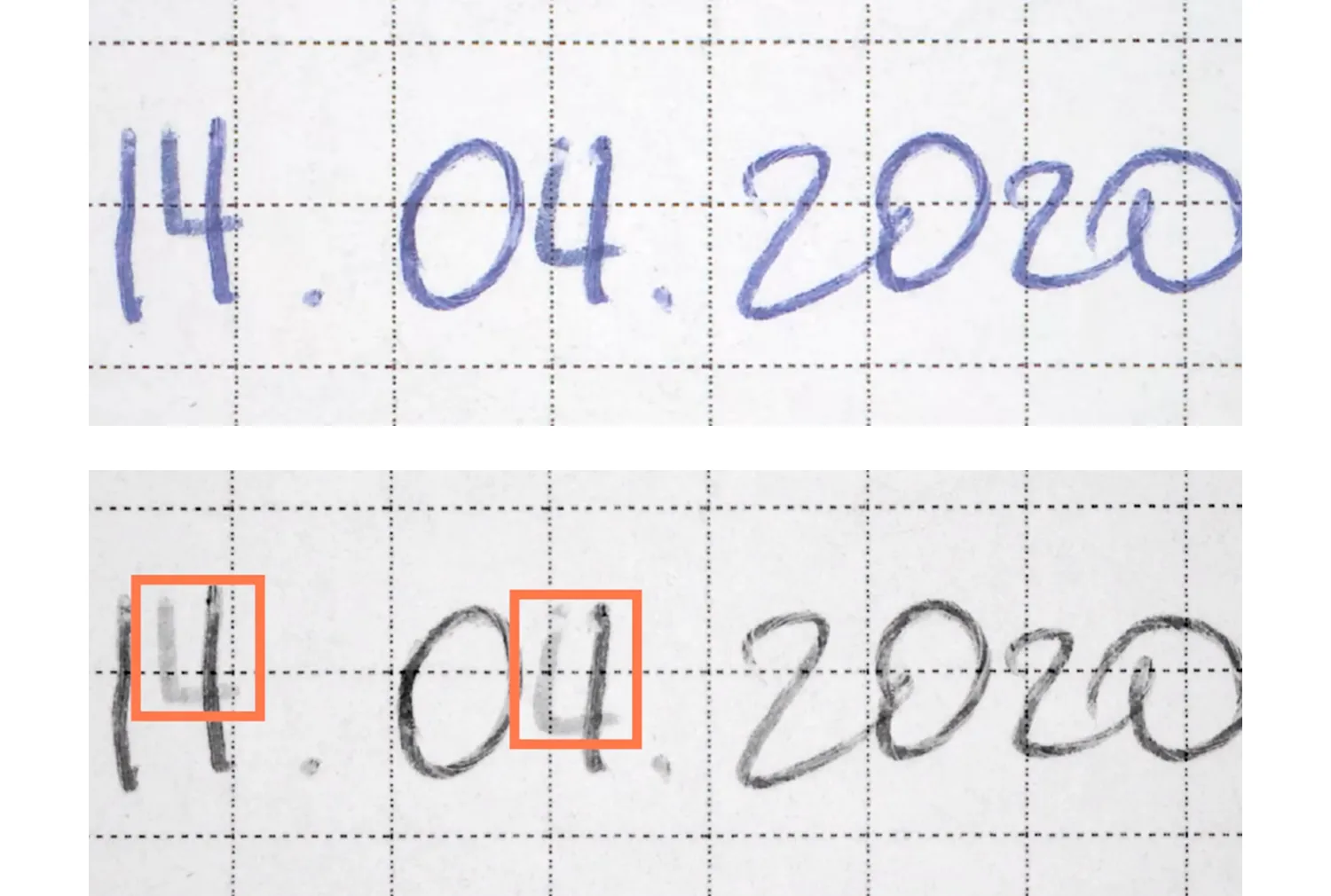
Example of addition to the original content of the document using another blue pen.

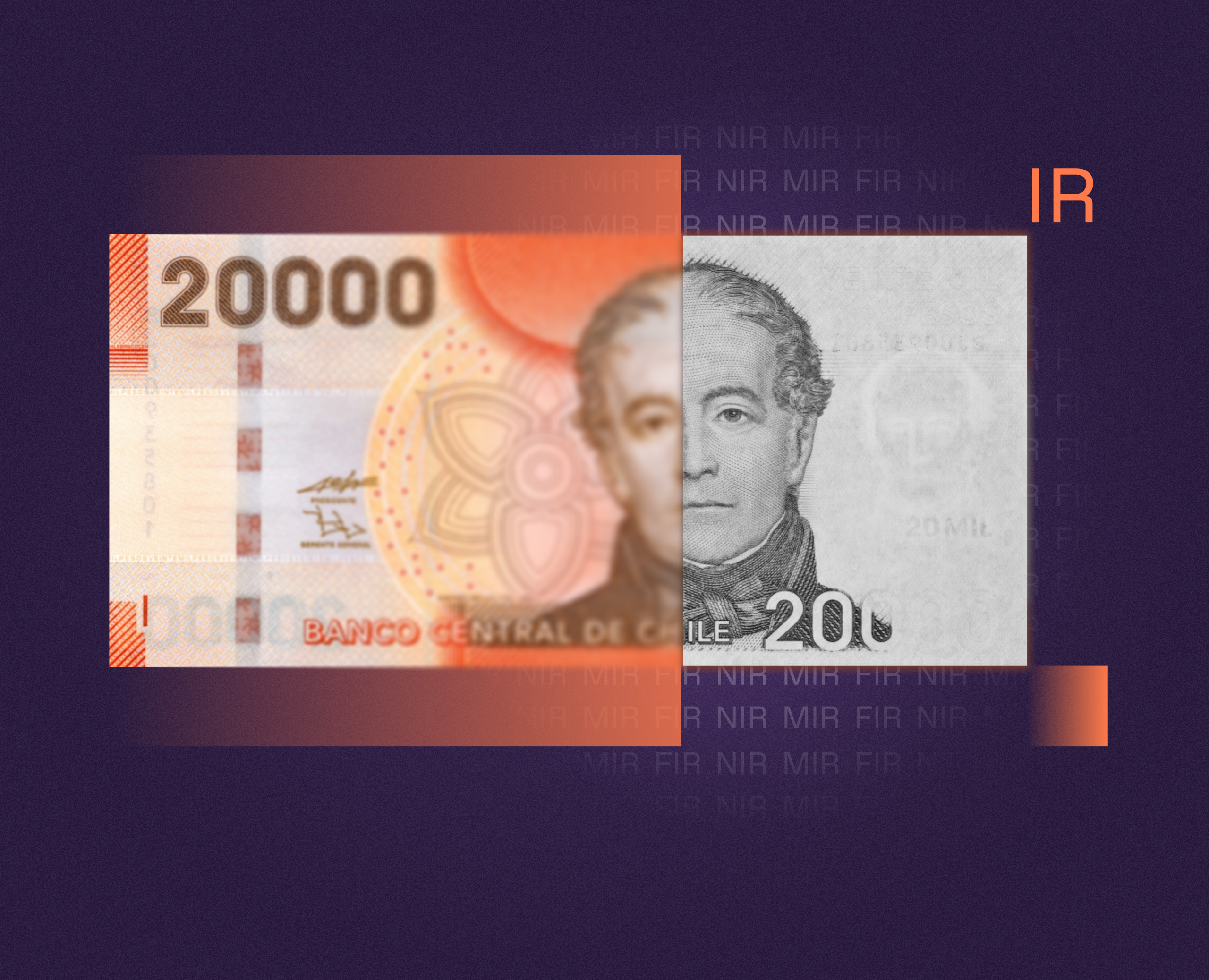
Chilean peso under incident white light and IR light.
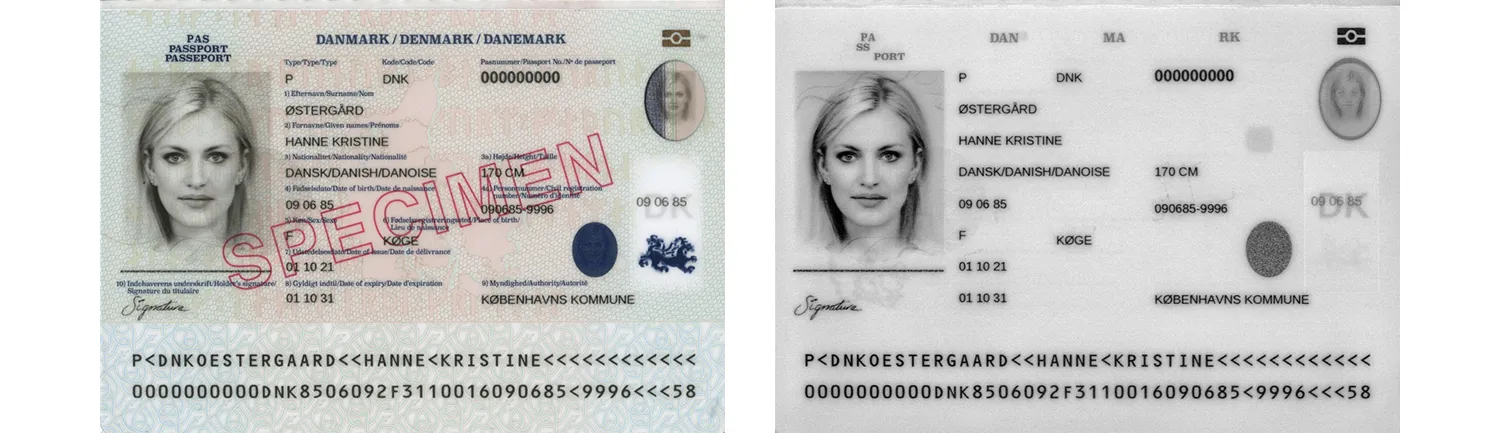
Danish passport data page under white light and IR illumination. Under IR light, key elements such as the holder's portrait, secondary portraits, personal data, and MRZ remain visible. According to ICAO Doc 9303, the MRZ must be machine-readable under near-infrared illumination. However, most letters in the inscriptions “PAS PASSPORT PASSEPORT” and “DANMARK DENMARK DANEMARK” disappear. The remaining letters form the words “PASSPORT” and “DANMARK.”
Beyond document and banknote examination, infrared imaging is also used in crime scene investigations and laboratory examinations. For example, it can help to find bloodstains and examine gunshot residue under suitable conditions.
IR imaging can help to detect bloodstains on dark clothing that are difficult to see under normal lighting. Under IR lighting bloodstains may appear darker than the surrounding fabric, making them easier to identify. The image was taken with the help of Forensic Light Kit Regula 3116M.
IR lighting helps to visualize gunshot residue patterns that may be difficult to detect under white light, particularly on dark surfaces. The image was taken with the help of Forensic Light Kit Regula 3116M.
IR-sensitive cameras capture the object’s response, while optical filters help isolate the wavelengths needed for examination. Depending on the setup, this allows experts to observe reflected infrared radiation or infrared luminescence without interference from unwanted light.
What is the difference between IR absorption, IR transparency, and IR luminescence?
There are two main ways infrared radiation is used in forensic examination. The first involves illuminating an object with IR light and observing how different materials absorb or transmit it – IR absorption and IR transparency. The second is IR luminescence, where narrowband light sources excite certain materials, causing them to emit radiation in the infrared spectrum.
IR absorption and IR transparency
Let’s take as an example a Chilean peso banknote. Under IR illumination, only part of the portrait remains visible, while the rest disappears. This happens because different parts of the design have different infrared properties. Areas printed with IR-absorbing inks remain visible, while IR-transparent inks allow infrared radiation to pass through and reflect off the underlying substrate, making these areas appear lighter.
Inks that look similar under visible light but respond differently to infrared radiation are called IR metameric inks. They allow document manufacturers to create designs that change their appearance under IR illumination without looking different to the naked eye.
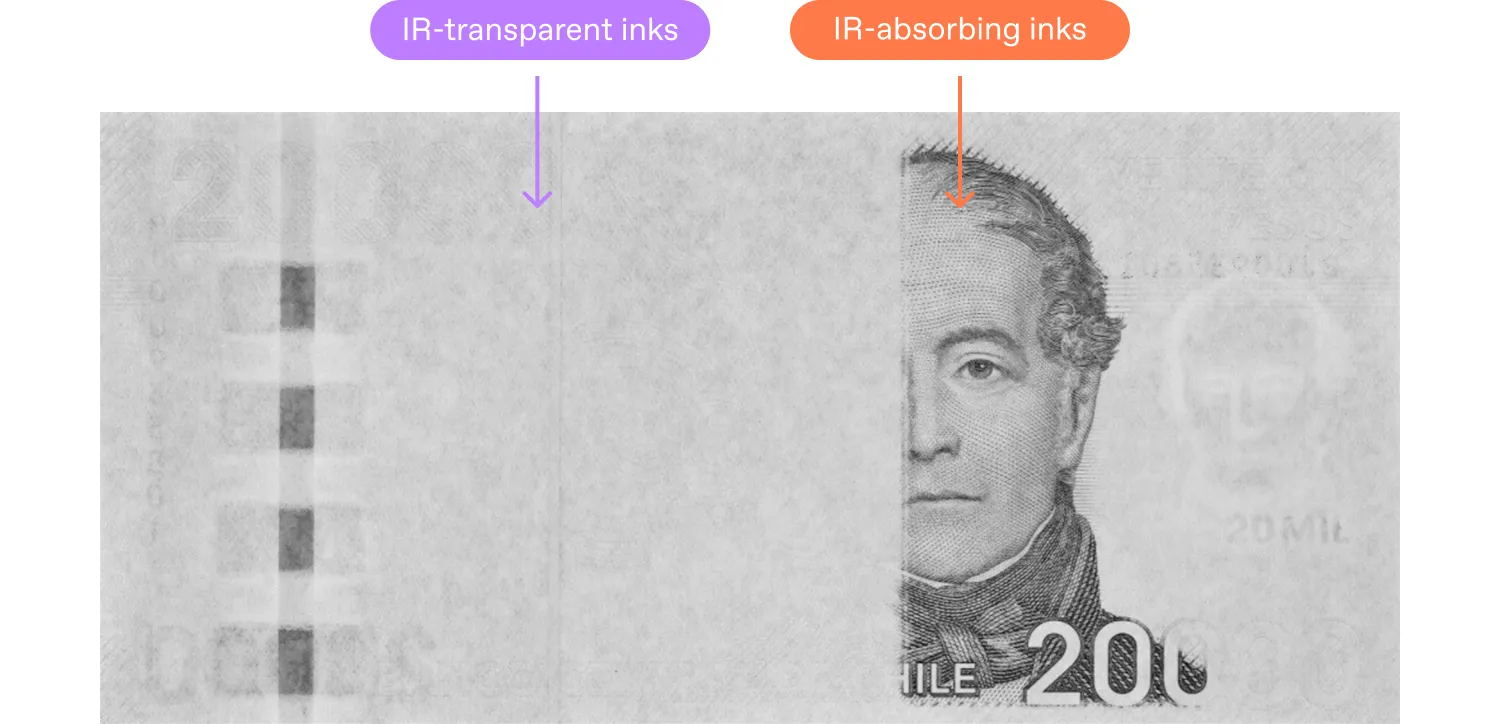
Chilean peso. The banknote contains IR metameric inks.
This effect is an intentional security feature. By checking which parts of the design remain visible under infrared light, forensic experts can compare a questioned banknote with the expected IR pattern of a genuine one.
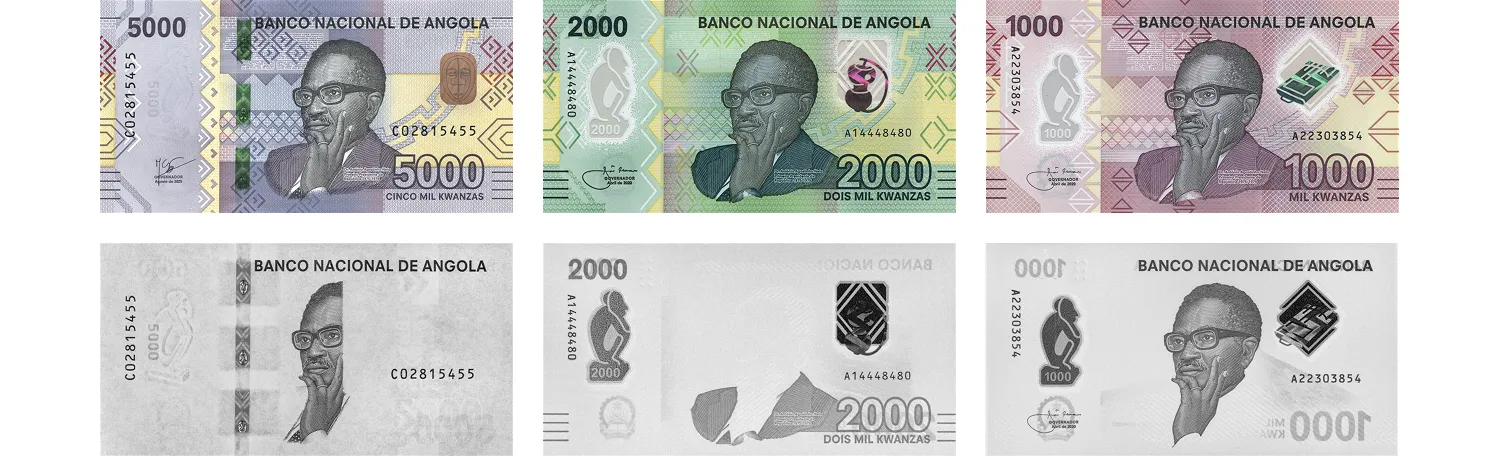
Angolan kwanza banknotes of different denominations. The parts of the portrait that disappear under IR illumination vary by denomination, making the banknotes more difficult to counterfeit.
IR luminescence
IR luminescence occurs when certain materials absorb visible light of a particular wavelength and then emit infrared radiation.
For example, when a document is illuminated with blue or green light, certain inks/materials may emit infrared luminescence. According to the SWGDE Guideline for the Use of Infrared Radiation (IR) in Forensic Science, blue-green illumination at approximately 450–550 nm is commonly used to excite IR luminescence. However, the required wavelength depends on the properties of the material being examined.
Although the emitted infrared radiation is invisible to the human eye, an IR-sensitive camera can detect it. Special filters block the visible illumination while allowing the emitted infrared radiation to reach the camera.
As a result, inks that look similar under white light may luminesce differently, with some appearing brighter against a dark background. This helps forensic experts reveal security features and examine document alterations that are difficult to detect under white light.

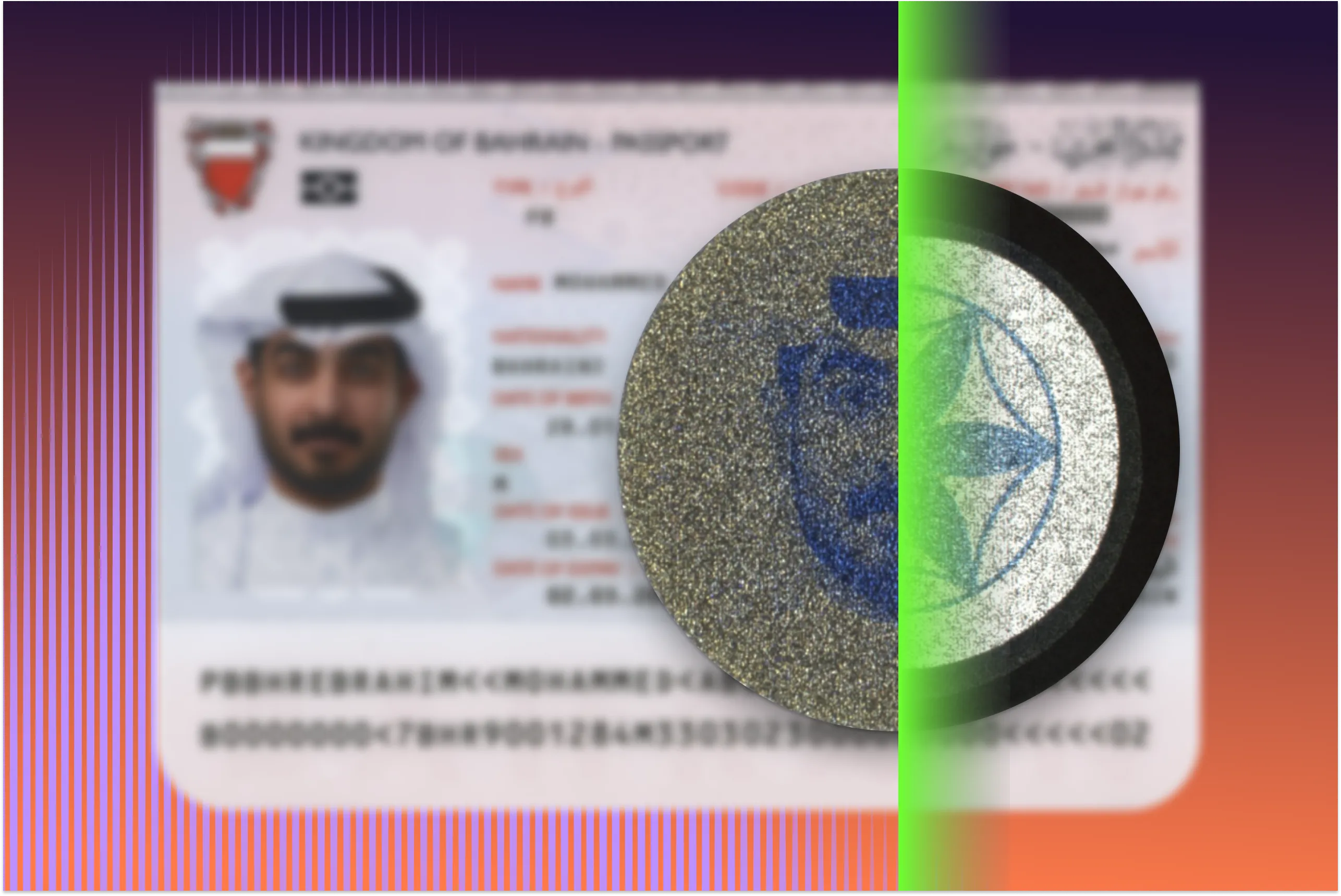
Finnish passport under different lighting conditions. The third image shows infrared luminescence.
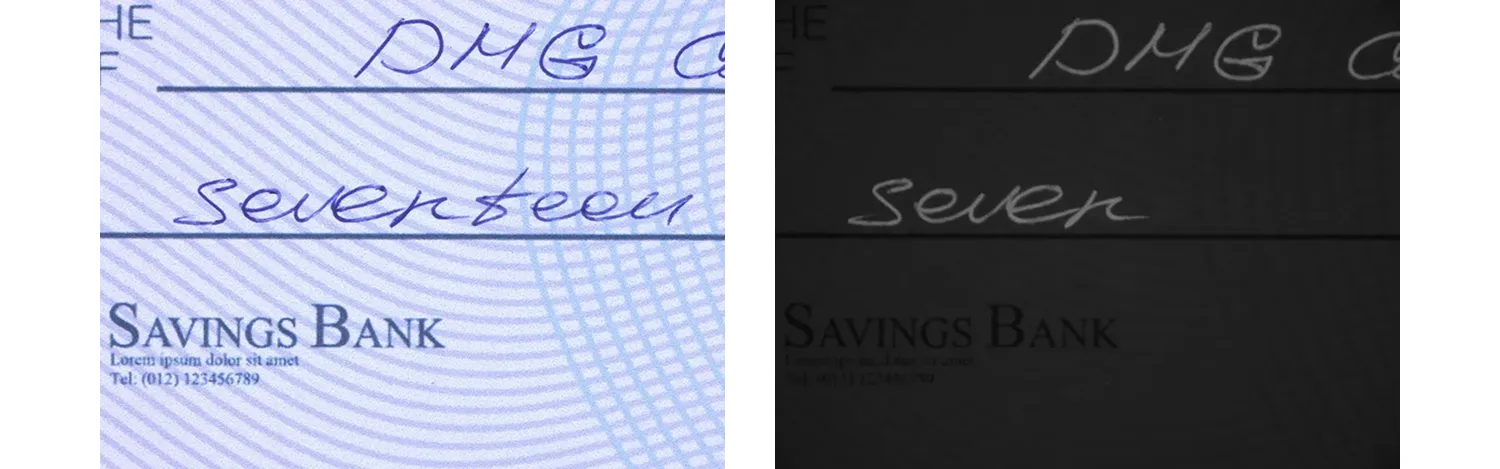
Illumination with green light at 530 nm reveals an addition to the original text on a bank cheque.
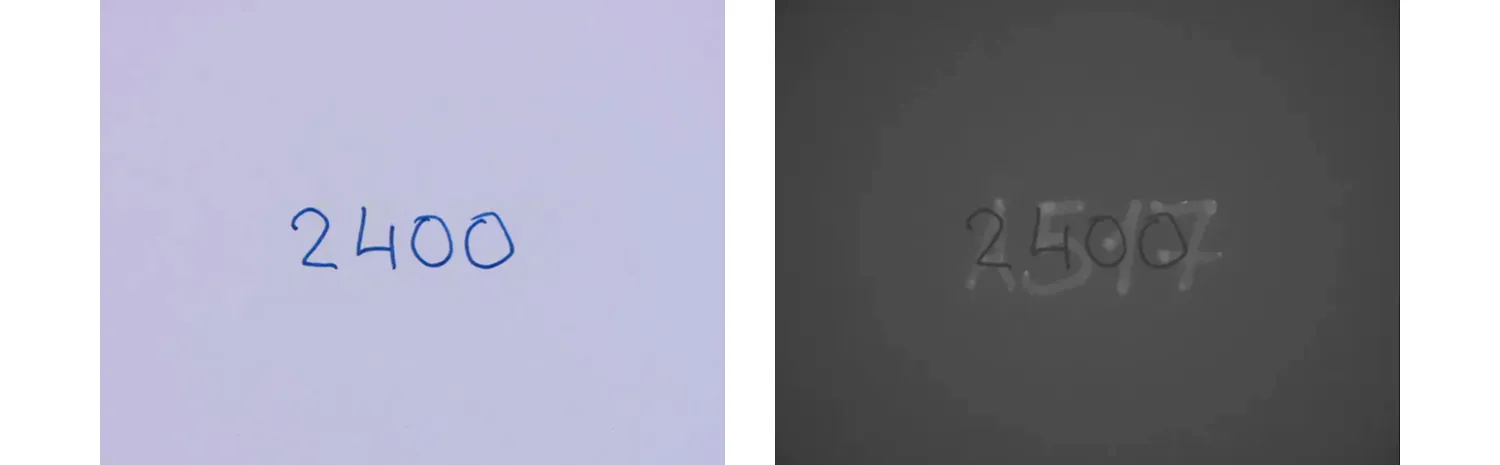
Illumination with blue light at 450 nm reveals the document's original content, which had been chemically erased and covered with new text.
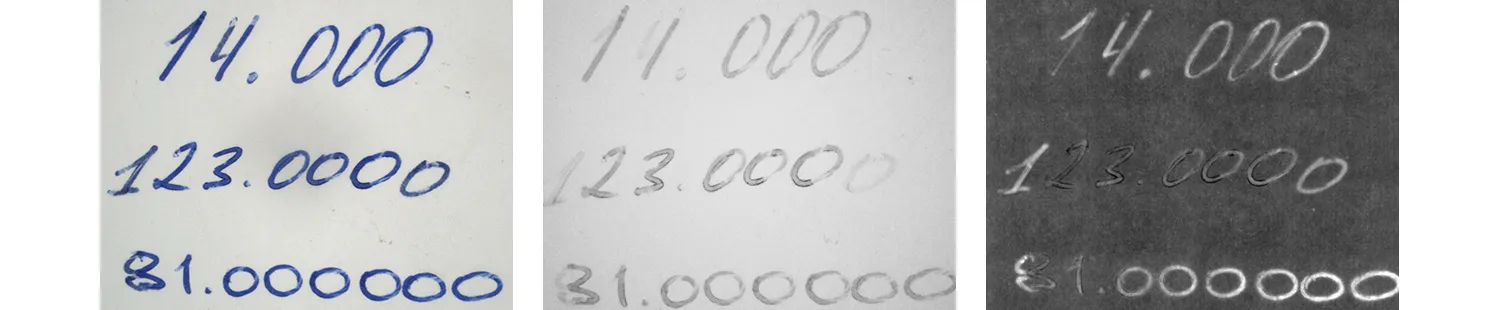
Numbers written with different ballpoint pens. Examination under 780 nm IR and 530 nm green light reveals alterations made with another pen, including changing 1 to 4, changing 3 to 8, and adding zeros.

Green light at 530 nm helps reveal crossed-out text. Differences in the luminescent properties of inks can make the original writing more visible beneath the crossing-out marks.
How Regula supports forensic examination in the infrared spectrum
Regula offers a wide range of solutions for various tasks, from quick authenticity checks at bank counters and border checkpoints to detailed document examination in forensic laboratories and evidence examination at crime scenes.
Comparing documents with genuine references
To check whether a banknote or identity document has the expected IR security features, examiners need a genuine specimen or reliable reference images. However, physical specimens are not always available. Even when they are, examining the genuine document under different IR wavelengths before checking a suspicious one can be time-consuming.
Information Reference Systems (IRS) offers a more convenient approach. This regularly updated database contains reference images of genuine identity documents and banknotes captured under different light sources and IR luminescence.
Experts can compare a questioned document with these images to check whether its security features and general appearance respond as expected.
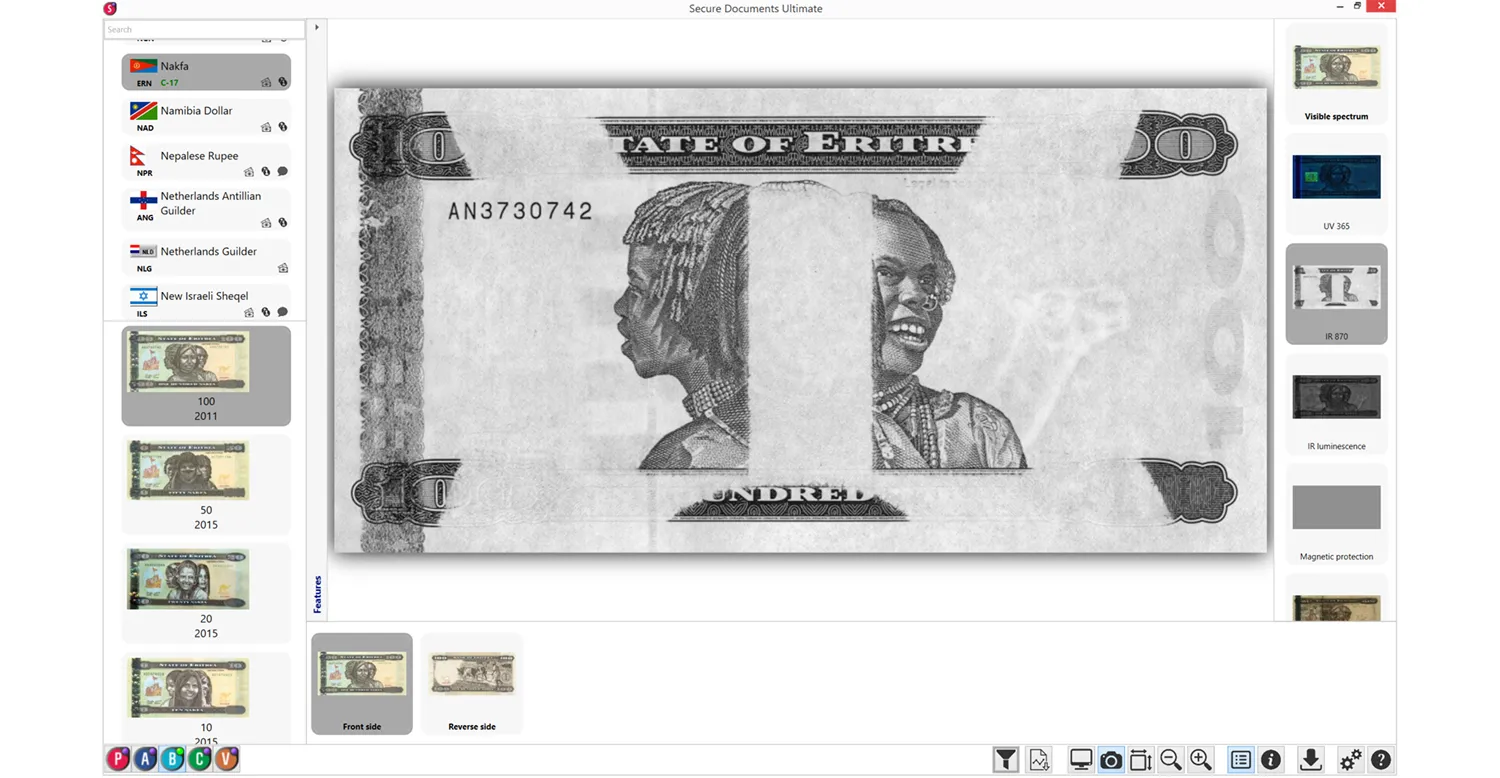
Information Reference Systems contains reference images and samples of banknotes and identity documents from around the world.
Express examination
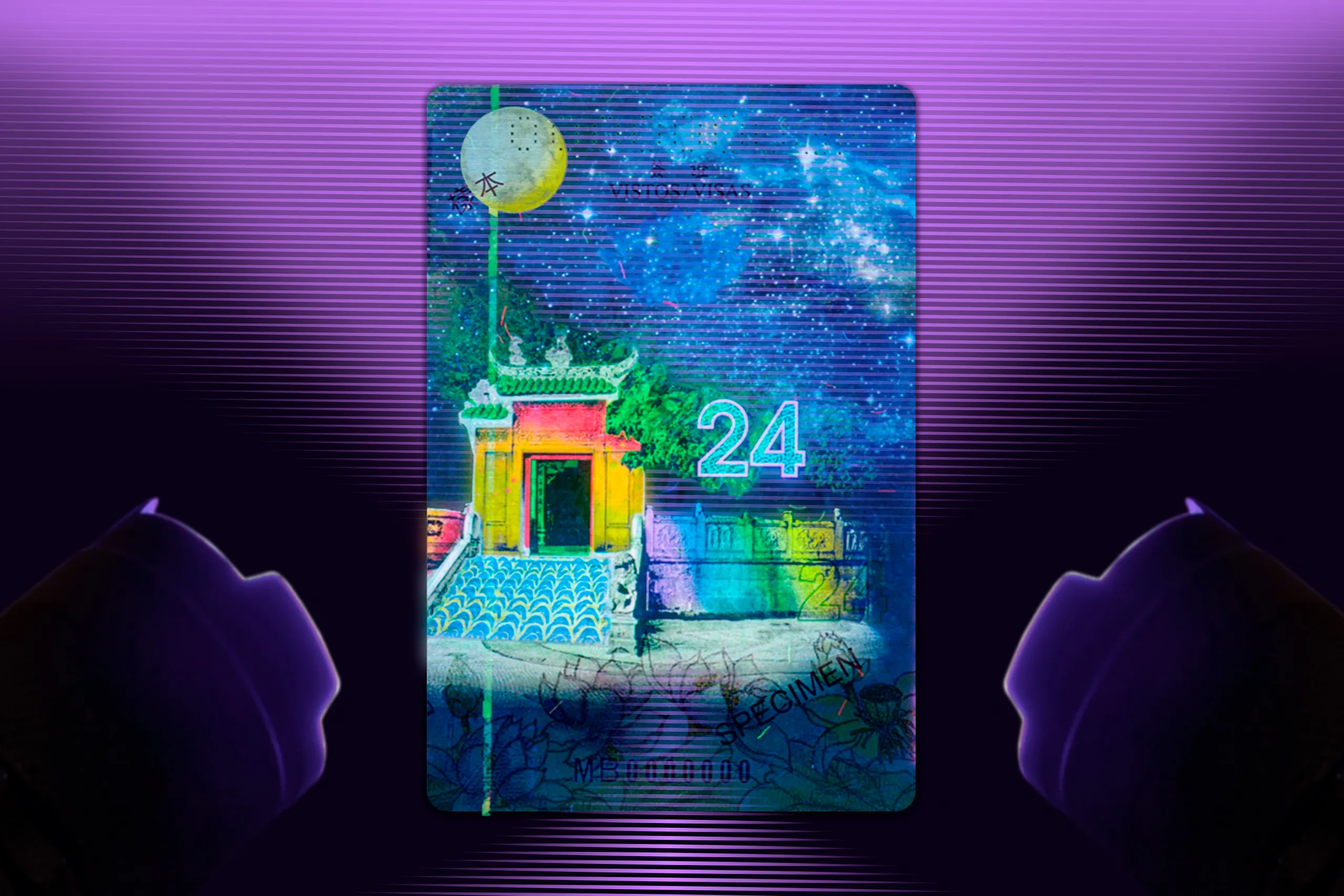
The Regula 4205D is a versatile document examination device designed for authenticity checks outside forensic laboratories. For border control and passport examination, the Regula 4205D helps officers inspect IR security features including IR luminescence on passport pages. It can also be used to examine entry and exit stamps, handwritten entries, and other document details for signs of alteration.
The device can also be equipped with an integrated IRS database, allowing users to compare questioned documents with genuine reference images during examination, directly on the device display.
Laboratory examinations
For more detailed forensic analysis, the Dual-Video Spectral Comparator Regula 4308M offers a wider range of illumination and imaging options.
The device provides IR illumination at 700, 780, 810, 850, 950, and 1030 nm, allowing experts to examine how security features and printing materials respond at different wavelengths.
In addition, the device offers over 4,000 combinations of narrowband light sources. Together with two filter turrets (whose filters can also be combined) this provides forensic experts with a wide range of illumination and observation options for examining objects at different wavelengths.
Document examination can also be supplemented with IRS reference images, allowing experts to compare their findings with the expected security features of genuine documents.
Conclusion
Infrared light sources as well as narrowband light sources are valuable tools in forensic examination. They can help experts differentiate inks that appear identical under visible light, reveal altered or obscured writing, and recover original document content. These capabilities are particularly useful when investigating document alterations and determining how a document was modified.
For authenticity checks, examiners also need to compare a document's infrared response with that of a genuine specimen. Regula supports these tasks with Information Reference Systems and examination devices, ranging from equipment for routine checks at banks and border checkpoints to advanced systems for detailed forensic analysis.