
Data entry automation can be approached differently, depending on the type of technology that helps populate the data fields. And that’s exactly the line of thinking that feeds the NFC-versus-OCR debate in this matter. However, in practice, it’s rarely just one or the other that does all the heavy lifting.
While it’s important to distinguish between NFC and OCR in terms of their capabilities, they are not two versions of the same procedure. They are two ways of reading different layers of the same document.
So what does each one actually do, when does it make sense to combine them, and are there cases where only one of them is enough? Let’s take a closer look.

Subscribe to receive a bi-weekly blog digest from Regula
What OCR adds to data entry automation
Optical character recognition, or OCR, turns printed text on an identity document into structured output for data extraction. In ID verification, that usually means reading fields such as name, document number, date of birth, and expiration date from passports, ID cards, residence permits, driver’s licenses, and other documents.
That is why ID card OCR remains a standard part of customer onboarding. The user already expects to photograph the document, so OCR fits naturally into the first capture step.
OCR carries the broad intake layer…
The main value of OCR is reach: a business dealing with passports, local licenses, residence permits, and many formats of ID cards needs a method that still works when there is no readable chip. This reliable versatility is exactly why OCR verification remains a standard entry point in many onboarding processes.
A good example is desktop or cross-device traffic: for example, a user can upload a scan on a laptop, and then switch to a phone for a live selfie. OCR can still work in such a flow, but NFC will not, because it depends on a compatible mobile device and a readable chip.
… but image quality still decides a lot
OCR performs well when the capture is clean, but low resolution, blur, poor contrast, skew, and small text can all reduce extraction accuracy. While OCR gives the system a practical first pass across a very wide set of documents and devices, it still needs good capture design and sensible fallback logic.
What NFC adds when a chip is present
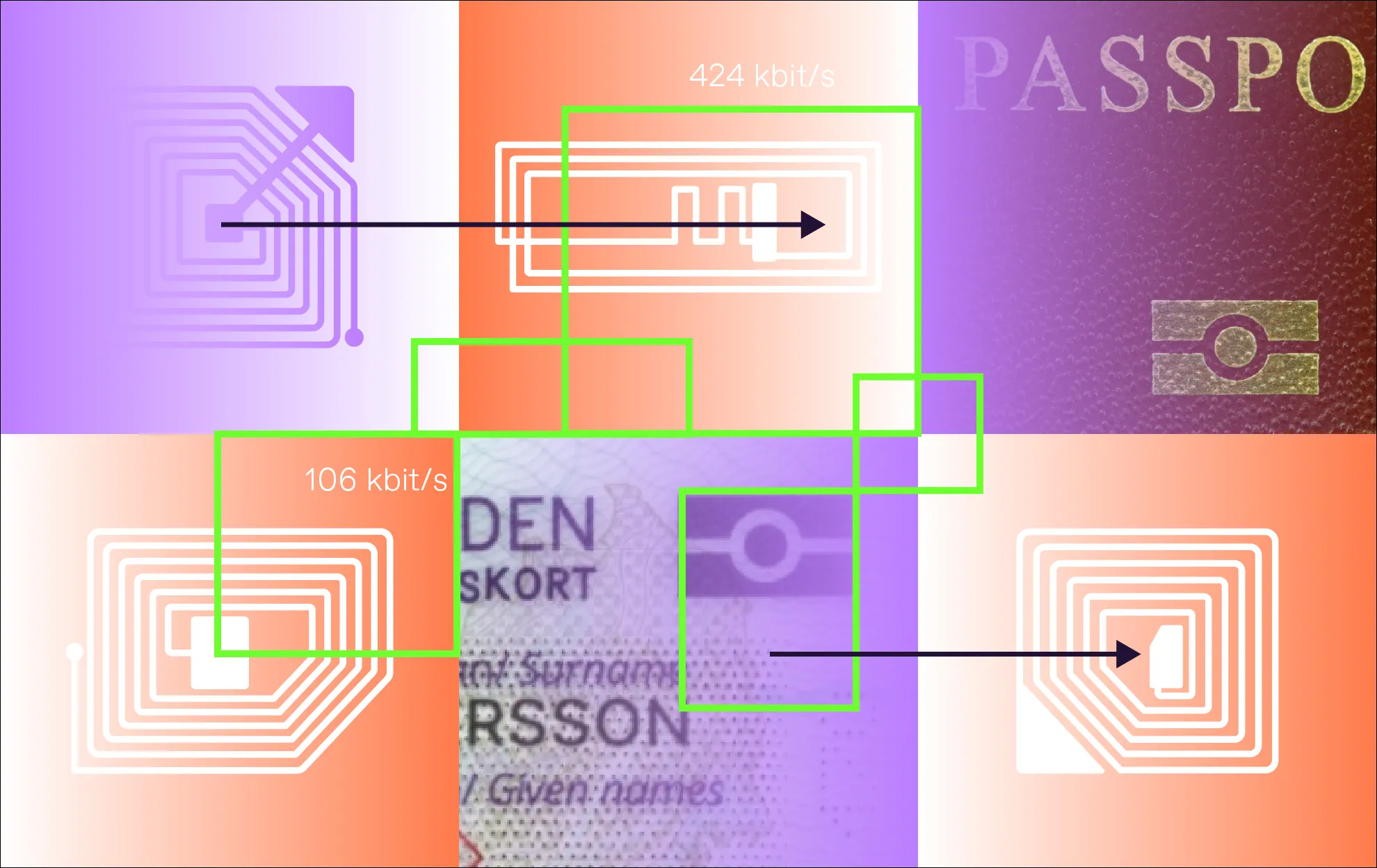
NFC works very differently: it reads chip data from an RFID chip embedded in certain electronic documents. When the verification system performs chip validation, it can verify the chip’s digital signature and confirm that the stored data has not been altered. Where chip authentication is supported, it can also help show that the chip data is not a copy.
That is why NFC verification can add a higher-confidence data source when the document supports chip reading and the chip data is properly validated against the printed or OCR’d data of the physical ID.
NFC adds a stronger second source…
If OCR gives breadth, NFC gives depth. Secure NFC verification can retrieve the holder’s personal data and, for many chip enabled identity documents, the biometric photo is also stored in the chip. The chip’s digital signature can then be validated, and the data read from the chip can be compared with the physical document. On top of that, reading the NFC chip, where available, is generally considered one of the leading best practices for ID document verification.
That is also why real-time NFC verification makes the most sense when the business has a concrete reason to ask for an extra action. In the case of a higher-risk bank account or a regulated service with tighter proofing demands, chip-backed confirmation will carry more weight than a photo alone.
… but can add friction too
NFC technology is conditional by nature, because:
The document has to carry a readable chip.
The phone has to support NFC technology.
The user has to complete the step correctly.
That means NFC can serve as a highly reliable source of document data where chip reading is available. At the same time, it still depends on document support, device compatibility, and correct user interaction, which is why many production flows pair it with clear guidance, fallback logic, and OCR where needed.
Why the hybrid model usually works best
Once you look at how document checks work in practice, the head-to-head framing becomes much less convincing.
OCR covers the broad capture layer across many document types and channels, while an NFC check adds chip-backed confirmation where the document and device support it. In most production systems, they work best as two connected parts of the same verification flow.
The strongest systems read the document twice in different ways
OCR ID verification does the first hard job well: it gets visible data off the document at scale and feeds it to the rest of the system. In many electronic documents, the MRZ is also read at this stage, since it often provides the access data needed to open the chip session.
NFC document verification then steps in where the document and device make it possible, giving the business a stronger source that can be checked against the printed record and OCR results.
A simple way to summarize the flow is this:
OCR reads the visible document fields first, including the MRZ where available.
The system uses that data to open the chip session if NFC is supported.
NFC then reads the chip and checks the chip data against the printed and OCR-collected data.
If chip reading cannot be completed, the flow falls back to the visual document path.
That sequence is much closer to how strong ID verification systems are actually built than any “OCR or NFC” debate. OCR-only flows are common when documents do not carry a readable chip, or the user’s device cannot support NFC. NFC-only flows are much less common, because the document still usually needs to be captured visually and checked as a physical object.
To summarize the inner workings of each technology, we have compiled the following table:
| OCR | NFC | Practical Implication |
|---|---|---|---|
What it reads | Printed text on the document surface | Chip data stored inside certain documents | They read different layers of the same document |
Main strength | Simple data extraction | Higher security and trustworthiness | NFC is preferable when authenticity matters |
Main weakness | Sensitive to image quality | Sensitive to device capabilities | Both need fallback logic |
Best place in the flow | First-pass capture | Any-pass confirmation | Hybrid flows usually make more sense |
A final word on NFC vs. OCR
“NFC vs. OCR” works as a headline, but it is not the most useful way to think about data entry automation. In practice, strong verification flows usually combine both: OCR handles broad document capture, while NFC adds chip-backed confirmation where it is available and worth the extra step.
For teams that want both in one flow, Regula Document Reader SDK can be a strong choice. It extracts data from visual zones, MRZs, and barcodes, reads RFID chips where supported, and runs authenticity and document liveness checks across mobile, web, desktop, and server environments.
The SDK also supports zero trust to mobile: the RFID chip can be read on the device, then the session can be re-verified on the server for chip and data authenticity through complete server-side verification.