RFID
What is RFID?
How does RFID reading work with identity documents?
- Collect access information. The application reads information from the document’s machine-readable zone (MRZ) or Card Access Number (CAN), depending on the document.
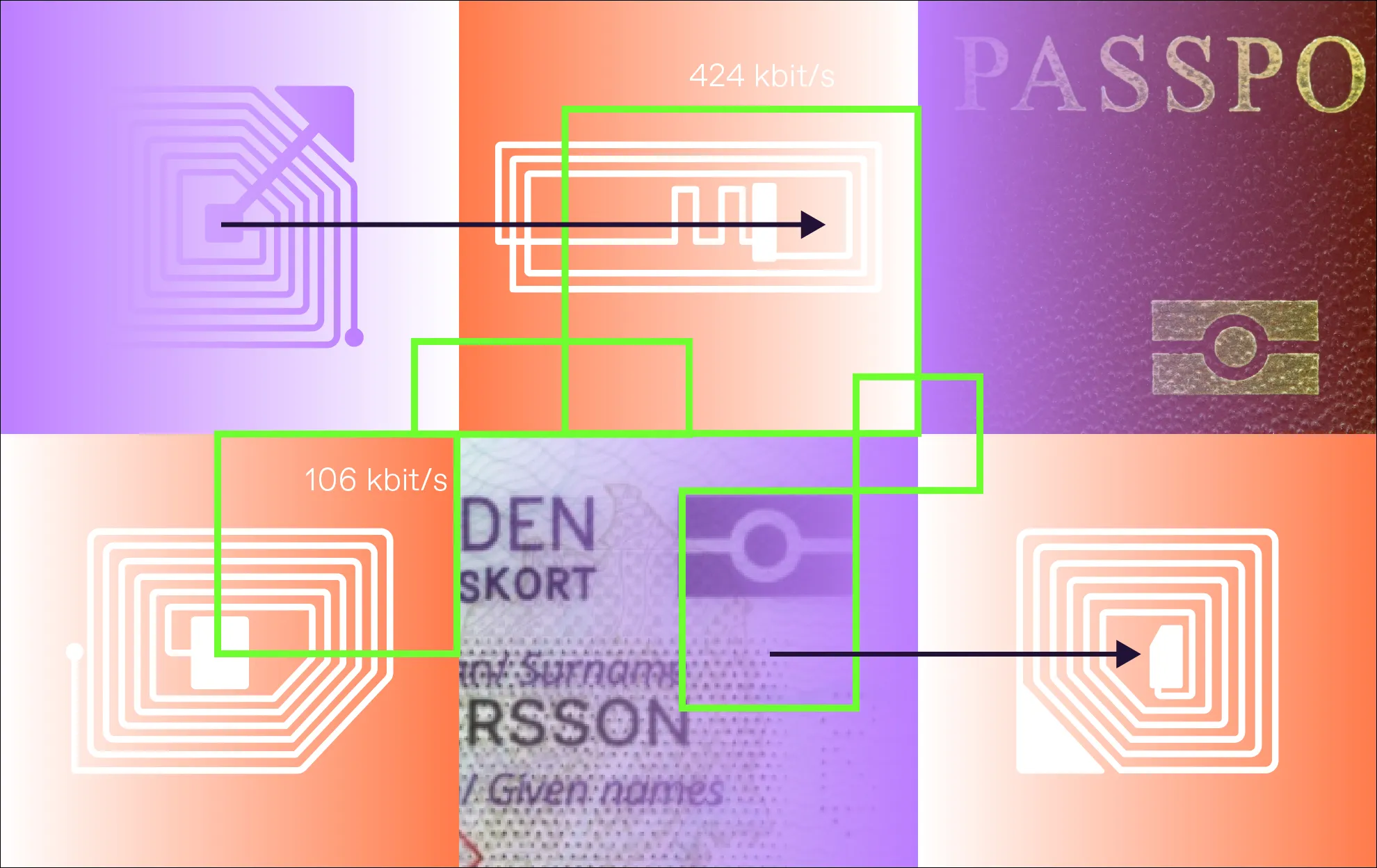
- Connect to the chip. The user places the document near an NFC-enabled smartphone or a document reader equipped with an RFID module.
- Establish secure access. The reader uses a supported access protocol, such as Basic Access Control (BAC) or Password Authenticated Connection Establishment (PACE).
- Read the data groups. The system retrieves the information that it is authorized to access.
- Authenticate the data and chip. Available cryptographic checks are performed to assess the origin and integrity of the data and, where supported, the genuineness of the chip.
- Cross-check the results. Information from the chip can be compared with the document’s visual zone, MRZ, barcode, and portrait.
What data can an RFID chip contain?
- Biographical information corresponding to the MRZ
- Document details, such as the passport number and expiration date
- A digital facial image of the holder
- Security information and digital signatures
- Optional additional biometrics, such as fingerprints or iris images
How is an RFID chip verified?
- Passive Authentication (PA): Checks whether the data was signed through the issuing authority’s trust chain and has remained unchanged.
- Active Authentication (AA): Helps determine whether the chip possesses the expected private key, reducing the risk of accepting copied chip data.
- Chip Authentication (CA): Establishes a secure session and helps detect chip cloning or substitution.
- Terminal Authentication (TA): Checks whether the reader is authorized to access restricted information, such as certain biometric data.
How can Regula help with RFID verification?
FAQ
Is RFID the same as NFC?
No. RFID is the broader technology used for wireless communication with electronic tags and chips. NFC is a short-range communication technology that enables compatible smartphones and readers to interact with certain RFID chips, including those in electronic identity documents.
Does reading an RFID chip prove that a document is genuine?
No. A successful read confirms only that the device communicated with a chip and retrieved data. The verification system must validate the digital signatures and other supported security mechanisms before relying on that information.
Can an identity document’s RFID chip be cloned?
Signed data can potentially be copied from one chip to another. Passive Authentication may still validate the copied data because it checks the signature and integrity of the data rather than the physical chip. Active Authentication or Chip Authentication can help identify cloning when the document supports them.
Do all identity documents contain RFID chips?
No. RFID chips are found in e-passports and many electronic identity cards, but their availability varies by country and document version. A verification system should first identify the document and determine whether a chip is expected.
Does RFID reading require an internet connection?
Communication between the document chip and a nearby reader does not inherently require internet access. However, the verification application may need connectivity to send results to a server, retrieve certificate information, or complete other identity checks. The requirement depends on the system’s architecture.