


In brief: A residence card proves a foreign national’s residence rights. Key checks may include data extraction, template comparison, security feature inspection, and, where applicable, RFID chip authentication.
A residence card is a physical document that proves a foreign national’s right to live in a country. The legal permission itself is the residence permit or residency status. Because these documents can open access to financial services, work, study, public benefits, and long-term stay, residence cards are a natural target for fraudsters.
This guide explains what residence cards are, which forms they can take, how they are secured, and how to verify whether the document is genuine, valid, and consistent with the person presenting it.
💡Curious about other ID documents and what makes them unique?
Read our expert reviews of:
Residence card vs. residence permit: what’s the difference?
A residence permit is the legal permission that allows a foreign national to live in a country. A residence card is the physical document used to prove permission during identity checks.
In everyday life, the terms are often used interchangeably. However, document verification and status verification aren’t always the same thing.
A residence card check can confirm that the document is authentic, valid, and belongs to the person presenting it. This includes checking the card format, security features, MRZ, RFID chip, expiry date, and data consistency.
However, a genuine card doesn’t always prove that the person’s current residence status is still valid. The underlying permit might have been revoked in an official system. Where the use case requires proof of current legal status, the document check may need to be combined with a database or authority-side status check.
Get posts like this in your inbox with the bi-weekly Regula Blog Digest!
What types of residence permits are there?
Residence permits usually fall into two broad categories: temporary and permanent. The core distinction is whether the person can stay for a limited period or has long-term/indefinite residence rights.
Temporary residence permit
A temporary residence permit allows a foreign national to live in a country for a limited period, typically up to 3 years. It is usually tied to a specific purpose, such as work, study, family reunion, humanitarian protection, or another approved reason for stay.
Because the permission is time-bound, verification teams should closely monitor the expiry date.
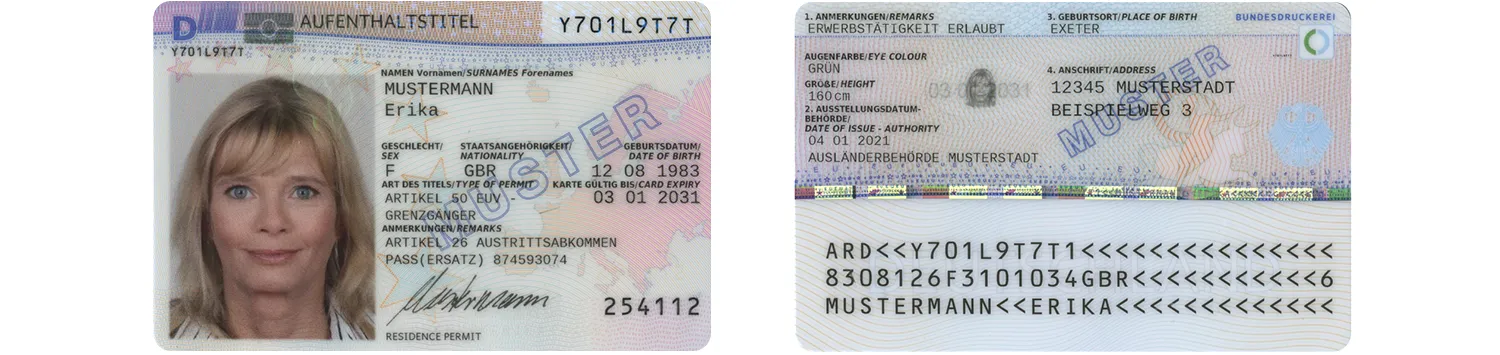
A typical example is the German Aufenthaltserlaubnis, which allows foreign nationals to live and work in Germany under certain conditions (e.g., proof of qualifications, income, etc.).
Permanent residence permit
A permanent residence permit, such as the famous United States Green Card, grants indefinite residency rights. Holders of these permits can live and work in the issuing country without having to renew them.
Still, “permanent” doesn’t mean unconditional. Some countries can cancel or change residence rights if legal conditions are no longer met. For example, permanent residents in Canada may lose their status if they fail to meet the residency obligation of being physically present in Canada for at least 730 days within a five-year period.
Administrative errors can also affect a document's status. In 2024, the UK Home Office apologized after retracting asylum approvals that had already been granted. According to The Guardian, some applicants had already received residence permits before being told the decision was an error and that they should destroy the permits.
That is why high-risk checks may need to separate two questions: whether the physical document is genuine, and whether the person’s current residence status is still valid.
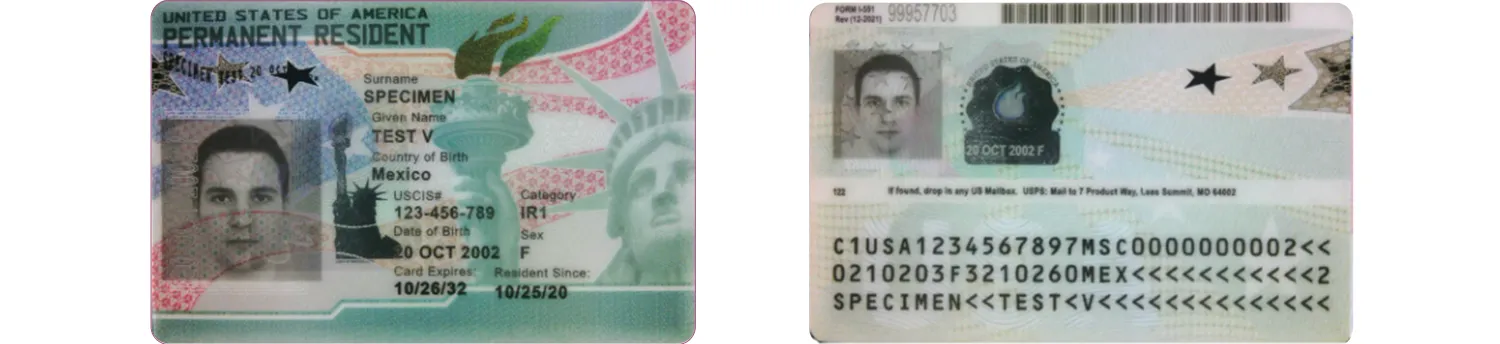
While Green Card holders can live and work permanently in the US, they cannot vote in federal elections.
What forms can residence permit documents take?
Many associate residence permits with something that resembles an ID card, and they aren’t wrong. However, this is just one of a few possible forms they can take. Depending on the country, issuing system, and document generation, proof of residence status may appear as a biometric card, a paper-based document, or a sticker in a passport.
Biometric residence card
Also known as an electronic residence permit, this is the most common type. They come in the form of an ID-like document and are typically made of polycarbonate or PVC for durability.
They may also include a wide range of security features, such as RFID chips, holograms, microtext, UV features, and more.
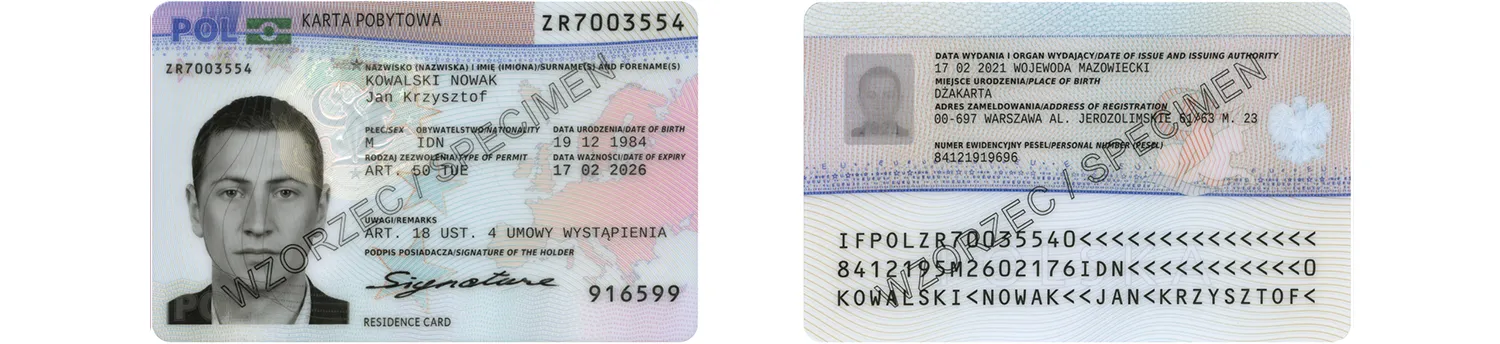
The Polish Karta Pobytu is a typical example of a biometric residence card. It comes with an embedded microchip containing the holder’s fingerprints, facial image, and digital signature, as well as Optically Variable Ink on the card’s surface.
Paper-based residence permits
Some countries still issue paper-based residence permits, typically as booklets or certificates. In some African countries, for example, paper-based formats may remain practical because they are less costly to produce and easier to support in administrative environments where digital or biometric infrastructure is limited.
These documents can still include security features, such as watermarks, embossed stamps, ink seals, serial numbers, signatures, or special paper. However, the lack of biometric integration makes them more susceptible to fraud.
Combined passport stamps and stickers
Some countries issue visa-style stickers affixed to passport pages as residence permits. And the similarities don’t end there — all the security elements used for visa verification (like OVI or government stamps) are also often found in such residence permits.
Now considered mostly obsolete, countries like Germany used to issue it until 2021, but they eventually moved to biometric residence permits.
When do organizations need to verify residence cards?
Residence cards are usually verified when residency status affects access, eligibility, or compliance. A weak check can lead to unlawful employment, onboarding errors, incorrect customer or applicant records, and poor evidence that the organization performed a proper identity check.
| Scenario | Why residence card verification matters |
|---|---|
| Crossing international borders | Helps confirm that the person can enter, remain, or pass through a country under the claimed status. |
| Employment screening | Helps employers check the candidate’s eligibility and reduce the risk of unlawful employment practices. |
| Student enrollment | Helps universities confirm that an international student has the required basis to study and stay. |
| Banking and fintech onboarding | Supports KYC and AML checks when a foreign customer uses a residence card as proof of identity or residency. |
| Tax registration | Helps determine tax obligations and eligibility for certain deductions or credits. |
| Renting accommodation | Helps landlords or property managers meet local tenant-status or right-to-rent requirements where applicable. |
| Public services and healthcare | Helps determine eligibility for services or benefits tied to residency status (e.g., for foreign nationals). |
What security features protect residence cards from forgery and tampering?
Residence cards can include several layers of protection, from visible printing effects to electronic chip data. These security features aren’t unique to residence cards, but their placement, appearance, and behavior are document-specific.
In the EU, for example, residence permits follow a uniform format, which helps standardize the blank and core security elements across Member States. Still, the issuing country, document series, and personalization details must be checked against the expected template.
UV fluorescent ink
This type of fluorescent ink becomes visible under ultraviolet (UV) light. Most commonly, it’s used to create hidden texts, symbols, or patterns. For accurate residence permit verification, UV elements should appear crisp, and their intensity should be consistent throughout the document. Overly bright or dim fluorescence can indicate forgery.

For example, Polish residence permits under a UV lamp will show letters spelling “EU” intermingled with other imagery (e.g., five-pointed stars).
Optically Variable Ink (OVI)
OVI changes color — for example, green to gold or green to purple — when viewed from different angles. In residence cards, it’s often used to highlight critical symbols or text.
Just like many other protection methods on this list, OVI is patented and virtually inaccessible to counterfeiters who rely on commercially available inks.

This example showcases changes of OVI from blue to green, depending on the angle of view.
Holograms
Similar to OVI, holograms are designed to exhibit smooth, multicolor transitions that shift with the viewing angle. A genuine hologram should behave predictably when tilted and match the expected location and design. If it looks flat, static, poorly registered, or inconsistent with the template, the residence card needs closer inspection.

Polish residence permits feature a hologram of an aurochs-like figure.
Machine-readable zone (MRZ)
MRZ is a standardized text area printed at the bottom of a residency permit, designed to be read by optical ID scanners. It encodes key information about the holder and the document, such as name, nationality, date of birth, document number, and expiry date, in a specific format.

The MRZ is printed using a special font called OCR-B. This font is simple and clear, making it easier for machines to scan accurately, even if the document is slightly damaged.
RFID chip
RFID chips serve as secure storage of vital data when scanned by a compatible reader. As an overall technological improvement over magnetic strips or barcodes, they boast higher data capacity and tamper resistance. Not to mention, they make biometric residence permit verification much easier.
Similar to biometric passports, the chips in electronic residence permits follow a structured logic, storing various data types — such as basic personal information, fingerprints, and facial images — in separate files.
For verification, simply reading the chip is not enough. The system should authenticate the chip data and validate the certificate chain. Otherwise, readable electronic data does not necessarily mean trusted electronic data.
Microprinting
Microprinting means embedding text so small that it can appear as a solid line to the naked eye instead of text. To verify documents with microprinting, experts would use at least 10x magnification and assess the uniformity of the text. Fakes, on the other hand, often show breaks or blurring under close inspection.
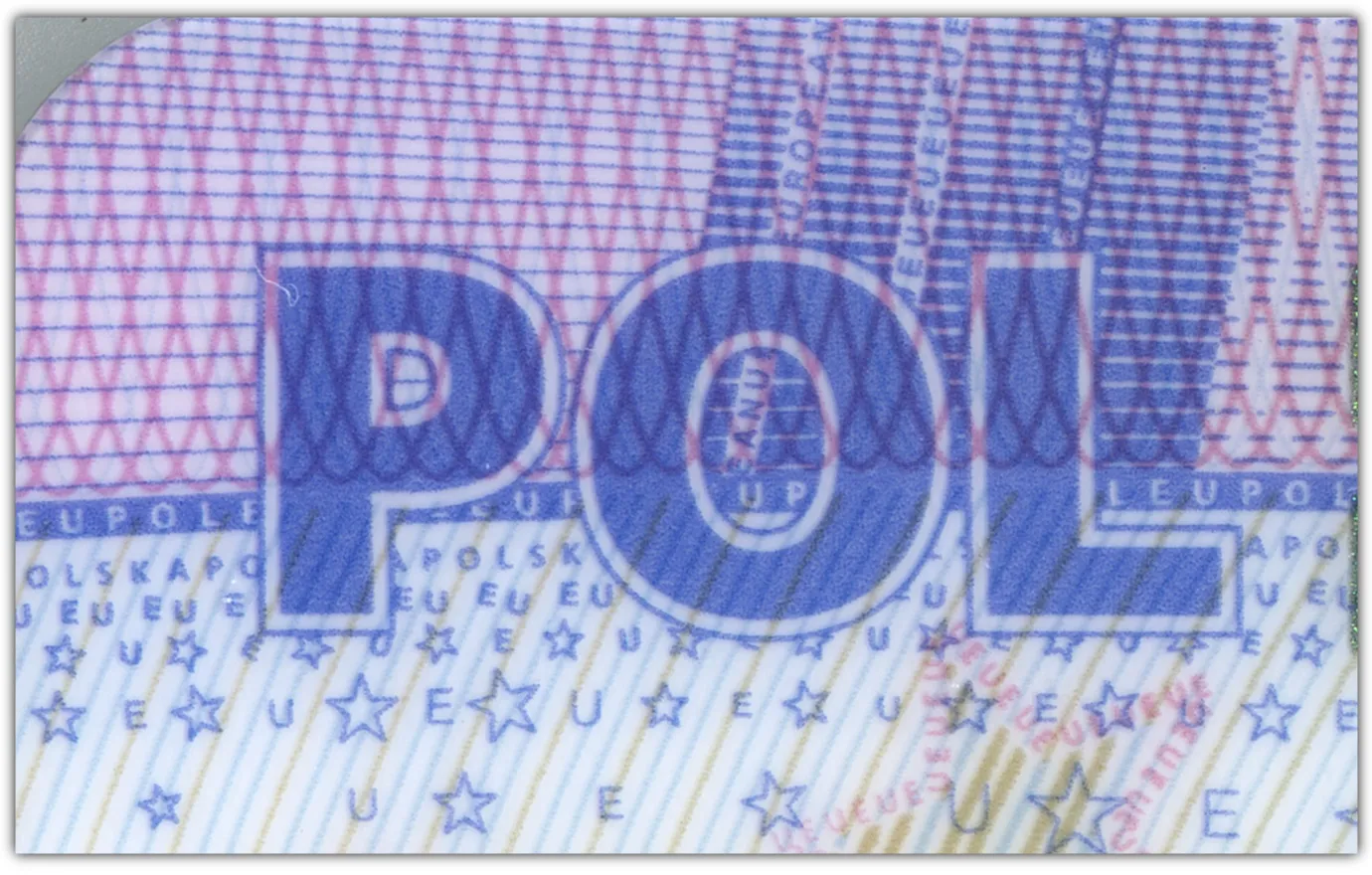
Example of microprinting in a Polish residence card.
Why can residence card verification be challenging?
Many organizations mainly check residence cards issued by their own jurisdiction. Even then, the process can be difficult because several card series, permit categories, security designs, and status rules may coexist.
No reliable template to compare against
Residence card verification typically depends on comparison. If the reference template is missing or outdated, it becomes hard to interpret unusual details. A design difference may be a legitimate feature of an older series, or it may be a sign of alteration.
Regula’s document template database helps reduce this guesswork by letting verification teams compare the presented document with expected templates from 254 countries and territories.
Several valid series in circulation
Residence cards change over time. This creates a practical verification problem: a card that looks different from the latest design is not necessarily fake. At the same time, fraudsters may imitate older designs because they assume verifiers are less familiar with them.
To reduce this guesswork, verification teams need references that cover not only the newest document version but also older valid series, known design changes, and expected security features for each version.
Local scripts and transliteration
Residence cards may contain data in a local script, Latin transliteration, or both. The same name or place of birth can also appear in the visual zone, MRZ, barcode, RFID chip, and the user’s application form.
The challenge is not always that a human verifier cannot read the local language. In many domestic flows, they can. The harder problem is consistency: the system must extract the right fields, preserve special characters where needed, handle transliteration, and compare data across different document zones without creating false mismatches.
This becomes especially important in remote or international verification flows, where residence cards may be processed by automated systems and centralized review teams.
Physical authenticity doesn’t always prove current status
Lastly, expired or revoked permits are not always physically retrieved from the holder. As long as they appear valid upon visual inspection, there’s room for fraudulent usage.
This can pose a problem even in areas with high mutual integration, such as the EU. At the moment, there are not many universal live databases that would track such nuanced status changes.
How to streamline residence card verification?
Residence card verification depends on where the check happens.
At a staffed counter, the organization can use a specialized document reader to automate data entry and validation, authenticate the RFID chip (where available), compare the document against a template, and inspect the card under different light sources to ensure it’s genuine. Document readers come in all shapes and sizes: kiosks, desktop workstations, portable handheld devices, and more.
In remote flows, the check usually happens through a mobile or web application. In this case, the system needs to capture a high-quality image of the residence card, identify the document type, extract the data, verify that the document is physically present, and confirm that the data and visible features are consistent.
| Verification environment | Better fit | Why |
|---|---|---|
| On-site verification at a front desk or service counter | Desktop document reader | Speeds up data entry by reading document fields automatically, then helps validate the data and authenticate the document |
| Field inspections | Portable or mobile document reader | Helps verify residence cards outside a fixed counter or office |
| Self-service kiosks | Embedded document reader | Lets users scan documents without staff assistance |
| Mobile or web onboarding | Document Reader SDK | Captures, identifies, extracts, and verifies residence card data in remote flows |
Regula supports both on-site and remote residence card verification. Its document readers help organizations worldwide inspect physical documents at in-person verification points, while Regula Document Reader SDK can be integrated into mobile and web flows.
Both rely on Regula’s document template database, which includes over 16,000 document templates from 254 countries and territories.
Talk to our experts to find the right residence card verification workflow for your use case.