


What to expect in this blog
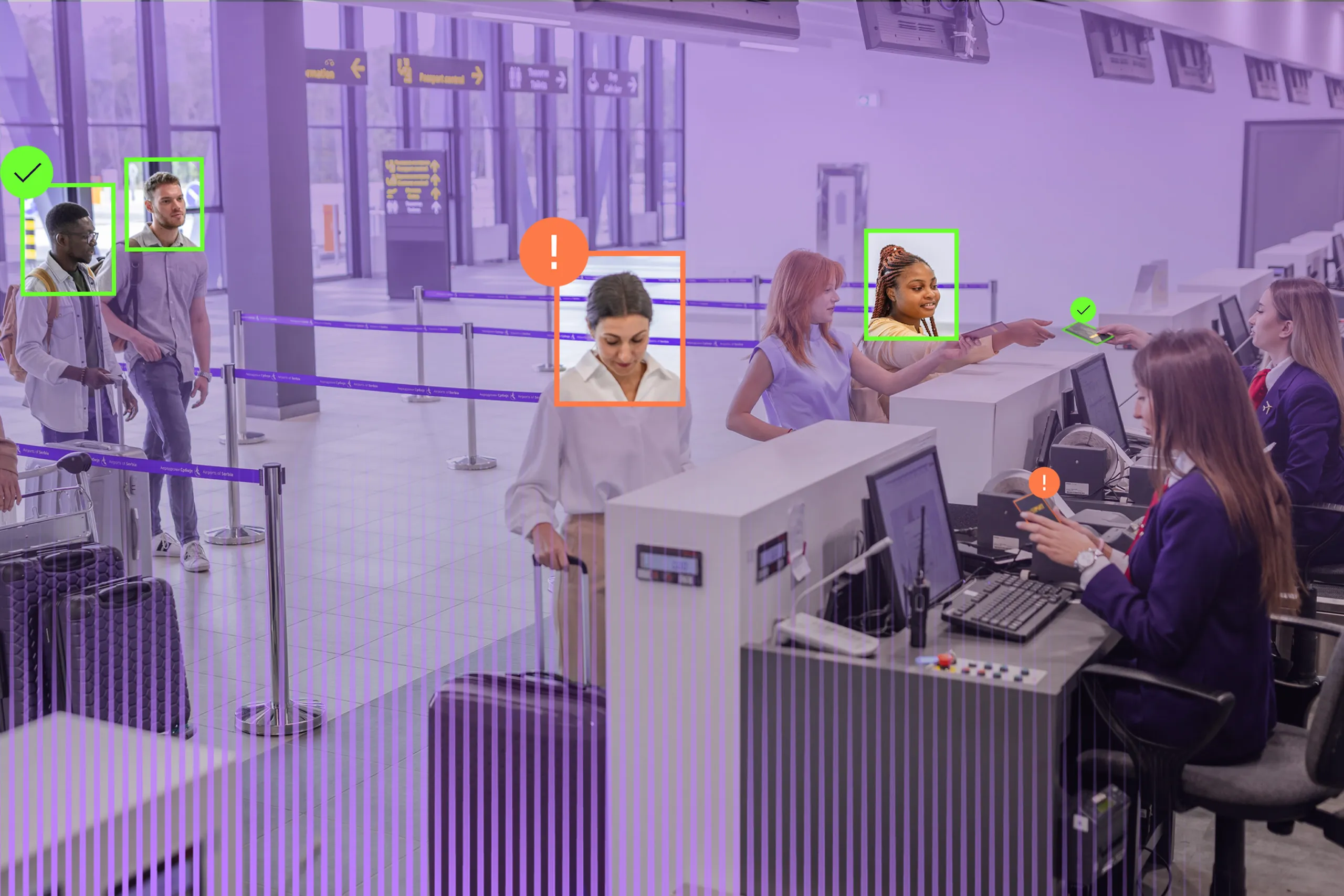
Airports are now securing more travelers with fewer touchpoints. Biometric systems are replacing boarding passes, manual verification checks at the airport are giving way to automated gates, and digital IDs are stepping in for physical documents. These upgrades boost efficiency, but they also concentrate risk. If airport identity verification systems fail, the impact spreads fast across the terminal.
This article introduces the Airport Identity Risk Index 2026: a practical look at the top identity-related threats airports face today, along with strategies to manage them.
Airports are now among the most identity-dependent environments in the world. Traditional security measures — metal detectors, X-ray scanners, patrols — still play a role. However, airport identity verification (IDV) checks determine which zones passengers can access, which flights they board, and what security level they receive.
As more airports adopt biometric boarding, remote check-in, automated e-gates, and soon, digital travel credentials (DTCs), the identity perimeter is rapidly evolving. And so are the risks.
Fraudsters are targeting weak spots in physical infrastructure, digital workflows, and operational procedures. Importantly, the threats go beyond forged documents or tailgating. They now include chip authentication errors, synthetic identities, and poorly secured biometric capture points.
To help airport security leaders focus on what matters most — and what’s gaining momentum — we’ve developed the Airport Identity Risk Index 2026. It ranks today’s most pressing identity risks and their trajectory through 2028.

Subscribe to receive a bi-weekly blog digest from Regula
Airport Identity Risk Index 2026 by Regula’s experts
To turn field insights — such as how often threats occur, how technologies evolve, and how workflows adapt — into a practical scoring model, we use two expert-weighted metrics:
Risk Probability Index (RPI): How likely it is that a threat will occur today, based on real-world airport and aviation IDV environments.
Future Growth Probability (FGP): The likelihood that this threat will grow by 2028, driven by tech advances, automation, and operational shifts.
The scores reflect real-world conditions, where automation works alongside human controls, and security maturity varies across terminals, roles, and regions. These indices allow for consistent risk comparison and focus on practical exposure rather than abstract forecasts.
| Threat | RPI Today | FGP 2028 |
|---|---|---|
| Forged documents | 9/10 | 8/10 |
| Weak chip & certificate validation | 7/10 | 9/10 |
| Morphing & photo substitution | 4/10 | 6/10 |
| Insider & restricted-area identity misuse | 4/10 | 5/10 |
| Boarding pass & digital identity tampering | 6/10 | 7/10 |
| Deepfake-assisted remote enrollment | 4/10 | 7/10 |
| Biometric presentation & injection attacks | 3/10 | 6/10 |
Methodology
The Airport Identity Risk Index 2026 is an analyst-driven assessment developed by Regula to examine how identity-related risks are evolving across airport identity environments.
The index is designed as a forward-looking risk model to support prioritization and strategic decision-making. It reflects a structured expert evaluation that combines Regula’s operational experience with aggregated industry perspectives.
The analysis is informed by cumulated insights from ongoing interactions with Regula’s customers and partners, such as regular surveys, feedback, consultations, and structured discussions conducted as part of the company’s research and advisory activities. It also incorporates Regula’s practical experience with real-world identity systems, including document authentication, chip and certificate validation, biometric verification, and identity decision workflows.
These inputs are used to identify consistent patterns and shifts in risk exposure, rather than to produce statistically representative market metrics.
Now let’s take a closer look at each of these threats:
1. Forged documents
RPI Today: 9/10 | FGP 2028: 8/10
Document fraud hasn’t gone away — it’s just become more sophisticated. Modern forgeries often look convincingly authentic: fraudsters alter polycarbonate data pages with laser precision, tweak machine-readable zone (MRZ) codes, and imitate holograms well enough to deceive inattentive eyes. These fakes often travel across borders before reaching an airport check-in or passport booth.
Airports, under pressure to process high passenger volumes quickly, remain vulnerable. A forged passport only needs to get past one distracted officer or outdated reader to succeed.
The good news? The risk may decline over time. As airports roll out more advanced ID scanners and automated document checks, traditional forgery methods will become less effective — likely shifting fraud efforts toward digital identity manipulation instead.
💡Want to learn how to verify IDs effectively?
Read our expert reviews of:
2. Weak chip & certificate validation
RPI Today: 7/10 | FGP 2028: 9/10
Every ePassport contains a cryptographically signed chip that protects the document’s integrity, provided that full chip verification is implemented, as recommended by ICAO guidelines. However, many airport systems validate only the data on the chip, not the digital certificates that confirm the chip’s authenticity.
This oversight, more common than the industry admits, opens the door to sophisticated attacks. Fraudsters can clone chips or modify data in ways that some readers won’t detect.
As DTCs gain traction, the risk will grow. When physical documents are replaced with digital identities, the cryptographic layer becomes the primary target. Without full PKI validation — including CSCA/DSC chains, signature checks, and revocation lists — airports may unknowingly accept identities that should never have passed.
3. Morphing & photo substitution
RPI Today: 4/10 | FGP 2028: 6/10
Face morphing, which involves blending photos of two people into one realistic image, is one of the most overlooked IDV threats. If accepted, the resulting passport becomes a shared identity token, usable by more than one person.
Even trained officers may miss a well-executed morph. Automated systems can also be fooled, as these images often pass the similarity thresholds used in biometric checks.
As AI tools for image editing become more advanced and widely available, morphing will pose a growing risk. To counter it, airports must adopt layered checks, including comparisons between chip-stored images, live selfies, and submitted photos.

4. Insider & restricted-area identity misuse
RPI Today: 4/10 | FGP 2028: 5/10
Insider threats don’t make headlines, but they show up often in incident reports. Airports rely on thousands of staff, from airline crews, contractors, and logistics providers to catering firms and service vendors. Every badge or login issued is a potential weak spot.
Lost credentials, borrowed access cards, tailgating, and outdated permissions can all open doors — literally and digitally — to unauthorized access.
While less frequent than other threats today, this risk is growing. As airports digitalize more operations, automated systems reduce human oversight, and complex vendor networks complicate identity management. Without stronger identity governance, insider misuse could quietly become one of the most damaging risks in the years ahead.
5. Boarding pass & digital identity tampering
RPI Today: 6/10 | FGP 2028: 7/10
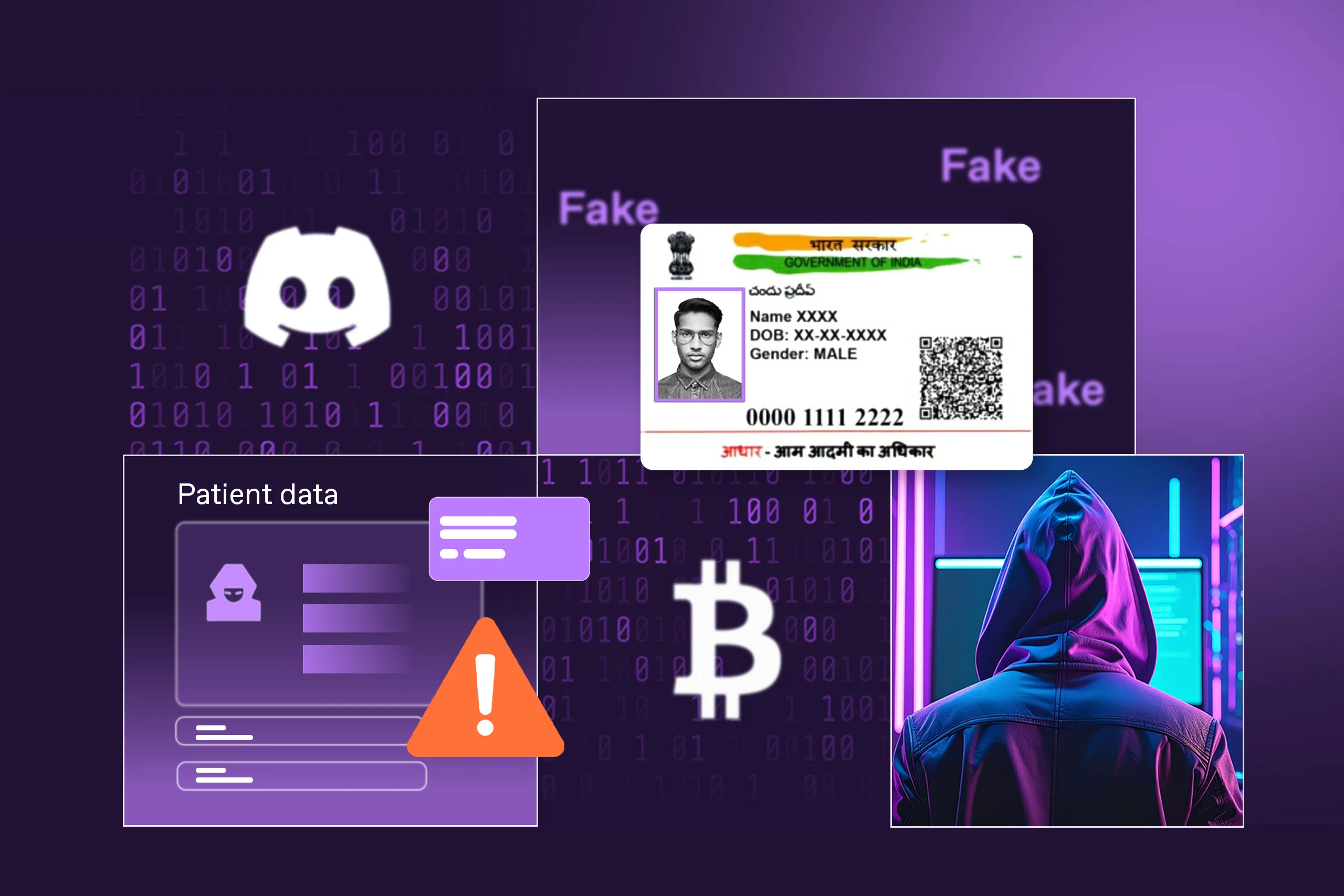
Boarding pass manipulation remains an effective tactic — especially in airports that rely solely on barcodes for access control. In poorly configured systems, it’s possible to edit passenger names, flight numbers, or access parameters within a QR code to bypass security.
The move to digital credentials doesn’t eliminate the risk. Without cryptographic signatures and real-time backend validation, digital passes are just as vulnerable. As more boarding passes, travel documents, and identity tokens shift to mobile devices, attackers will increasingly target them, exploiting weaknesses in apps, readers, and data flows.
6. Deepfake-assisted remote enrollment
RPI Today: 4/10 | FGP 2028: 7/10
This is one of the fastest growing threats — and the one least visible to airport terminals. As airlines and border agencies adopt remote IDV, more passengers are confirming their identity at home via smartphone before arriving, outside the secure airport environment.
This shift improves convenience but opens new vulnerabilities. Deepfake tools now make it easy to create realistic synthetic faces or impersonate real individuals, especially when liveness detection is weak.
There are no publicly known aviation cases yet, but with remote enrollment and DTCs on the rise, the risk is growing quickly. The time to act is now, before deepfake-driven fraud becomes a common reality.
7. Biometric presentation & injection attacks
RPI Today: 3/10 | FGP 2028: 6/10
Airport biometric systems are becoming common at boarding gates, e-gates, check-in kiosks, and staff access points. While most setups today are supervised, the trend is shifting toward unattended biometric interactions.
Presentation attacks involving printed photos, on-screen images, video replays, and other tools may seem basic, but they can bypass weak liveness checks. A more advanced risk is video injections: feeding synthetic images directly into a device’s camera stream to spoof a live capture.
These methods aren’t yet widespread in aviation, but as airport biometric systems expand, so does its appeal to attackers. Airports need to start securing systems now, before these threats become common.

What airports can do now: Building a multi-layer identity defense
Securing identity at airports is no longer about a single checkpoint or technology. It requires layered defenses so that if one control fails, another can catch the threat:
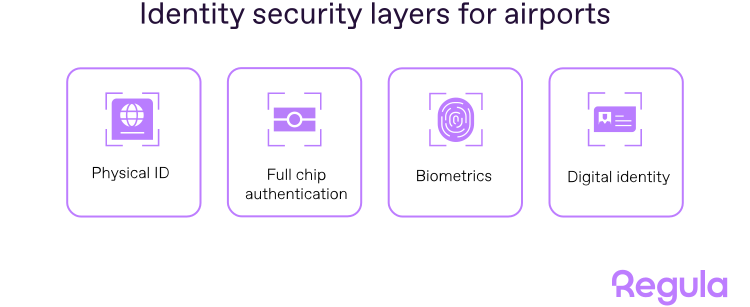
Physical documents. Airports that rely on visual checks or basic scanners remain exposed to document fraud. Forensic-level document readers with multispectral UV/IR light and high-resolution optics let front-line inspectors spot alterations instantly. Paired with automated tools like Regula Document Reader SDK, they flag even minor tampering, template inconsistencies, or missing security features without slowing passenger flow.
Chip authentication. As passports and upcoming DTCs carry more identity data, simply reading the chip is no longer enough. Full PKI validation is essential. This requires both NFC-capable hardware and software that confirms that the document’s cryptographic signatures and other security mechanisms are authentic and issued by a legitimate authority.
Biometrics. Biometric gates, staff entry points, and self-service kiosks need secure camera capture and liveness detection to prevent spoofing. Solutions like Regula Face SDK can distinguish live faces from masks, photos, and synthetic imagery, and support chip-to-live photo comparisons that help counter morphing and other fraud.
Digital identity. Mobile boarding passes and DTCs must be cryptographically signed and validated against backend systems. Platforms like Regula’s IDV orchestration tools help verify digital assets before they enter airport workflows — spotting manipulation early and reducing exposure.
Together, these layers — document, chip, biometric, and digital — form a unified identity defense. Airports that invest in this structure now will be better prepared for the complex identity challenges ahead.
Want to explore how a layered IDV strategy can work for your operations? Let’s discuss your case in detail during a free discovery call!


