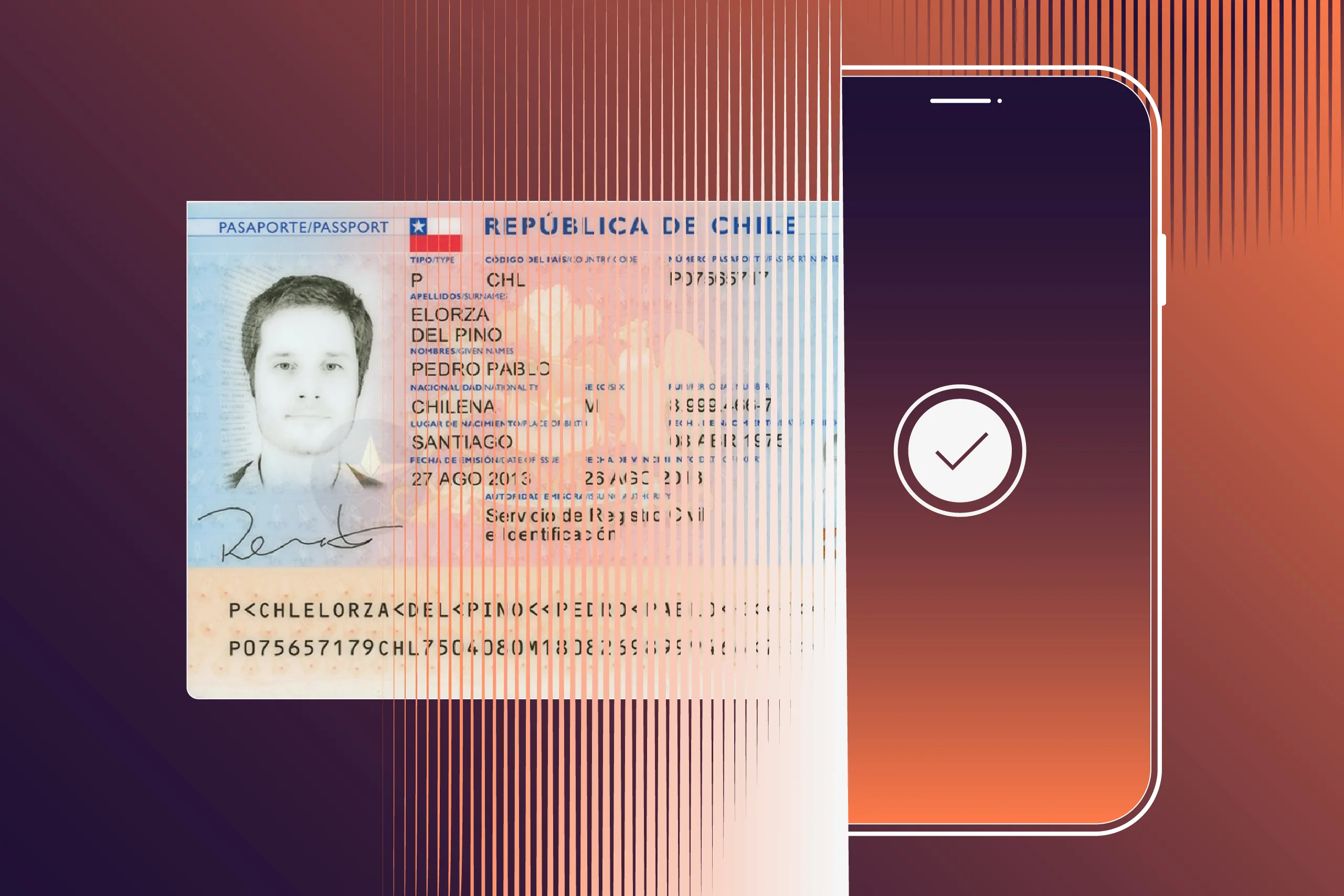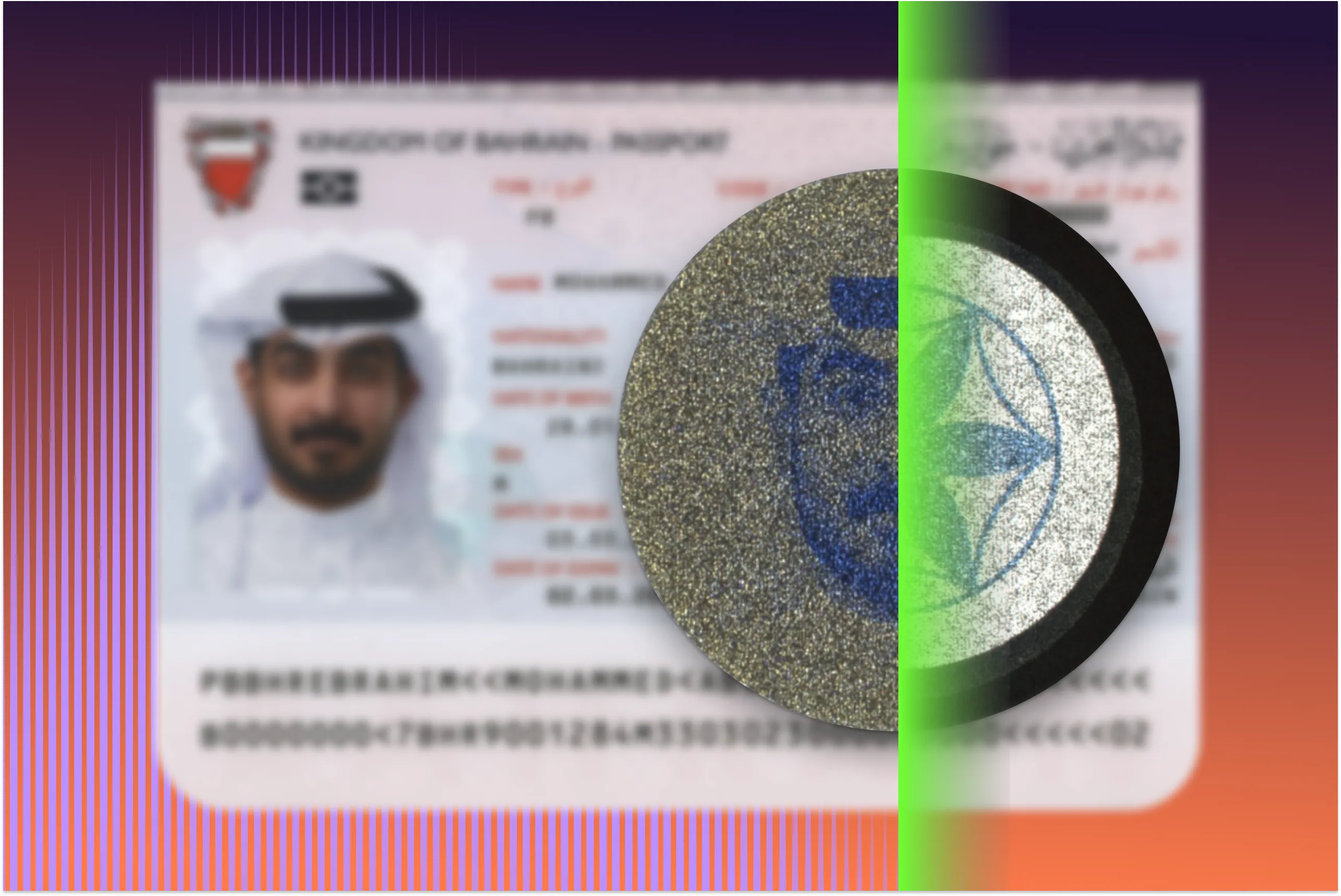


Chile is setting ambitious goals in identity verification. As Omar Morales, the national director of the Civil Registry, states, Chile aims to "be among the five countries with the best identification level in the world.”
This article explains what makes Chilean IDs harder to process and what an identity verification system should be able to handle.
💡 If you're new to this series, you might also like:
The challenges of processing Chilean IDs
Chile is one of the more demanding countries for identity document processing in Latin America. The challenge comes from several factors at once: multiple live series of passports and ID cards, colorful and security-rich document layouts, Spanish-language fields with diacritics, long names that may not fit neatly into the MRZ, and laminated driver’s licenses that remain difficult to capture reliably.
Chile also began offering digital versions of the passport and national ID card in December 2024. That matters strategically, but for most verification workflows today, the main challenge remains reliable handling of the physical documents.
Complex passport data page layout
Passports in Chile are used mainly for international travel, so they appear less often than national ID cards in domestic verification scenarios.
Since 2013, all Chilean passports have been biometric and display information in Spanish and English. They have also had a 10-year validity period since February 1, 2020, replacing the previous five-year term.
In 2024, the country updated the passport again, introducing a new design and revised security features. The new Chilean passport includes 70 security features, such as an MLI ghost portrait, OVI elements, and a Braille identifier on the polycarbonate data page, allowing visually impaired individuals to verify their documents.

The Chilean passport 2024 series now has a navy blue cover for regular documents, replacing the previous burgundy red color.

The updated data page introduces a visually richer layout and raises the bar for accurate capture in remote workflows.
The updated data page is visually complex. Its colorful background can make smartphone capture less reliable, especially in remote onboarding flows where users may struggle to take a clear, focused image on the first attempt. That increases the importance of guided capture, user prompts, and image quality assessment.
A high-quality capture is also crucial due to the presence of diacritic symbols like ñ, á, and é in data fields and names. This applies not only to Chile, but also to documents from any Spanish-speaking country, including Argentina and Mexico.
Names are another practical issue. Chilean full names can often be too long to fit entirely in the machine-readable zone, as they may include multiple given names plus paternal and maternal last names. Identity verification systems should therefore support partial matching between the visual inspection zone and the MRZ, rather than expecting a perfect one-to-one string match in every case.
Another useful field is the RUN (Rol Único Nacional), the national identification number assigned to every Chilean resident. It includes a check digit, so it can also support automated validation.
Subscribe to receive a bi-weekly blog digest from Regula
Multiple ID card series in circulation
Chilean national identification cards (Cédula de identidad) are mandatory for all residents of Chile, including international students and workers aged 18 or older. They are also the document most businesses are likely to see in online identity verification flows.
Like the passport, the Chilean ID card was updated in 2024. The current version shares the same colorful background design and several of the same security features, including the violet OVI “chip inside” emblem on the front and Braille text on the reverse side.


Chilean national ID cards are accepted as travel documents for entry into several neighbouring South American countries, including Argentina, Brazil, and Peru.
In addition to standard fields, the Chilean ID card contains the holder’s profession, a digitally printed fingerprint, and the RUN, verified similarly to the passport through a check digit.
There is also a QR code with personal information such as the RUN, document number, date of birth, and expiration date. Authorized inspectors can use the QR code to access this information via a government website.
Verification systems also need to account for the fact that Chilean residence permits (Residencia Temporal) look very similar to national ID cards. They use the same overall design but are marked “Extranjero” on the front and show the visa type on the reverse side. Their validity period also differs: unlike standard ID cards, which are valid for 10 years, residence permits may be issued for only a few months or several years.

Foreigners are also required to have a RUN, which is mandatory for all residents in Chile.
A new driver’s license series, still laminated
In 2025, Chile introduced a new driver’s license series. However, the update didn’t make the document processing easier, as Chilean driver’s licenses remain paper-based documents in laminate. Laminated surfaces are more prone to reflections, blur, and uneven lighting than polycarbonate identity documents, so image capture quality is critical.
Document verification providers need to support the new license template alongside older ones still in circulation.
As in many countries, Chile groups driver’s licenses by vehicle type and use case: professional licenses are class A (A1-A5), non-professional licenses are B, C, and CR, and special licenses are D, E, and F.
The validity of a license depends on its class, ranging from two to seven years. However, all licenses require the holder to be at least 18 years old.
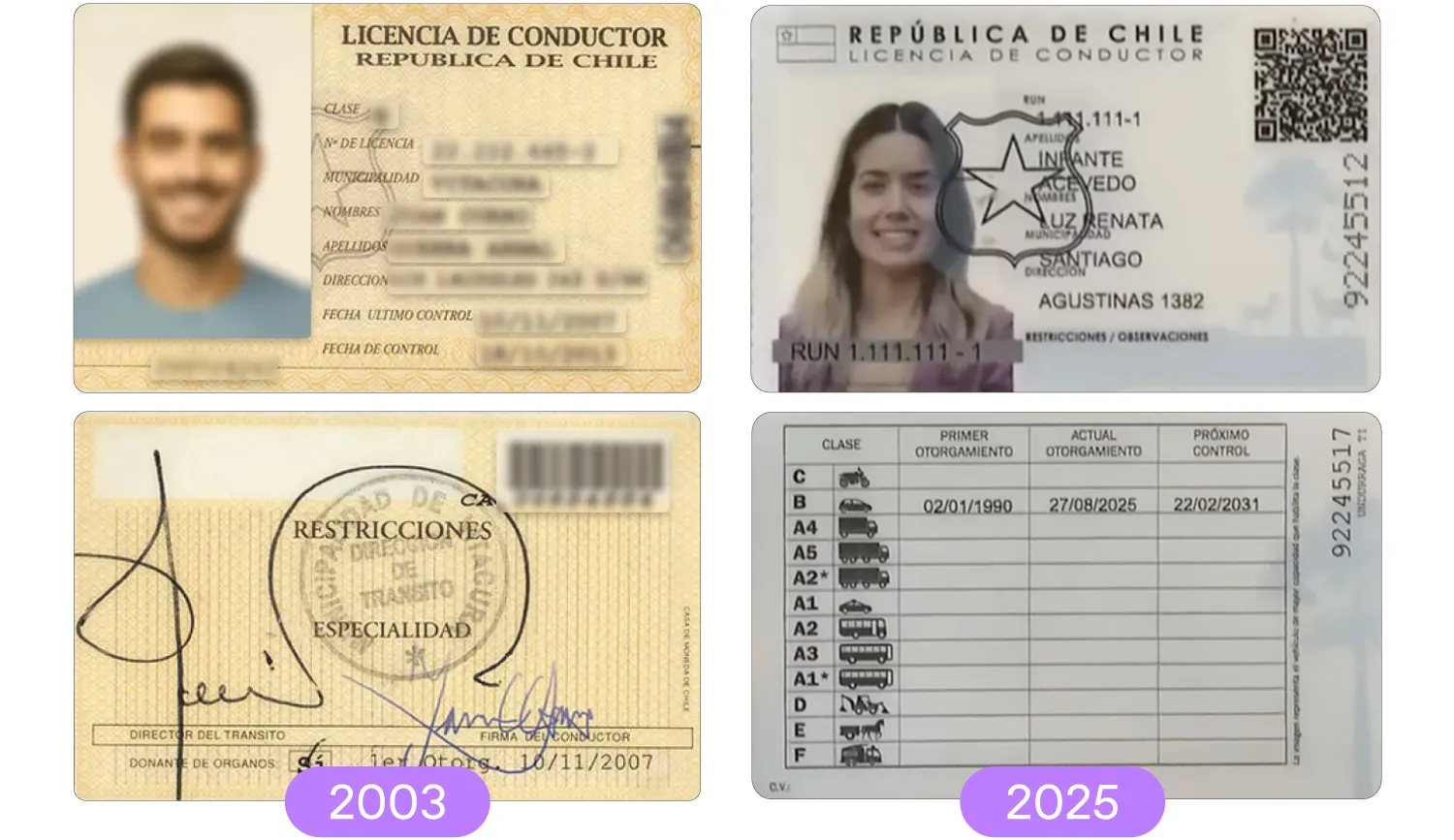
Chilean driver’s licenses: 2003 and 2025 series.
How to effectively process Chilean IDs
To process Chilean identity documents reliably, verification systems need to handle both document diversity and capture quality.
At minimum, make sure your system can:
-
Recognize both legacy and updated Chilean document templates
-
Extract Spanish-language data accurately, including characters such as ñ, á, and é
-
Handle long names and partial matching between the visual zone and the MRZ
-
Validate local identifiers such as the RUN
-
Capture colorful ID documents and laminated licenses without excessive user retries
-
Distinguish between similar documents such as national ID cards and residence permits
Regula Document Reader SDK helps you address these requirements by combining broad document template coverage, top-notch OCR, advanced image capture and quality assessment, and automated verification in one workflow. If you’re looking for a solution that effectively processes Chilean ID documents, get in touch with Regula.