



China’s identity document ecosystem operates at a scale few countries can match. With more than 1.4 billion people, high domestic mobility, international travel, and large volumes of digital onboarding, even a small document-processing gap can quickly turn into manual work.
This article explains what makes Chinese identity documents demanding to process and what businesses need to account for when building automated verification workflows.
💡 If you’re new to this series, you may also like our other posts:
The challenges of processing IDs in China
Chinese identity documents can be a stress test for identity verification systems. At first glance, the main document types look familiar: biometric passports, resident identity cards, and driver’s licenses. But each of them carries details that can break a generic verification flow.
These details include Chinese-to-Latin passport MRZ logic, structured ID numbers, minority-language variants, holograms, laminated surfaces, and non-standard formats.
In other words, Chinese document processing is not just an OCR challenge, as a system may read the text and still fail to verify the document correctly.
To make the complexity practical, let’s look at how these issues appear in the documents businesses are most likely to encounter.
Chinese passports look standard, but the data logic is more complex
For Chinese citizens, passports are mainly used for international travel and cross-border identity checks. Since 2012, all Chinese passports have been biometric, simplifying verification through an RFID chip.
Chinese biometric passports contain the standard ICAO chip data used in ePassports. Access to this data is based on information from the MRZ. However, the chip in Chinese passports also contains an additional data section with the holder’s photo and identification number. This section uses separate protocols and encryption.
This feature significantly speeds up border checks for Chinese citizens at domestic checkpoints, where authorized systems can read the additional chip data and compare it with internal citizen records.

Introduced in 2012, the current series of Chinese passports is non-polycarbonate and includes an electronic chip.
Older Chinese passports used a nine-character passport number: the letter “E” followed by eight digits, for example E12345678. By 2017, this numbering range had been exhausted. Newer ordinary passports therefore use a different format: E + 1 Latin letter (excluding I and O) + 7 digits, for example EA1234567.
Diplomatic and service passports follow separate numbering patterns. Diplomatic passports use “DE” followed by seven digits, while service passports use “SE” followed by seven digits.
The data in the passport is provided in both Chinese and English, which complicates verification. For example, the month in the dates of issue and expiration is not recorded as a standard digit but as a digit combined with the Chinese character 月, such as 1月 for January or 6月 for June.
Reading the MRZ on Chinese passports has its peculiarities as well. The MRZ encodes the passport holder's name in Latin script, but not as a straightforward transcription, but as a coded representation of their Chinese name.
During verification, an identity verification solution needs logic for matching the Latin-script MRZ name with the Chinese-character name in the visual inspection zone. Otherwise, a valid document can produce a false mismatch.

During MRZ reading in Chinese passports, identity verification software must perform a dual workflow: converting the Latin script into the original Chinese name and matching it against the visual data.
Last but not least, the passport data page also includes a large hologram. This can support document liveness and authenticity checks, but it can also make mobile capture harder. If the capture flow does not control glare and reflections, the system may struggle to read the visual zone or force the user into unnecessary retakes.

The intricate design and large size of the hologram on the Chinese passport can disrupt VIZ data capture using a mobile camera.
Chinese Travel Documents: additional passport-like document types
Issued by Chinese diplomatic and consular offices abroad, the Chinese Travel Document allows Chinese citizens overseas to return to China or travel to a limited number of countries, depending on the document type.
The Chinese Travel Document has a passport-like booklet format, but unlike Chinese passports, it’s non-biometric and is usually valid for two years.
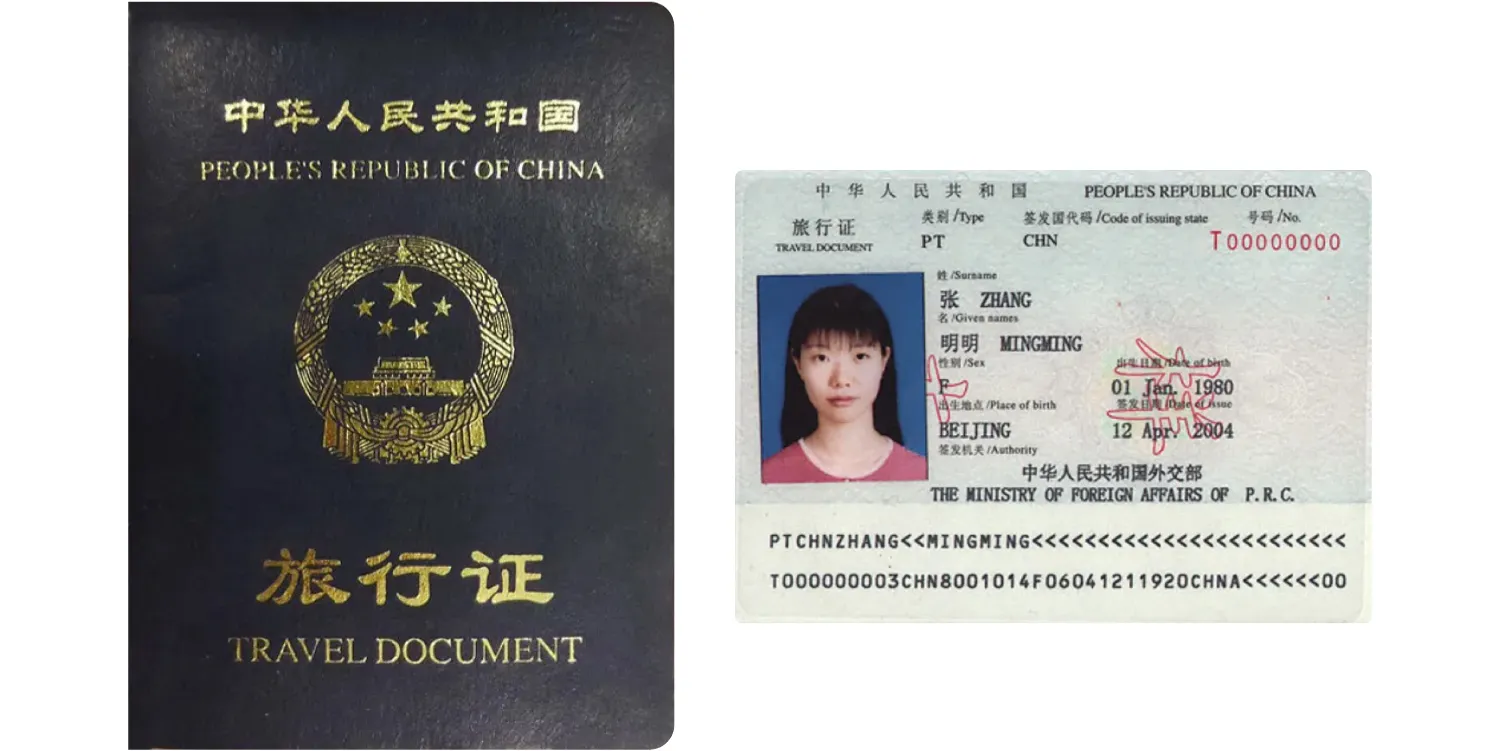
Unlike the red passport cover, the cover of the Chinese Travel Document is gray.
China also uses permit-style travel documents for specific domestic and cross-border travel scenarios.
One example is the Exit-Entry Permit for Travelling to and from Hong Kong and Macao, also known as the Two-way Permit. It’s a card-size biometric travel document issued to Chinese citizens residing in Mainland China for travel to and from Hong Kong and Macao.
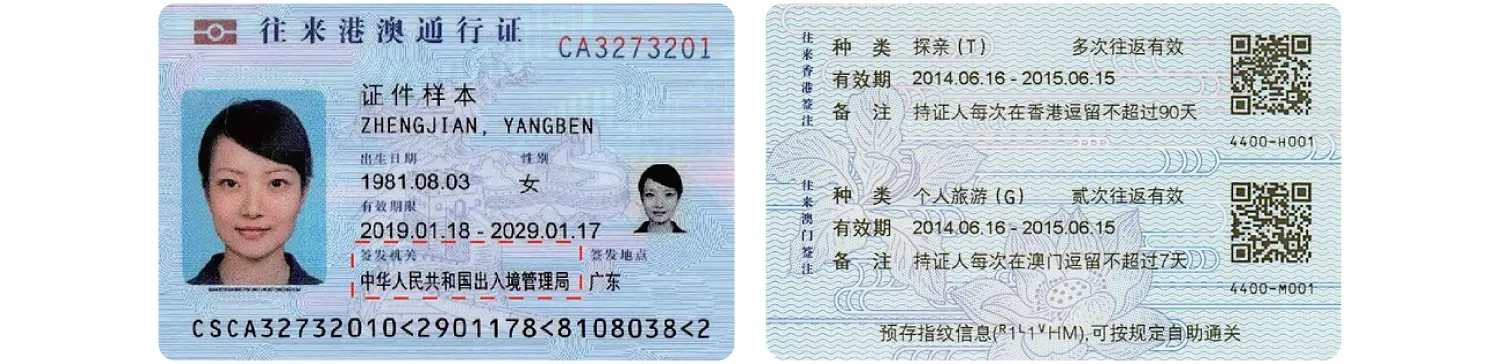
Two-way Permits are limited to internal travel.
Chinese resident identity cards vary by field set, language, and chip access
The Resident Identity Card is the main domestic ID document and functions as a Chinese national ID card. It is used for many everyday identity checks, including opening a bank account, registering for telecom services, applying to colleges, buying train tickets, and passing security checkpoints at domestic airport terminals.
It is also the only acceptable proof of identity for obtaining some other documents, such as driver’s licenses.

The majority of Chinese ID cards (including the pictured 2004 series) are written in Chinese only.
The Chinese ID card includes a standard set of data: name, photo, gender, date of birth, place of residency, etc. What sets it apart is the inclusion of an ethnicity field. China is home to diverse ethnic groups, including Mongols, Tibetans, Koreans, and others. For this reason, documents issued in ethnic minority regions may also contain information in the predominant local language.

ID cards for ethnic Mongolians (left) and Uyghurs (right) issued by Chinese authorities display data in both the holder’s native language and Chinese characters.
The validity period of Chinese ID cards varies based on the holder's age:
-
Under 16 years old: 5 years
-
16 to 25 years old: 10 years
-
26 to 45 years old: 20 years
-
Over 46 years old: Long-term
All Resident Identity Cards contain an 18-digit citizen identification number , such as 110102YYYYMMDD888X. This code can be automatically verified during an identity verification session:
| The code | The meaning |
|---|---|
|
110102 |
Address code—where the holder is located |
|
YYYYMMDD |
Date of birth code—when the holder was born |
|
888 |
Order code—used to differentiate people with the same address and date of birth codes; odd digits are used for males and even digits for females |
|
X |
Checksum—used to confirm the validity of the identification number |
Despite being non-biometric in ICAO terms, Chinese ID cards contain an electronic chip that stores information from the visual inspection zone. However, accessing it requires a specialized hardware crypto module, which provides APIs for secure cryptographic communication between the ID reader and the chip. Just as with Chinese passports, this ID card verification process is restricted to authorized inspectors.
China’s Foreign Permanent Resident ID Card needs separate template coverage
Foreign nationals residing in China can obtain a Foreign Permanent Resident Identity Card. Unlike the ID card for citizens, this document has undergone two updates since 2004.
The Foreigner ID Card doesn’t include the holder’s ethnicity and residence address, only their nationality. This type of ID is typically valid for ten years.
Also, the 2017 series foreigner ID card follows the 2004 coding rule for card numbers, featuring a 15-character alphanumeric code. In the latest version, introduced in 2023, this has been updated to an 18-digit code without letters, reflecting the new coding rule.

The latest version of the Foreigner ID card primarily differs in design and layout from the previous series.
Chinese driver’s licenses can be hard to verify remotely
Chinese driver’s licenses are perhaps the most demanding Chinese documents to verify online.
At first glance, they are fairly standard in terms of the dataset they contain. They feature the holder’s basic identification details, such as a photo, name, address, and date of birth. On the reverse side, the license specifies the vehicle categories.

The current version of the Chinese driver’s license dates back to 2012.
The difficulty comes from the physical document. Chinese driver’s licenses are paper-based, laminated, and covered with dynamic security features, including holograms and optically variable elements. These features can help detect document liveness and authenticity, but they also create glare during mobile capture.

Dynamic security features, such as holograms and OVIs, can be used to verify the document's liveness.
The document format adds another layer of complexity. Chinese driver’s licenses are slightly larger than standard ICAO-compliant ID-1 cards: 60 × 88 mm rather than 54 × 86 mm.
They may also include inconsistent font styles and sizes that demand a well-calibrated OCR algorithm capable of handling the legal “inconsistencies” commonly found in Chinese driver’s licenses.
Finally, the license isn’t just a single card. It contains additional pages — four in total. The third page includes extra details about the holder, such as their full name, registration and document numbers, and special notes. This information can also be processed and cross-checked during identity verification.

The Chinese driver’s license consists of four pages, with some personal details duplicated on the third page.
How to effectively process Chinese documents
Processing Chinese identity documents requires more than multilingual OCR. The system must recognize the exact document type, apply the right validation rules, and check whether data remains consistent across visual fields, MRZs, chips, document numbers, and repeated fields.
At minimum, the workflow should support:
-
Multilingual and multi-script data extraction. Chinese documents may include Standard Chinese, Pinyin, MRZ-compatible Latin script, and minority languages such as Mongolian, Zhuang, and Nuosu. The system must extract these fields and normalize them for matching.
-
Extensive document template coverage. The solution should cover current and legacy versions of Chinese passports, identity cards, and driver’s licenses.
-
Document-specific parsing rules. Chinese documents include details that generic OCR can miss, such as Chinese characters in dates, ethnicity fields on Resident Identity Cards, or multi-page driver’s license layouts.
-
Capture-quality control. The workflow should detect poor captures early and guide the user to retake the image when needed.
-
Data validation and cross-checks. The system should compare data across available sources, including the visual inspection zone, MRZ, chip data, document numbers, and repeated fields. This helps separate expected document-specific variation from extraction errors or suspicious inconsistencies.
-
Authenticity checks. The workflow should support security-feature checks, document liveness detection, and NFC/RFID verification where the document and access context allow it.
Regula Document Reader SDK is equipped to handle all these challenges, ensuring seamless processing of Chinese identity documents. See how it can help you build a reliable Chinese document verification workflow. Book a demo ↓


