

.webp)
Laos isn’t a high-volume travel market. For identity verification teams, however, the country is a good example of how complexity does not always come from scale.
This post explores what makes Laotian IDs harder to process than they may first appear.
If you're new to the series, also read our posts about other countries:
The challenges of processing Laotian IDs
Laotian identity documents combine several features that create friction in real verification flows: non-Latin script, multilingual fields, laminated surfaces, non-standard domestic document types, and now a new chip-based national ID card entering circulation.
The good news is that if your verification workflow can handle Laos well, it is usually built to handle document variation well more broadly. To see why, let’s break down the issues that affect different stages of Laotian ID verification, from image capture and OCR to document coverage and authentication.
The Lao language’s script
One of the first challenges in Laotian identity documents is the script itself. Lao uses its own non-Latin writing system, an abugida related to Thai and Khmer scripts. A verification system has to recognize Lao characters accurately, preserve spacing correctly, and avoid confusing similar-looking shapes.
.webp)
The Laotian passport displays the holder’s name in both Lao and English transliteration.
At the same time, Laotian documents are not fully consistent in how languages appear across document types. Passports and driver’s licenses include Lao alongside English, while domestic documents such as national ID cards may be issued in Lao only. That means the workflow cannot rely on one uniform pattern for field extraction or field matching.
Names and other personal data may appear in Lao script in one place and in Latin transliteration in another, so the system needs to handle both correctly and compare them without forcing a false mismatch.
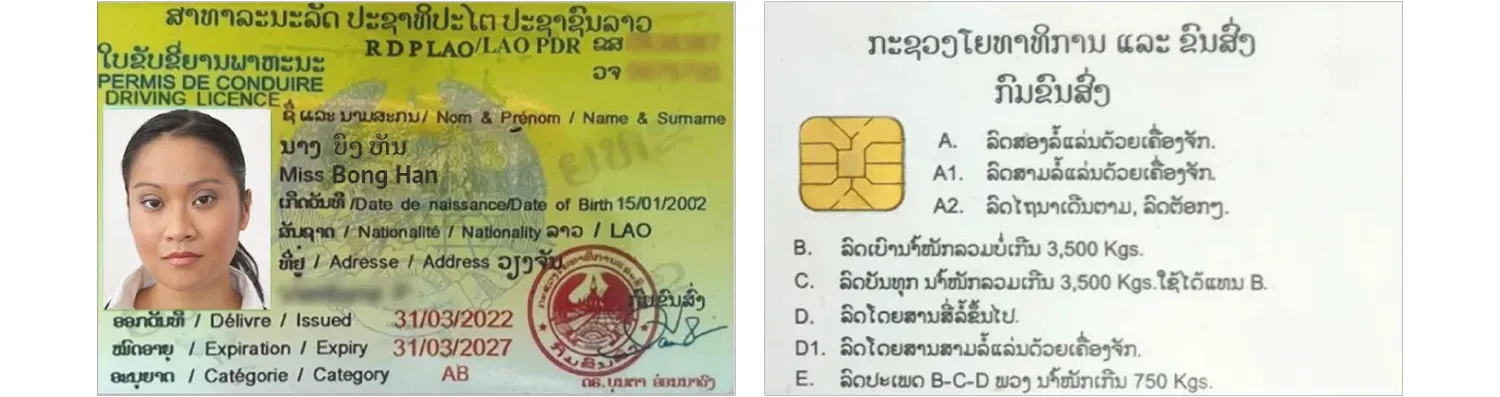
Unlike the passport, Laotian driver’s licenses contain more personal data, such as name, address, and nationality, in both Lao and English.
Subscribe to receive a bi-weekly blog digest from Regula
Potential OCR failures during ID capture
Laotian identity documents are visually striking — something they share with many other Asian countries that have issued some of the world’s rarest passports. These IDs often have colorful background patterns printed on paper-based substrates, and are typically laminated. Because of this fact, Laotian identity documents can create problems before verification even begins.
In remote verification, these design features can create extra challenges during the capture stage. Glare from lamination, reflections from holographic features, low contrast between text and background, or a photo taken at an angle and with a flashlight can make personal data harder to read accurately. This becomes even more of a problem when the image is captured on a low-resolution mobile camera or under poor lighting.
.webp)
When scanned at an angle, the Laotian passport reflects incident light, highlighting national symbols and the official name — LAO PDR. In such conditions, the text may become unreadable.
For remote identity verification, that raises the importance of guided capture, image quality checks, and document-aware preprocessing. Without those controls, the failure may look like a recognition problem when the real issue is the image itself.

The previous national Laos ID card series includes a red stamp that may overlap text. Also, it has a laminated lime-green background that offers lower contrast against black printed text.
A mixed document landscape
One of the practical challenges in Laos is that not all identity documents support the same level of verification.
For years, stronger chip-based verification was mainly realistic for passports. The country began issuing biometric passports in 2016. These documents are ICAO-compliant and contain an RFID chip storing the holder’s facial image and signature, in addition to a printed photo on the data page. However, domestic credentials such as national ID cards and driver’s licenses remained non-electronic.
In late 2025, Laos began a nationwide roll-out of a digital national ID card. While it’s definitely a positive development, different credentials require different verification logic. Earlier non-electronic ID cards are still in circulation and depend on visual inspection, template-based checks, and OCR, whereas the new ID card adds the option of stronger chip-based verification.
The roll-out of the new digital national ID is being pushed hard. In mid-January 2026, local reporting said police units were instructed to speed up issuance with a daily production target (reported as 220 cards per district per day). If that pace holds, these cards should start appearing more often through 2026.
Laotian Family Books and other non-standard documents
Not all commonly used identity documents in Laos follow the formats typically expected in identity verification workflows.
One example is the Family Book, a paper-based document issued by the Ministry of Public Security. It records key life events such as births, marriages, education, and residence, and may include photos and personal details of multiple family members. Typically, they are life-long documents, updated only when a family adds a new member or changes address.
However, this document type is now being phased out as Laos moves toward a digital population management system. New “household information certificates” are expected to replace traditional Family Books, reflecting a broader shift toward centralized and digital identity records. Previously issued Family Books remain valid until their expiration date, so they will likely continue to appear in verification workflows for some time.

Dark blue Family Books were granted to Lao nationals, while red Family Books were issued to foreign expatriates.
Laos also issues documents for non-citizens, including stay permits, work permits, and temporary driver’s licenses. These documents are less common in remote identity verification flows, but they still matter for systems that need to support a broad set of identity scenarios.
Some Laotian documents also depart from field structures that verification systems may expect. For example, driver’s licenses don’t include a gender field, which means workflows cannot rely on fixed field presence and instead need document-aware parsing logic.
How to effectively process Laotian IDs
Processing Laotian IDs starts before OCR. The workflow should first control the input: catch glare, blur, poor cropping, and low contrast. With laminated documents, this step prevents avoidable false rejections.
Next, OCR has to be document-aware, as Lao script support is only the baseline. The system should understand where fields usually appear, which fields may be missing, and how to interpret available context. For example, if a driver’s license has no dedicated gender field, Regula can derive it from titles such as Mr., Miss, or Mrs., which are specified next to the holder’s name.
The workflow should also match checks to the document type. An older domestic ID, a biometric passport, and a new chip-based national ID card should not go through the same verification path. Regula’s document template database helps identify the exact document type and series first, then apply the relevant checks: OCR, template validation, MRZ and barcode reading, RFID/NFC verification, or escalation to manual review when needed.
Laotian documents may look straightforward at first glance, but reliable processing depends on small details: field placement, font consistency, security elements, stamps, document series, and data structure. Regula builds this knowledge into its document templates, so verification teams don’t have to rely on generic OCR and one-size-fits-all rules.
Regula Document Reader SDK delivers all of this and more, ensuring fast, secure, and user-friendly identity verification. Learn more about the solution and how it can help you solve document verification challenges for your organization.
.webp)