
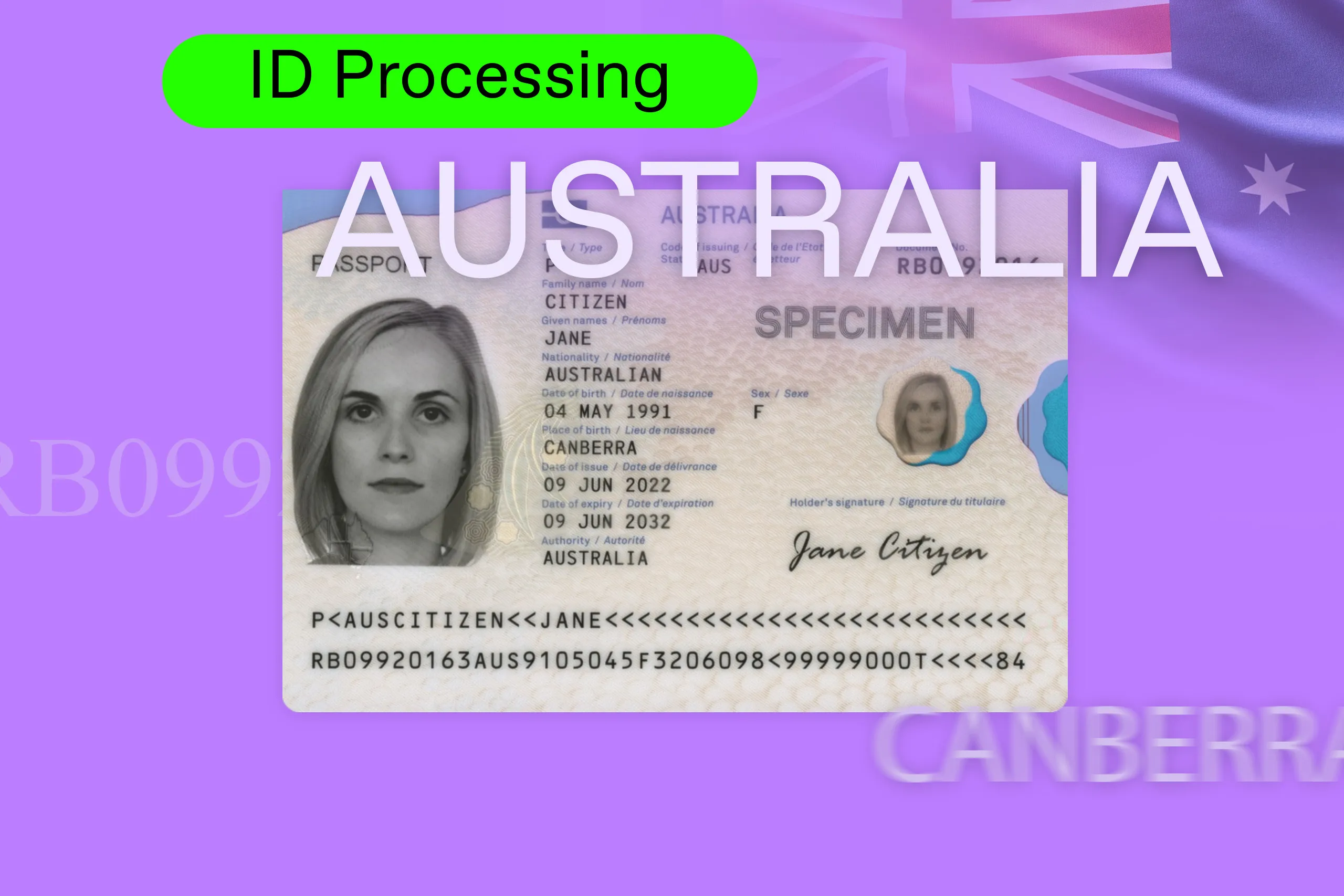
Australia is the only country that occupies an entire continent. It spans the mainland, Tasmania, and numerous smaller islands, with six states and two self-governing territories.
Its identity document landscape is just as decentralized. Australia has no national identity card, so businesses may encounter passports, driver’s licenses, photo cards, and other documents issued by different authorities across the country.
In this article, we’ll look at the Australian IDs that are most relevant for identity verification and the features that make them easier — or harder — to process accurately.
💡 If you’re new to this series, you may also like our other posts:
The challenges of processing Australian IDs
Australian IDs are relatively straightforward in one respect: they are issued in English, which removes the multilingual OCR challenges common in many other markets.
The harder part is document variety. Domestic IDs are issued at the state and territory level, so layouts, datasets, security features, and machine-readable elements can differ significantly between jurisdictions and document series.
Passports are the main exception. They are issued nationally and follow ICAO standards, making them much more consistent than most domestic Australian documents.
An Australian passport is the only common biometric document
Since Australia has no land borders, every international trip is by air or sea and requires a valid passport. Australian passports are used strictly for travel and come with strong security features.
Australia has a long history of adopting international standards for travel documents. The country was among the first — alongside the US and Canada — to issue machine-readable passports in 1980. Australia is a member of ICAO’s Technical Advisory Group, so it’s also a good example of a state actively involved in developing and adopting international standards and specifications for travel documents.
Australia has issued only biometric passports since 2005, with new features added in each series.
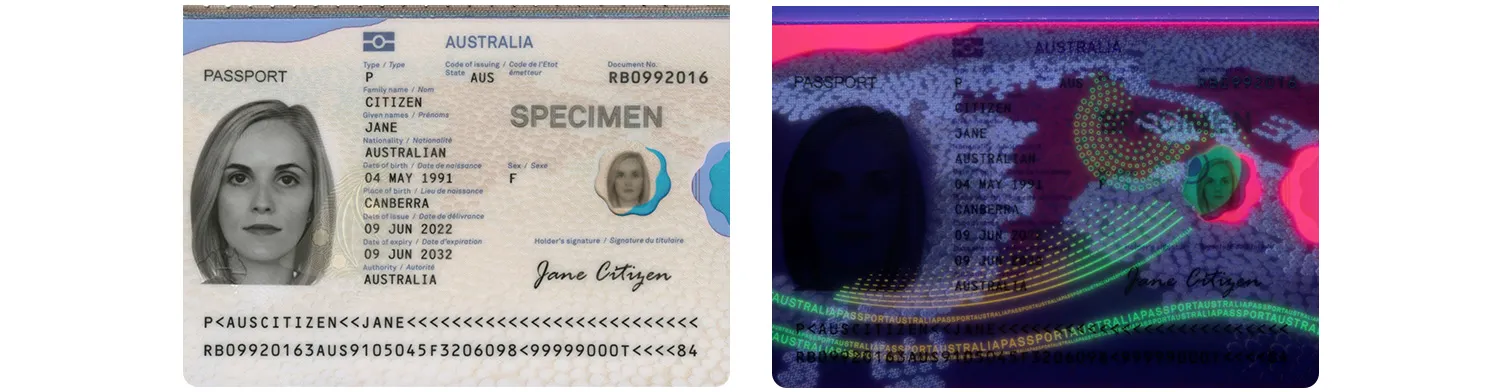
Under the recent passport standard changes, the Type code in newly-issued passports is now "PP" rather than "P"
The current, fully ICAO-compliant R Series passport was introduced in September 2022.
Its polycarbonate data page includes a transparent window, three ghost portraits, and several holograms. The embedded chip stores the holder’s personal data and digital facial image. When paired with NFC verification, all of these make the Australian passport harder to forge and easier to authenticate remotely.

One of the passport's holograms appears next to the photo. It can help check document liveness — but if scanned incorrectly, it may interfere with nearby data.
The passport contains the standard dataset. One exception is the Sex field. In addition to Male and Female, it may also display X — a marker used by holders who choose not to specify their gender. In the MRZ, however, ICAO standards represent non-specified sex with the filler character '<'.
Since the visual field and MRZ don’t contain the same character, even though they refer to the same holder attribute, some systems can treat it as a mismatch. Regula Document Reader SDK is trained to handle such cases and can process passports like these without errors.

The Australian Passport Office uses X for non-binary, indeterminate, intersex, unspecified, or other gender markers.
Australia also issues biometric travel documents to non-citizens, including Convention Travel Documents and Certificates of Identity. They are passport-like documents intended for people who cannot use a regular national passport, such as refugees, stateless persons, or people unable to obtain a travel document from their country of nationality.
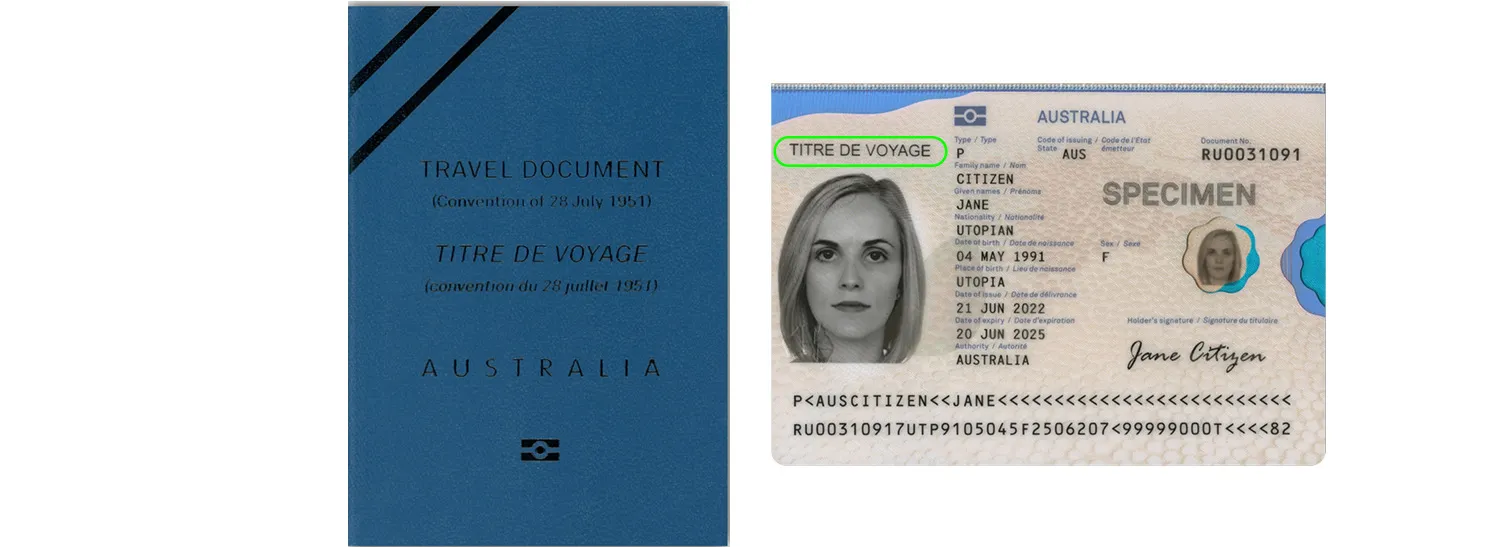
The convention travel document is valid for up to three years.
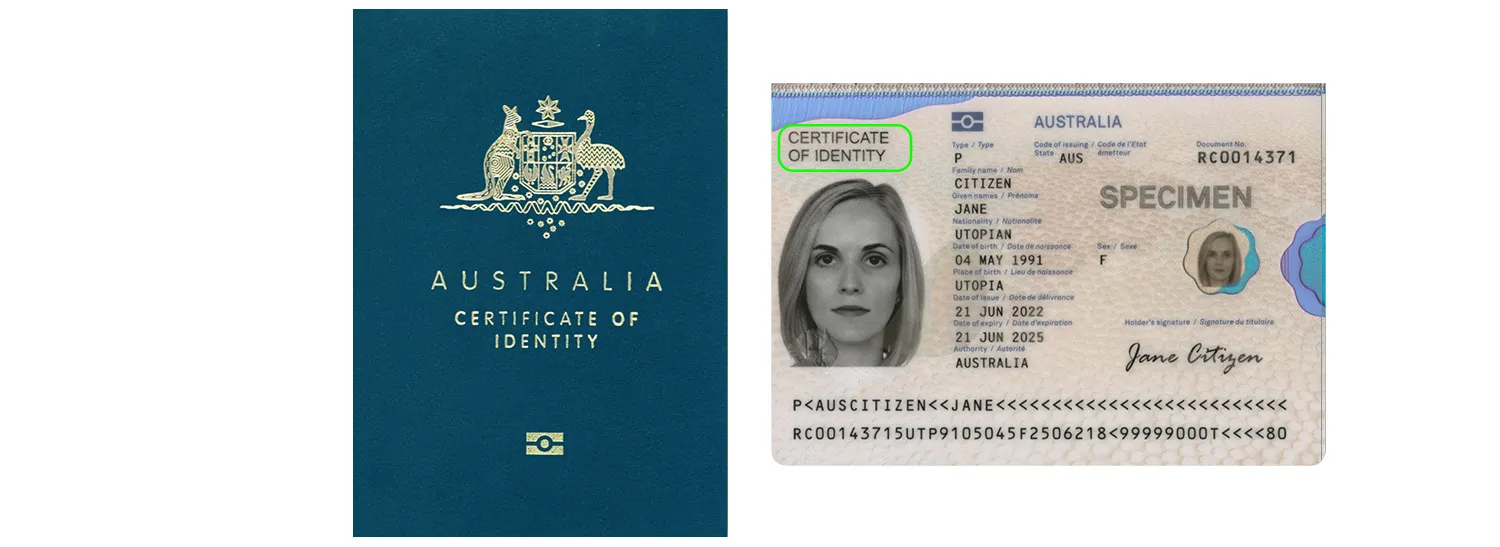
The certificate of identity is for individuals leaving Australia who are stateless or unable to get a travel document from their home country.
State-by-state differences in driver’s license design and data
Australia’s states and territories issue their own driver’s licenses, which means there’s no single national design. Still, the documents share some common elements: they are made of polycarbonate, include a photo, and follow a uniform vehicle class system.
For example, C is for car drivers, R is a motorcycle license, and HR is for heavy vehicle operators. The applicable class or classes are shown on the front side of the document.


The license class (or classes) is specified on all documents, no matter the state.
Beyond these common elements, layouts and datasets vary by jurisdiction. A license may include the holder’s name, date of birth, address, signature, license number, issue and expiry dates, as well as additional fields such as height.
There is also a Condition field where codes for special driving restrictions are specified: for instance, A — only vehicles with automatic transmission, S — must wear corrective lenses while driving, etc.

Queensland licenses include the holder’s height and a ghost image beside the main photo.

In New South Wales, donor status appears on the license.

Condition codes are standardized across all states, as seen in this example from Victoria.
Despite the variety of designs, Australian driver’s licenses are largely non-electronic documents. Dynamic security features and machine-readable elements are limited, while many checks still depend on visual document features and the data printed on the card. This makes remote authentication more challenging.
As a result, accurate image capture and OCR matter a lot. Recognition engines need to handle different layouts, fonts, field positions, intricate backgrounds, bright design elements, and transparent areas that can interfere with mobile scanning.
Driver’s licenses from Victoria and Tasmania, for example, feature transparent areas where important data is printed over the clear surface. If the document is captured against a dark background, the lack of contrast can make the data harder to recognize. That’s why user-friendly hints are essential during in-app driver’s license verification.

The wavy background and transparent stripe on Tasmanian driver’s licenses can obscure the holder’s date of birth.
Most states and territories also issue licenses based on driving status: learner, provisional, or full. These versions often differ in color. In South Australia, for example, learner licenses use yellow markings, provisional licenses red, and full licenses blue.
Some jurisdictions also issue special license types for more specific situations. Queensland, for example, may grant a work license to certain drivers convicted of alcohol- or drug-related offenses, allowing them to drive only for work-related purposes. The document valid at the time of the offense is often called a "day license."

In South Australia, learners receive yellow-marked licenses, provisional drivers get red, and fully licensed drivers are issued blue.
Mobile driver’s licenses in Australia
Australia was an early adopter of digital driver’s licenses, and several states already issue them through their own mobile apps. For businesses, this means a customer may present a digital license instead of a physical card during an identity or age check.
Today, South Australia, New South Wales, Queensland, and Victoria issue digital licenses. The exact format varies by state, but the general model is similar: the license is stored in a government app that may also hold other credentials. Users can typically present it on screen or share verified data via a QR code. Certain implementations, such as Queensland’s, also support selective disclosure, so only the information needed for a specific check is shared.
Some states are now introducing digital licenses that can be verified as digital credentials, rather than simply displayed in an app. In New South Wales, for example, users can upgrade their Digital Driver License to a verifiable credential based on the ISO/IEC 18013-5 standard for mobile driver’s licenses.
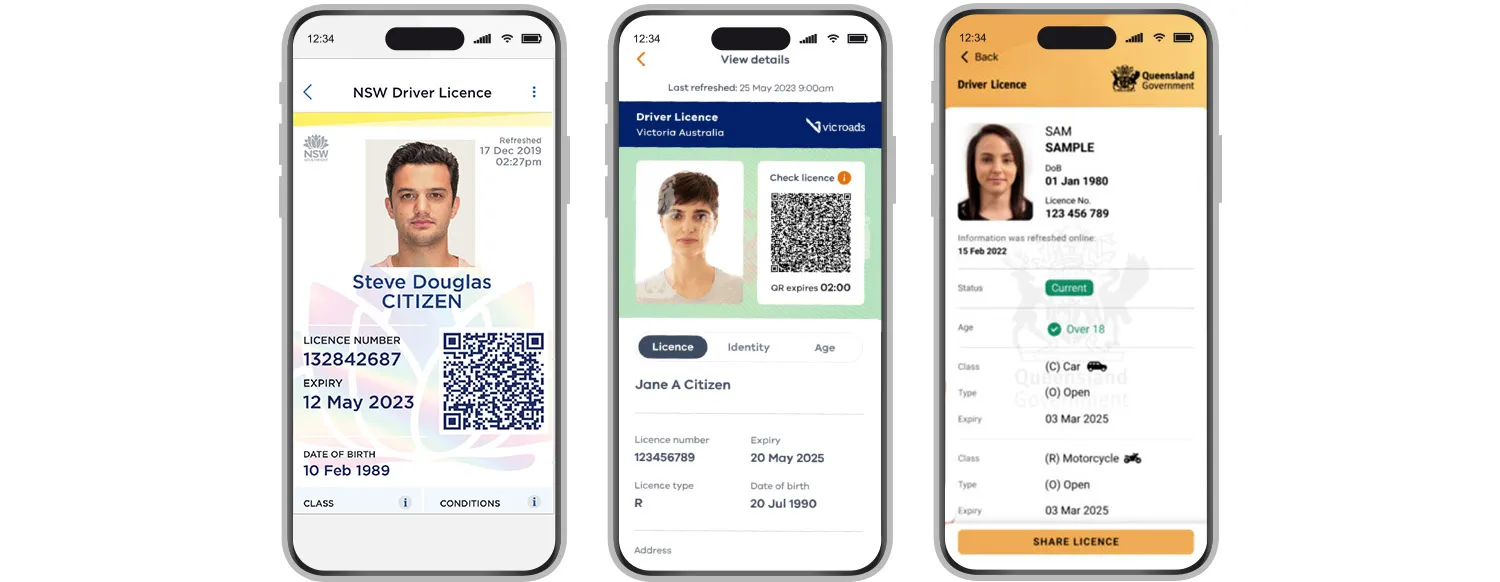
State authorities warn against treating screenshots as equivalent to a live digital credential.
Standalone licenses for water transport
Since none of Australia’s states or territories are landlocked, residents often operate watercraft in addition to cars or motorcycles. Some regions, including Queensland, Victoria, and New South Wales, issue dedicated identity documents for recreational boating.
These documents have distinct designs and typically grant permission to operate personal, non-commercial vessels used for leisure. Like driver’s licenses, they are issued in learner, provisional, and open categories, which determine when and how the holder is allowed to operate a boat.
Interestingly, marine license information may also appear on the reverse side of a regular driver’s license. For those without a driver's license, a separate marine license indicator card is available.

In some states, like Queensland, a marine license can be valid for life.
Photo cards for minors and adults
Although there’s no nationwide Australian identity card, each state and territory offers alternatives. These are known by various names: photo identity cards, proof of age cards, evidence of age cards, proof of identity cards, and more.
These voluntary documents are usually issued to non-drivers, often by the same authorities that handle driver licensing, like the Roads and Maritime Services. Because of this, photo ID cards can resemble driver’s licenses. They’re made of plastic, come in various styles, but most include a photo, date of birth, and signature.
Eligibility rules vary by jurisdiction. In Queensland, applicants can get a photo ID card from age 15; Tasmania has no minimum age requirement; and the Australian Capital Territory, by contrast, issues its proof of identity card only to residents aged 18 and older.
These cards are often used as proof of age, for example, when buying age-restricted products.
Expiration terms also vary by region. Some cards are valid for 5 to 10 years, while others have no expiration date.

In Queensland, two versions exist: red for minors and green for adults.
Like for driver’s licenses, remote verification of Australian photo ID cards requires a large and varied sample database. Most photo ID cards don’t include an MRZ or electronic chip, although some jurisdictions use barcodes. So, verification often depends on precise image capture and OCR accuracy.

Western Australia’s photo card, for example, includes a barcode on the reverse.
Australia also issues Medicare cards for access to healthcare services. These aren’t equivalent to passports or driver’s licenses as primary proof of identity, but they may still serve as supporting evidence of identity in some verification flows.
A Medicare card typically displays the holder’s name, but it can also include other family members, especially children. Along with the names, the card contains a unique number and an expiration date.
In addition to standard Medicare cards, Australia issues special cards for veterans, retirees, foster carers, and other groups.
Because all these cards lack dynamic security features or machine-readable zones, your identity verification software must rely on accurate OCR. To recognize and extract the correct data, it first needs a relevant template.

Medicare cards come in different colors: green for standard cards, blue for interim cards, and yellow for Reciprocal Health Care Agreement cards.
How to effectively process Australian documents
Australia’s document landscape is almost as diverse as its wildlife. If you operate in this market, broad coverage matters — and so does the ability to add support for less common or newly issued documents quickly.
Since many Australian domestic IDs are non-electronic and come in a wide range of designs, this puts more pressure on OCR and capture quality. A good verification flow should not only read these documents accurately, but also guide the user when glare, background, or positioning gets in the way.
Remote verification adds another challenge. When a document has no chip for authentication, document liveness becomes much more difficult: the system needs to distinguish a real physical document from a screen, a printout, or another presentation attack. This is one of the areas where vendor capabilities can differ significantly.
Regula Document Reader SDK combines broad document coverage with template-specific recognition, guided capture, and document liveness checks. If you need to process a document that isn’t supported yet, a new template can be added on request.
Need to support Australian IDs in your verification flow? Tell us which documents you need to process, and we’ll help you assess the right setup.