

.webp)
As the sixth-largest island country by area in the world, New Zealand has a diverse population, with Europeans and Māori as the major ethnic groups. At the same time, the country has just over 5.3 million residents, which helps simplify identification processes and leaves more room for innovation.
Balancing traditions and technologies, New Zealand’s identity documents are a distinctive example worth reviewing.
💡 If you’re new to this series, you may also like our other posts:
The challenges of processing New Zealand IDs
New Zealand is an independent parliamentary monarchy, with King Charles III as its sovereign, which ties the country to the UK in many ways, including language. All ID documents issued in New Zealand are in English. However, some of them also contain data in Māori, the country’s second official language.
New Zealand also follows global ID issuing standards, such as ICAO recommendations, and is often among the early adopters of the latest technologies.
All this makes New Zealand ID verification a fairly standard task. Still, there are specific features to consider.

Get posts like this in your inbox with the bi-weekly Regula Blog Digest!
New Zealand passports: Biometric with rare security features
Since 2005, New Zealand has issued chip-enabled travel documents. After that, the country updated its passports in 2005, 2009 (the first version with a polycarbonate datapage), 2016, 2020, and 2025.
The major differences can be seen when comparing the 2016 and 2020 series. By the way, the previous version is still in circulation. One of the key changes in 2016 was the full transition to passports valid for 10 years. Earlier series were valid for only five years, which is uncommon for this type of travel document.
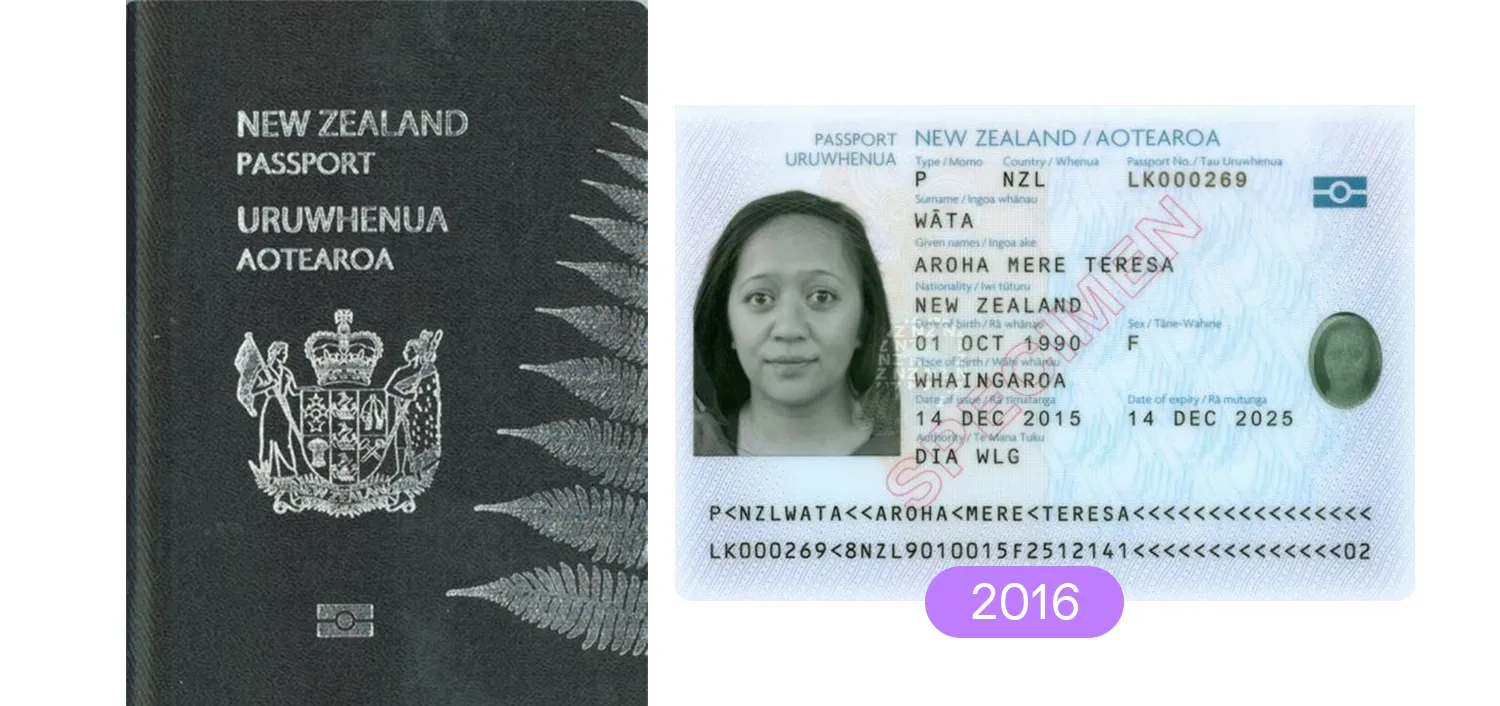
The 2016 New Zealand passport features a standard dataset and a fully ICAO-compliant design. The cover contains inscriptions in two official languages: English and Māori.
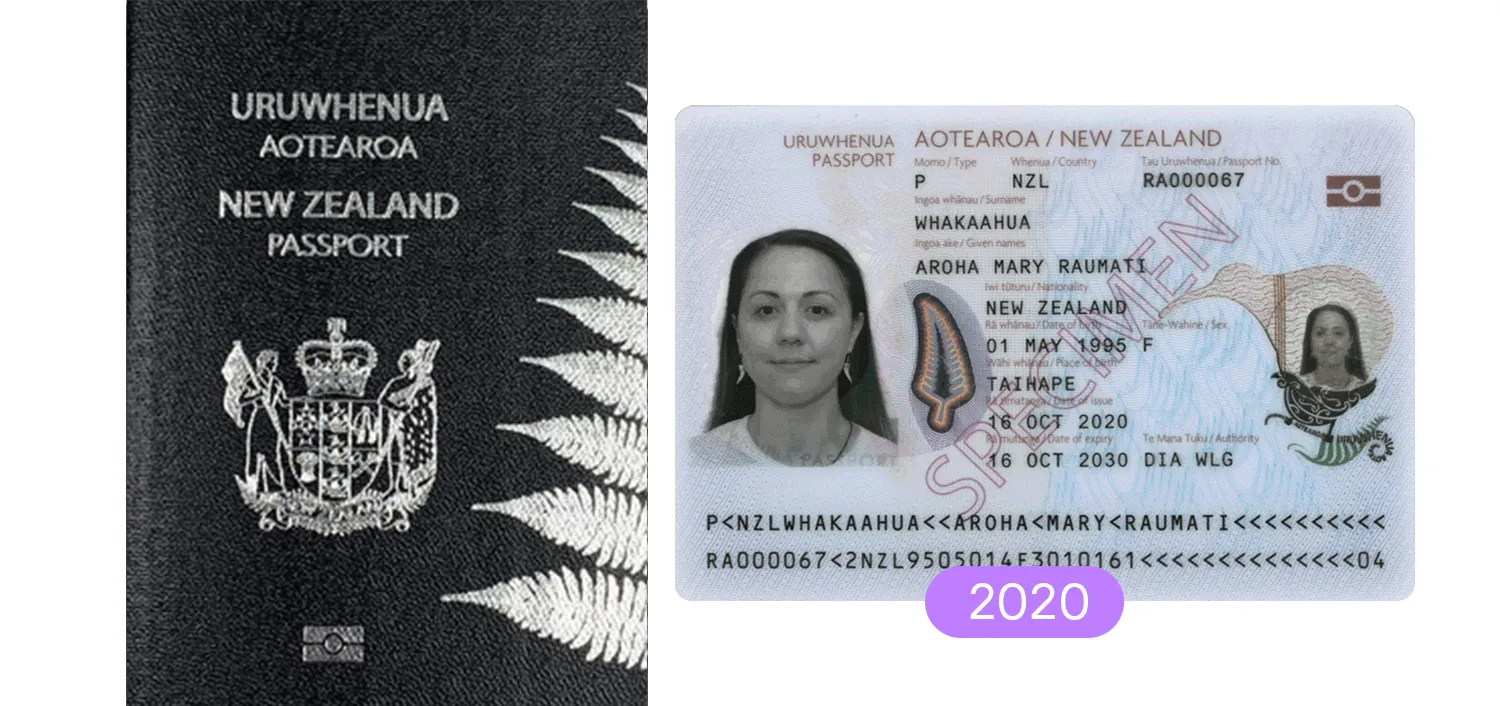
In 2020, the New Zealand passport received an updated design, including changes to the datapage and cover. Notably, the inscription in Māori appears first.
The 2020 passport became an example of a highly secure travel document, incorporating many modern features. It’s also often listed among the most beautiful passports in the world thanks to its authentic, vibrant design that reflects New Zealand’s culture and nature.
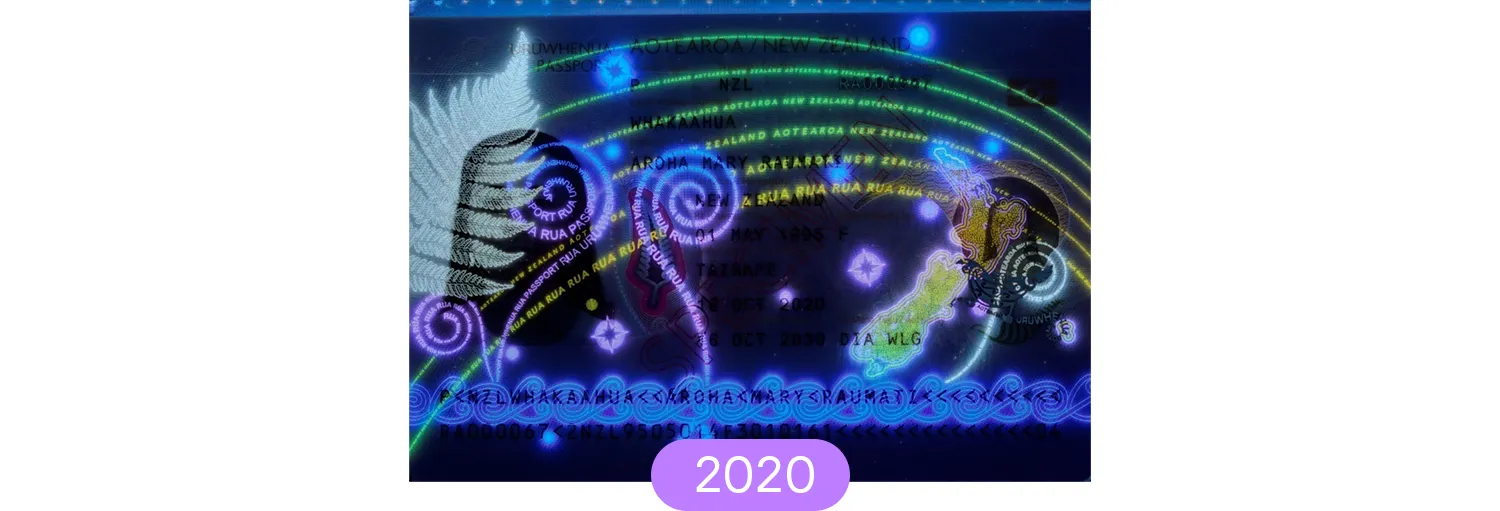
This version includes two ghost portraits in addition to the main photo. One of them is visible through a transparent window on the datapage. Below is a small green fern printed with thermochromic ink — a special dye that changes color depending on temperature.
As one of the rare security features used in ID documents, it creates a striking effect. If you place a finger over the fern and warm it to body temperature, the image disappears.
💡Features printed with thermochromic ink can also be found in passports from Finland, Ireland, and Austria — countries with populations under 10 million.
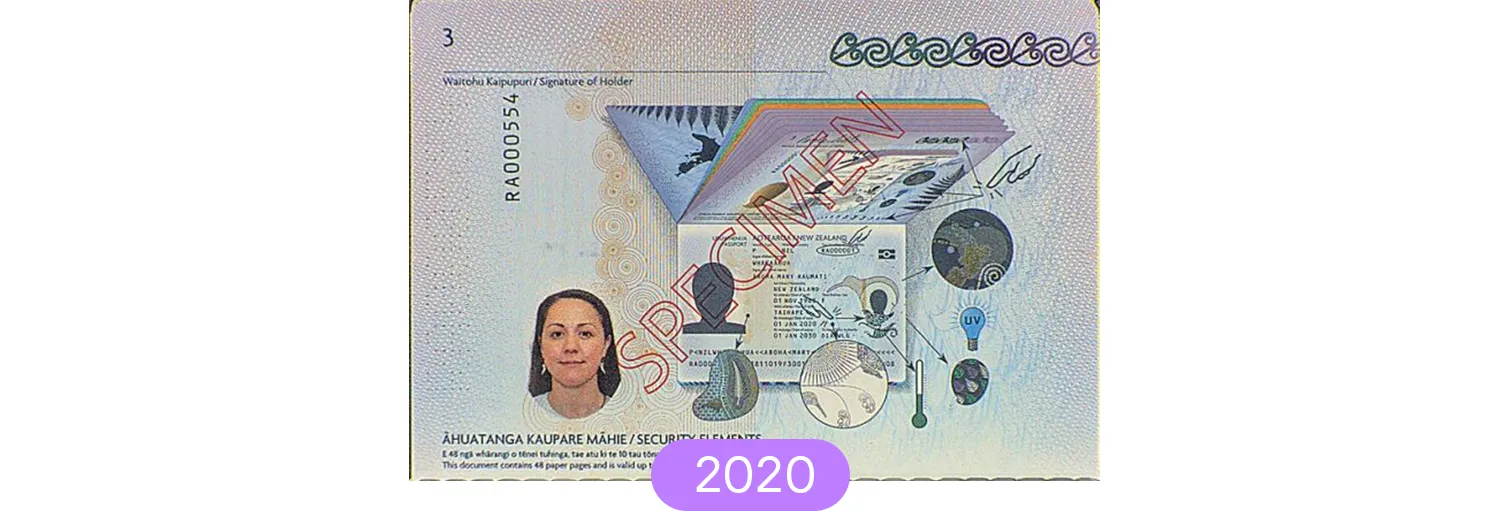
Page 3 of the 2020 New Zealand passport serves as a kind of cheatsheet, describing some of the security elements used in the document.
Another fern appears as a hologram next to the main photo. To prevent it from overlaying with textual data, the layout is shifted slightly to the right, which makes mobile scanning easier. This feature can also support document liveness during remote authenticity checks.

The latest series, introduced in 2025, includes only minor updates. The most notable change is the addition of a new two-letter passport code in both the visual inspection zone and the machine-readable zone (MRZ): PP instead of P for ordinary documents. This change aligns with ICAO Doc 9303 requirements, effective from January 1, 2026.
Another detail worth mentioning is that New Zealand passports currently in circulation may contain slightly different wording on the inside cover. Beneath the coat of arms, there is a message referring to the sovereign. Some passports mention the late Queen Elizabeth II (Her Majesty or Kuini Erihapeti Tuarua). Passports issued after 2023 may instead refer to King Charles III — His Majesty (Kīngi Tiāre te Tuatoru).
Online verification for New Zealand passports should also include chip reading. This is a standard process and poses no challenges for NFC-enabled devices where an identity verification app is used.
In addition to passports, New Zealand issues travel documents for foreign nationals. The most common ones (used both domestically and internationally) are certificates of identity and refugee travel documents.
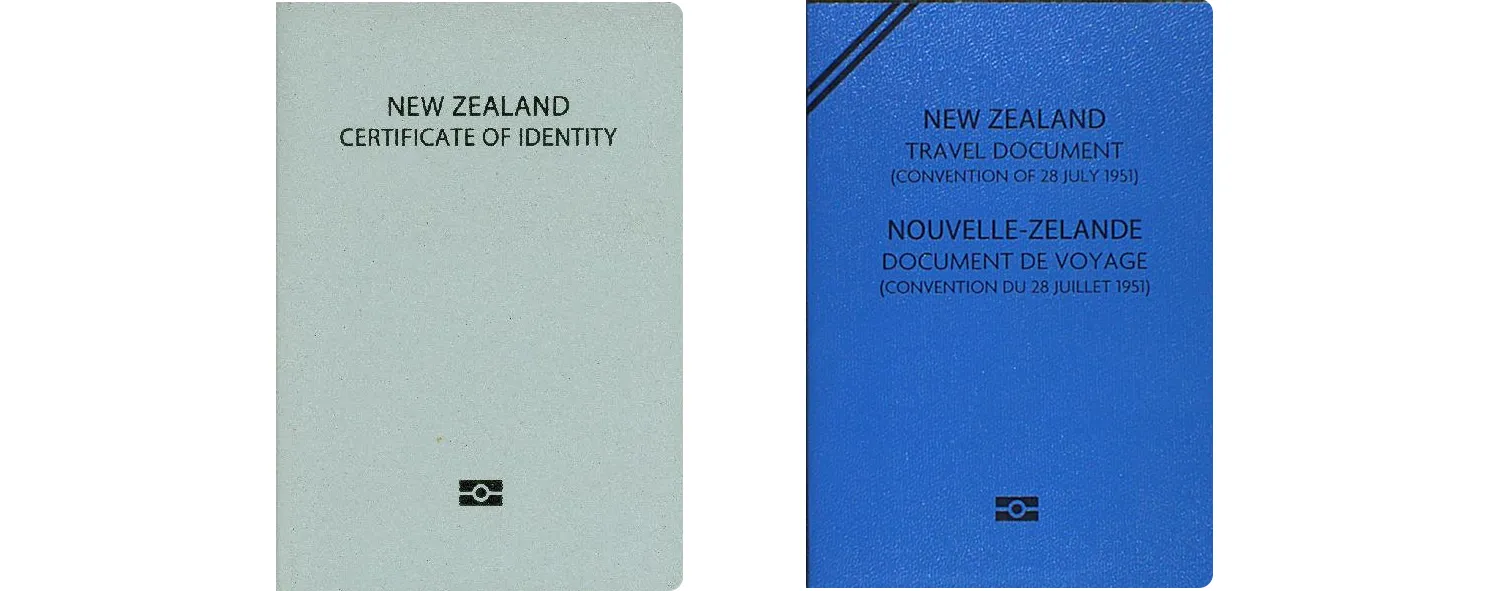
The internal design of these documents is similar to that of passports. The main difference lies in their validity period: up to two years for certificates and up to five years for refugee travel documents.
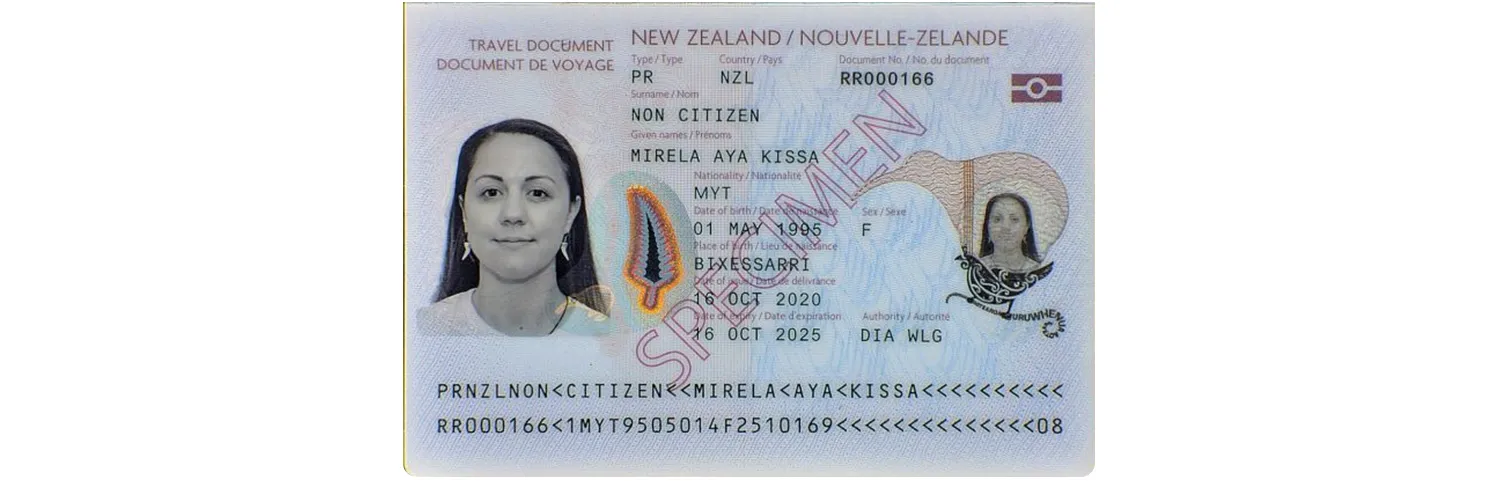
The datapage in the current version of the New Zealand refugee travel document resembles that of a passport.
New Zealand national ID cards: Common proof of age and identity
While passports are mainly used by New Zealanders for international travel, Kiwi access cards serve as proof of identity within the country — for example, when buying age-restricted products or opening a bank account.
Kiwi access cards are issued to individuals aged 18 or older. As a common identification alternative to driver’s licenses and passports, they are also valid for ten years.
The issuance of Kiwi access cards is managed by Hospitality New Zealand, an industry membership organization. IDs are approved under the Sale and Supply of Alcohol Act. In this sense, the concept is similar to the UK’s Citizen Cards, which are issued as proof of age.
The document’s name comes from the informal demonym for New Zealanders, which is based on the kiwi, a flightless bird endemic to the country, and also its national symbol.
The New Zealand national ID card is made of polycarbonate and contains only the minimum personal data required to confirm age: name, date of birth, and the dates of issuance and expiration.
In online scenarios, this data can be captured using OCR technology. However, there are some challenges. The card features a holographic background and a semi-transparent element showing an outline of New Zealand. These elements overlap with the data, and may cause glare and visual noise during scanning. Also, the card number in the bottom right corner, which may also be used for verification, is embossed, creating another visual obstacle.

The latest version of the Kiwi access card features two portraits of the holder along with their main personal details.
Alongside the Kiwi access card, many New Zealanders still use the evidence of age document for similar purposes. It contains the same dataset but has a different design and layout. Notably, it’s easier to scan because it lacks complex visual elements.

The 2014 evidence of age document was the previous version of the Kiwi access card.
New Zealand firearms licenses: Common ID for minors and adults
In addition to ID cards, residents and visitors of New Zealand may hold firearms licenses. While primarily issued for possessing, selling, or using non-prohibited firearms, for instance, for hunting or competitions, these licenses also serve as a widely accepted form of photo ID. For instance, holders can use them to identify themselves when applying for a driver’s license.
Notably, eligible applicants must be at least 16 years old, which means the document can also serve as proof of age. For citizens, the license is valid for five years, while visitors may obtain one valid for up to 12 months from their arrival date.
There are two versions of the firearms license currently in circulation, each with a distinct design. The older version includes the holder’s portrait, name, date of birth, and expiration date. This data can be easily captured in online verification scenarios.

The earlier series of the New Zealand firearms license — issued before 2021 — remains in circulation.
In 2021, an updated version was introduced. It features a holographic background, which can be somewhat challenging to scan using a phone camera, and includes two portraits of the holder — the main photo and a ghost photo in a transparent window. Also, the card contains a unique three-digit version number used for license authentication.
Textual data is accompanied by a Code 128 barcode that stores the license number, which is also printed below it, and a unique three-digit number.

The 2021 firearms license includes additional security features, such as a unique document number and a barcode. A magnetic stripe on the reverse side can be used at ammunition sales points.
New Zealand driver’s licenses: Many color-coded types
The country has updated its driver’s licenses at least three times — in 2007, 2013, and 2014. The 2014 series is currently the most common. However, 2013 licenses are still in circulation.
The 2013 and 2014 versions differ only slightly. The classification of vehicle categories remains the same. For cars and motorcycles, there are learner’s, restricted, and full licenses. For other vehicle types, the restricted stage may be omitted.
The minimum age varies depending on the license type: from 16 for learner’s and restricted licenses to 18 for full licenses.

In New Zealand, there are at least three types of driver’s licenses — learner’s, restricted, and full — each distinguished by background color.
Another distinct type is the zero alcohol license. It’s issued to drivers sentenced by the courts or those approved to exit the alcohol interlock stage under the alcohol interlock program. These licenses include a corresponding inscription on the front.
All licenses contain the holder’s name, date of birth, version, license numbers, address, and donor status. This data can be captured with OCR. However, the wavy background pattern featuring the country’s name on the front may cause glare during scanning.

Vehicle classifications are placed on the reverse side of the license. A barcode is also included and can be read during verification.
Other domestic IDs in New Zealand
The country also issues more specialized IDs for specific purposes, such as accessing healthcare benefits or receiving discounts in stores and on public transport.
These documents are issued by public institutions or third-party providers. In some cases, they may also be accepted as supporting identity documents when applying for government-issued IDs, such as a driver’s license.
Examples are the StudentCard, the Community Services Card (for low-income individuals and families, people with disabilities, and seniors), and the SuperGold Card (for elderly people and veterans). Most of these documents don’t include a photo but contain personal details that can be captured using OCR.
How to effectively process New Zealand documents
While New Zealand’s travel documents are fully ICAO-compliant, its domestic IDs vary widely. To support remote verification of passports, ID cards, and other proof-of-identity documents, your IDV toolkit should include the following components:
NFC-enabled verification: New Zealand’s passports, certificates of identity, and refugee travel documents contain electronic chips. Reading and verifying the chip data is essential for secure online checks.
Document liveness detection: Holograms and holographic backgrounds are used in many New Zealand IDs. To ensure the user submits a genuine document during remote verification, the system should detect and validate these dynamic security features.
Barcode reading: New Zealand IDs mostly use standard barcode formats. The encoded data should be extracted and cross-checked against the visual information to prevent AI-generated or digitally altered manipulations.
Access to document references: Many domestic IDs, such as Kiwi access cards, rely primarily on OCR in online scenarios. However, capturing data accurately is not enough; the document itself must also be verified against an official reference template. It’s important to have access to a database such as Regula’s, which contains 16,000 templates from 254 countries and territories.
ID image quality assessment: Intricate design elements like wavy background patterns or semi-transparent overlays can complicate scanning with a mobile camera. Smart image quality assessment algorithms within an IDV solution help users capture appropriate images on the first attempt.
Still have questions about verifying New Zealand documents, or want to discuss your specific case? Feel free to book a call with a Regula expert at your convenience.