
Located in Central America, Costa Rica stands out for its high levels of literacy, democracy, and economic development in the region. With a population of just over 5 million, it’s comparable in size to countries like Norway, Finland, or Oman.
This level of progress is also reflected in its approach to identification. Smaller countries often have an advantage when it comes to implementing innovations and updating ID systems more quickly than larger nations. However, Costa Rican identity documents come with unique features that can sometimes complicate verification.
In this overview, we highlight the key details to keep in mind.
The challenges of processing Costa Rican IDs
Before we get into the technical details, it’s worth clearing up a common misconception.
Many Google searches show that people often confuse Costa Rica with another nearby place that has a similar name: Puerto Rico.
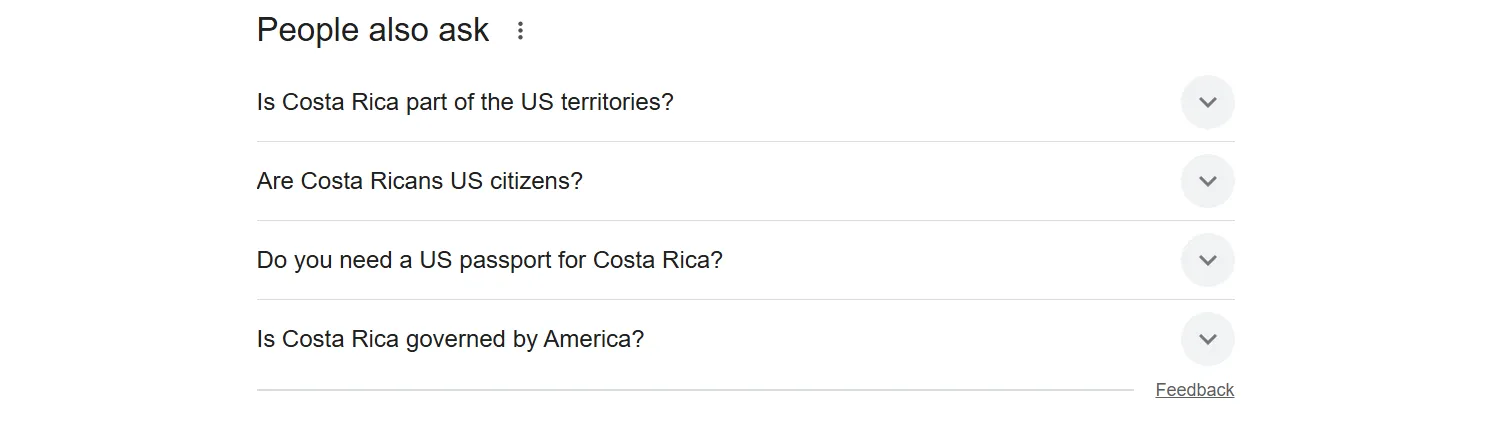
A quick Google search reveals frequent questions about Costa Rica’s relationship with the US.
But the two are very different. Puerto Rico is not an independent country, it’s a territory of the United States. Its residents are US citizens and use standard US passports. Geographically, Puerto Rico is an island, while Costa Rica is part of the mainland, bordered by the Caribbean Sea and the Pacific Ocean.
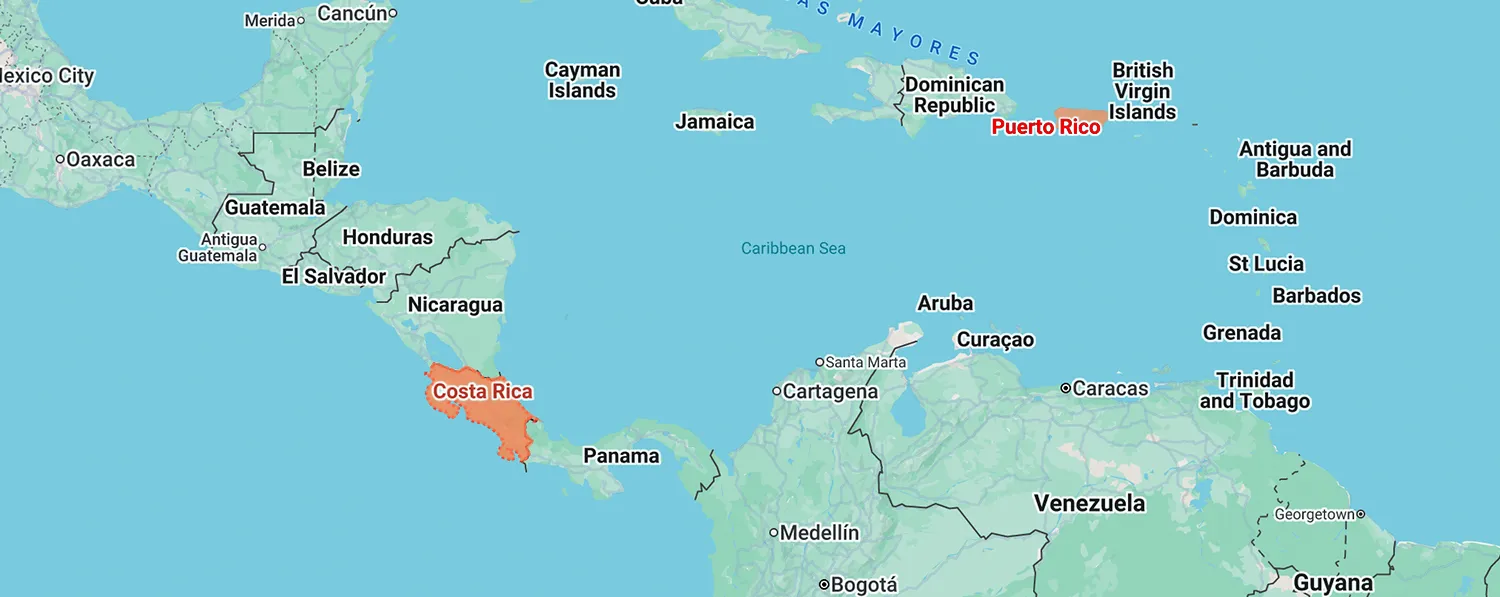
Costa Rica, neighboring Nicaragua and Panama, has a Caribbean coastline. Puerto Rico, by contrast, is located in the Caribbean Sea.
To be fair, they do share a few things: similar names and Spanish as the official language. But there’s an important difference — Puerto Rican passports are issued by the US and are in English, while all Costa Rican ID documents are issued locally and written in Spanish.
Now that we’ve cleared that up, let’s examine the main types of Costa Rican IDs.

Get posts like this in your inbox with the bi-weekly Regula Blog Digest!
Costa Rican passports: Two distinct series in circulation
In Costa Rica, there are two versions of the passport currently used — from 2017 and 2022. According to the Henley Passport Index, the latest biometric passport is the strongest in Central America, granting visa-free or visa-on-arrival access to about 148 countries. It also includes over 60 security features, making it highly secure.
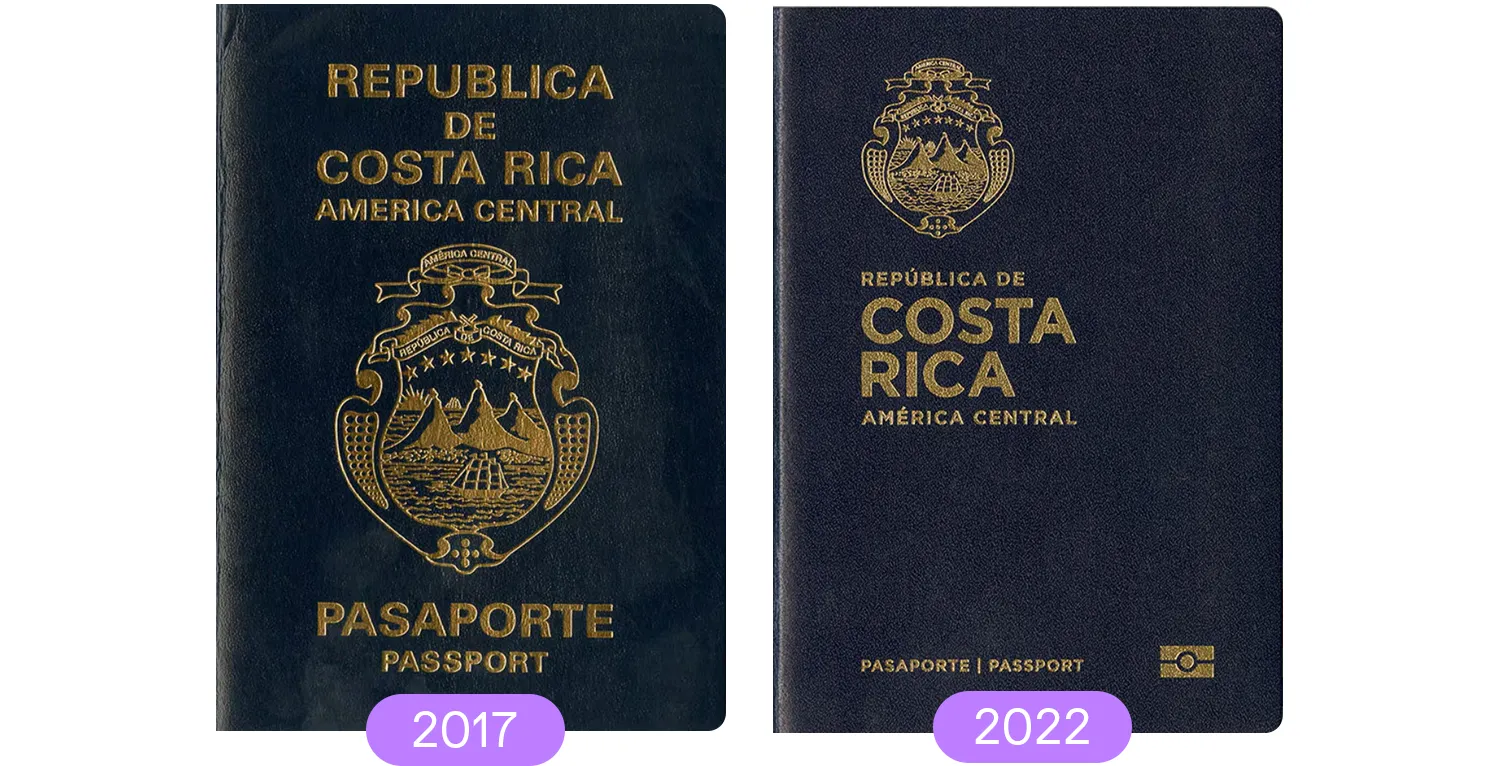
The 2022 passport differs from the 2017 series starting right from the cover.
The 2017 series doesn’t include an electronic chip and has a different layout and datapage design. It’s similar to the older 2006 version, which featured both a machine-readable zone (MRZ) and a barcode.
By contrast, the 2022 biometric passport introduces a polycarbonate datapage with advanced dynamic security features like Optically Variable Ink (OVI), Multiple Laser Image (MLI), and two portraits of the holder — one main photo and one ghost image in a transparent window.
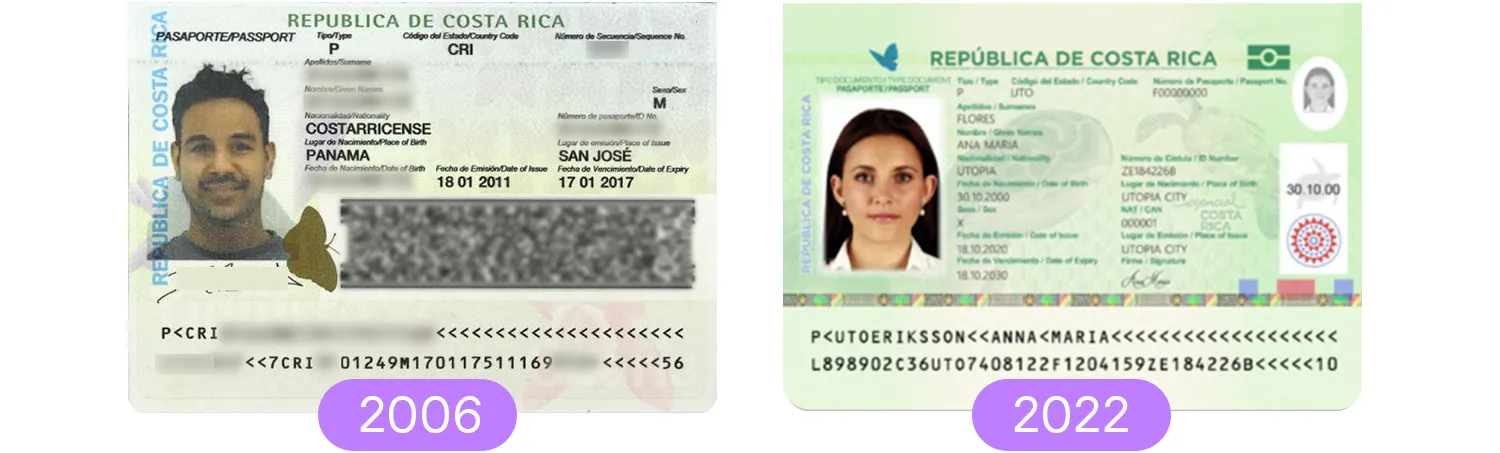
A comparison of the 2006 and 2022 series — the latter of which is biometric — shows how Costa Rica’s passport design and security have evolved significantly.
Another difference is validity. The latest passport is valid for 10 years, in line with ICAO standards, while both the 2006 and 2017 series are valid for up to 6 years. That means the 2017 version will remain in circulation until at least 2028.
For verification, the non-biometric Costa Rican passport requires OCR scanning, machine-readable zone (MRZ) reading, and checks of the visual inspection zone (VIZ).
However, the 2022 biometric passport allows for more advanced methods. These include chip verification (the chip stores an MRZ, fingerprints, and a facial image), liveness checks for MLI, OVI, and a holographic strip. Notably, the MLI contains the holder’s date of birth, which can be matched against visual data.
One consistent detail across all series is the presence of two personal numbers: the passport number (also found in the MRZ) and the national ID number, which also appears in Costa Rica’s identity cards.
Costa Rican ID cards: Two versions for adults and minors
All Costa Rican citizens aged 18 or older must carry a national identity card — one of the major ID documents used in domestic scenarios. The previous version has been in circulation since 2019 and was updated in late 2025.
The 2019 series features several notable characteristics:
No MRZ: While polycarbonate ID cards typically include an MRZ, Costa Rica’s 2019 version has only a barcode on the reverse side.
Extra personal details: In addition to standard data like name and date of birth, Costa Rica’s identity card also lists the holder’s parents’ names and their registered address used for elections.
Modern printing technique for the main portrait: The photo is printed using LASINK™ technology. Similar techniques are used in documents issued by Greece, Estonia, and Burkina Faso. Another distinctive detail is the right-side placement of the photo.
No holograms: This is a benefit for OCR engines, especially when scanning with mobile phones, as holograms often interfere with image capture. Instead, the card includes an MLI with a ghost portrait on the front and an additional image on the back for verification. Also, using LASINK™ significantly secures the portrait, making a hologram overlay redundant.
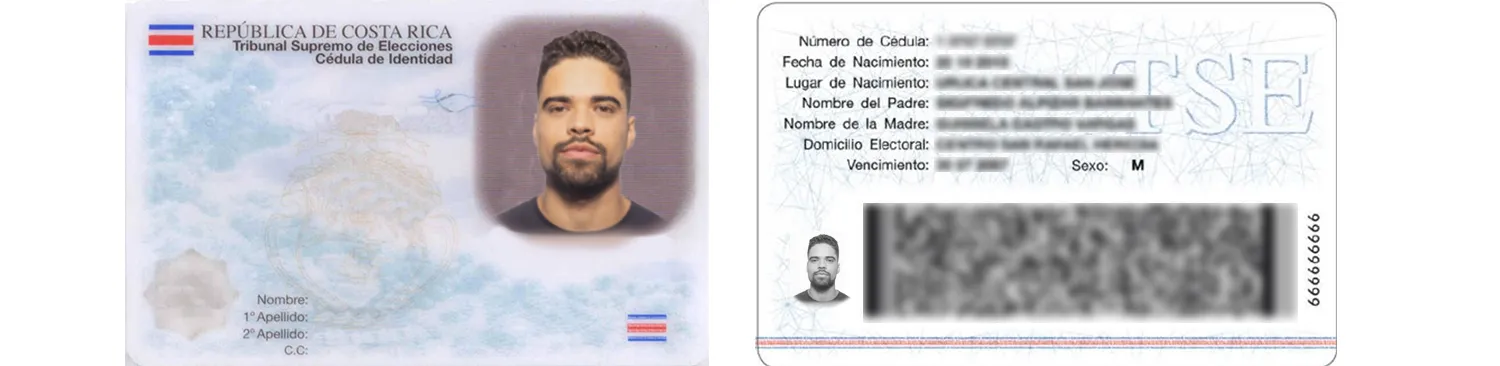
The 2019 series of Costa Rica’s identity card includes innovative security elements but lacks a standard MRZ.
In 2025, the ID card was redesigned. Some older elements, like parents’ names and voting address, were removed. The barcode was replaced with the MRZ, improving compatibility with OCR-based systems. The layout also changed: the left-aligned portrait is now layered with Invisible Personal Information, and an MLI appears in the lower right corner.
The reverse side now features OVI and a QR code that links to the official government portal and can be used during verification. By following the link, the verifier can retrieve identification data from the ID issuer to confirm that the presented ID number is valid. This data is also used for matching.

Costa Rica’s latest national ID card is updated in terms of layout, design, and security features.
One thing that hasn’t changed is the absence of a date of issue and e-chip. Both the 2019 and 2025 series are non-biometric and only indicate the expiration date. The 2025 card is valid for 10 years.
Verification flows for both versions are quite similar. OCR accuracy and reliable liveness detection remain key. It’s also essential that your IDV solution includes templates for Costa Rican ID cards in its database.
The 2025 update also introduced a new version of the Costa Rican ID card for minors, issued to citizens aged 12 to 17.
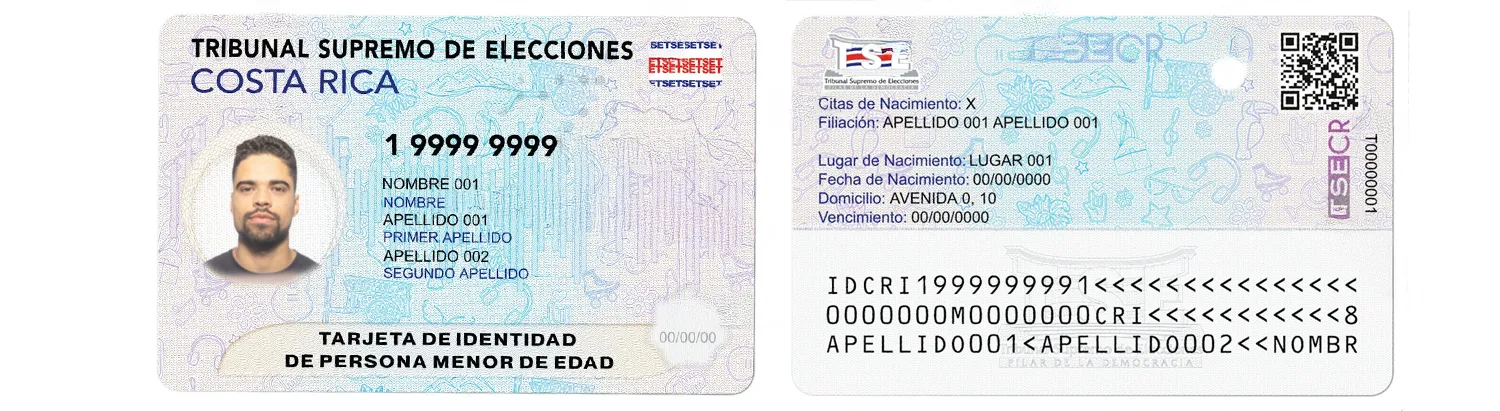
In 2025, Costa Rica introduced updated ID cards for minors (Tarjeta de Identidad de Persona Menor de Edad) featuring a modern design and security upgrades.
The new card reflects a modernized approach to both design and security. It features a left-aligned layout, a sophisticated (and more fancy) background pattern, and three images of the holder — one main portrait and two ghost photos, one of which is incorporated in the MLI. It also includes an MRZ and a QR code. The 2025 layout is more OCR-friendly, making it easier to process during online verification.

The previous version of the ID card for minors lacked many of these updated security features.
All 2025-issued Costa Rican passports and ID cards — for both adults and minors — are already available in the Regula Document Reader database, ensuring accurate and up-to-date verification.
Costa Rica Digital ID: The current state
In September 2025, Costa Rica Digital ID (IDC), a mobile-based version of the physical ID card, was launched. This digital credential carries the same legal weight and is accepted across banks, telecom providers, public services, and other businesses.
Costa Rican driver’s licenses: OCR complications and no chip
Unlike passports and ID cards, Costa Rica’s driver’s licenses haven't been updated since 2009. The current version is a polycarbonate card containing the standard data expected for this type of ID: name, vehicle category, date of birth, date of first license issuance, and expiration date. The date of issuance is not listed, same as in ID cards. The license may also include additional details such as donor status and blood type.

Costa Rican driver’s licenses include two portraits of the holder. A key challenge lies in how this personalization is applied to the card.
Alongside the visual data, the card includes a barcode that may contain the license number and vehicle category. All critical verification data is located on the front of the card; the reverse side shows only the category classification.
When it comes to verification, accurate image capture and quality assessment are essential. The layout can vary from card to card, with shifting margins and field placements. These inconsistencies are part of the document’s original characteristics, not necessarily signs of tampering. Additionally, the card’s green background can interfere with OCR accuracy, making verification even more challenging.
How to effectively process Costa Rican documents
Costa Rica issues modern passports and ID cards, but still uses somewhat outdated driver’s licenses. To handle all of them accurately, your IDV system should offer the following:
A full set of authenticity checks: This includes basic steps like OCR analysis, MRZ, barcode and VIZ reading, as well as more advanced measures like document liveness detection and NFC verification.
Complete ID template coverage: Your IDV solution should support all versions of Costa Rican passports and ID cards to authenticate them correctly.
Advanced capture and image quality assessment: This is especially important for Costa Rican driver’s licenses, which may feature legal variations in layout. Smart algorithms should be able to capture a usable image on the first try — a feature users value highly.
Photo check: Every Costa Rican ID includes at least two portraits of the holder. That’s why your system should detect, verify, and match all of them by analyzing their positions and specific attributes, ensuring none are missing or misplaced.
Have more questions about Costa Rican identity documents? Let’s talk — schedule a call with us!