

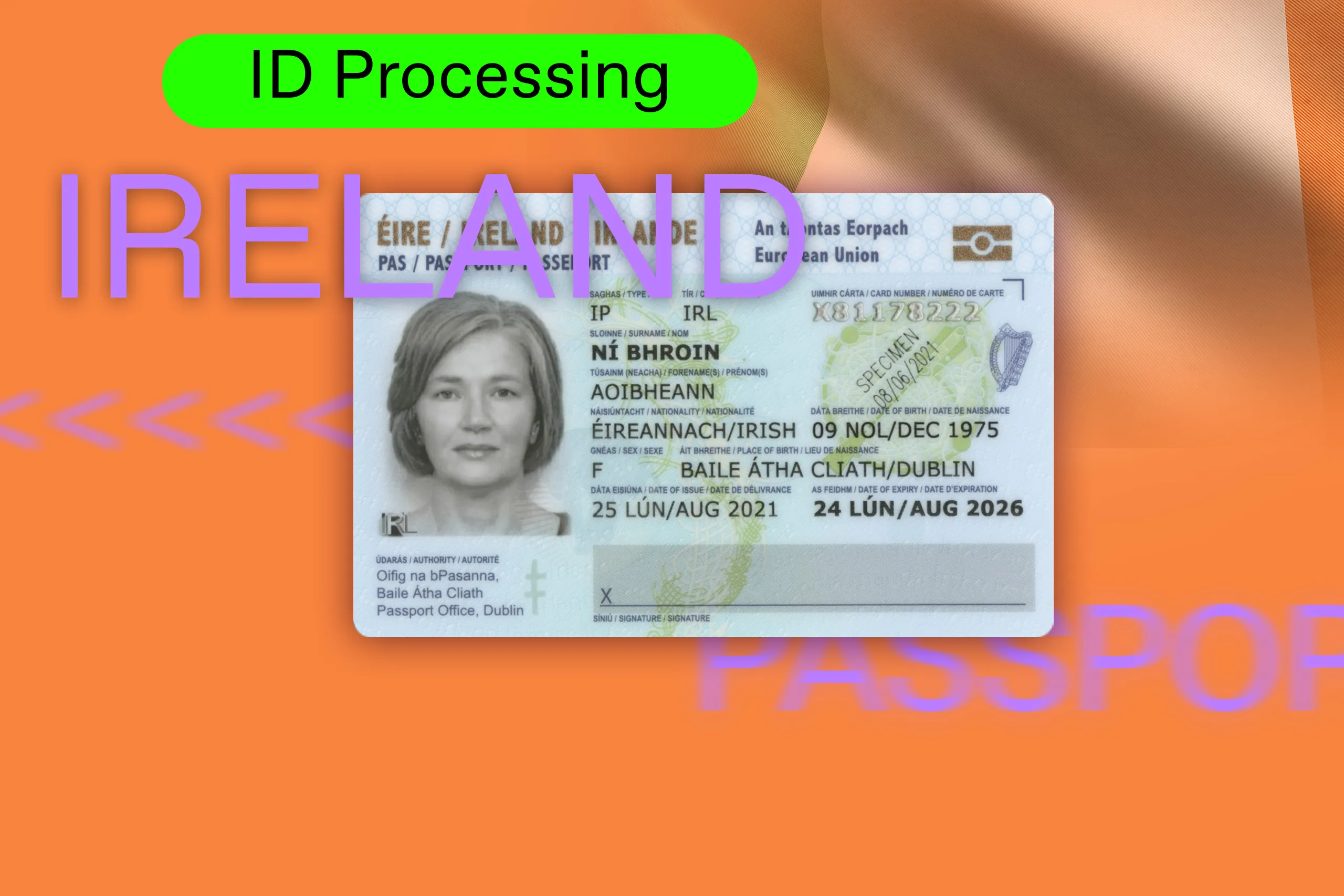
Irishness isn’t always documented. It can live in a passport, a language, a family name, or a place of birth. But when identity has to be verified, businesses still have to rely on what is printed, encoded, and checked on the document.
In this article, we look at Irish passports, cards, and driving licenses from a document processing perspective: what has changed, what can cause confusion, and which details businesses should check before they trust the result.
💡 If you’re new to this series, you may also like these posts about processing other countries’ documents:
The challenges of processing Irish identity documents
Ireland has a funny way of breaking the “one card, one identity” assumption. The passport can appear as a booklet or a card. Another official-looking card may be tied to public services rather than travel. Even the driving license includes a specific machine-readable detail that many systems may not expect.
None of this makes Irish documents chaotic. The risk is simpler: treating different credentials as if they were the same kind of ID.
The Irish passport: new design, new templates
Ireland introduced its new passport design in June 2026. The redesign maintains the passport’s core role as a secure biometric travel document while updating its visual language, security features, and document template.
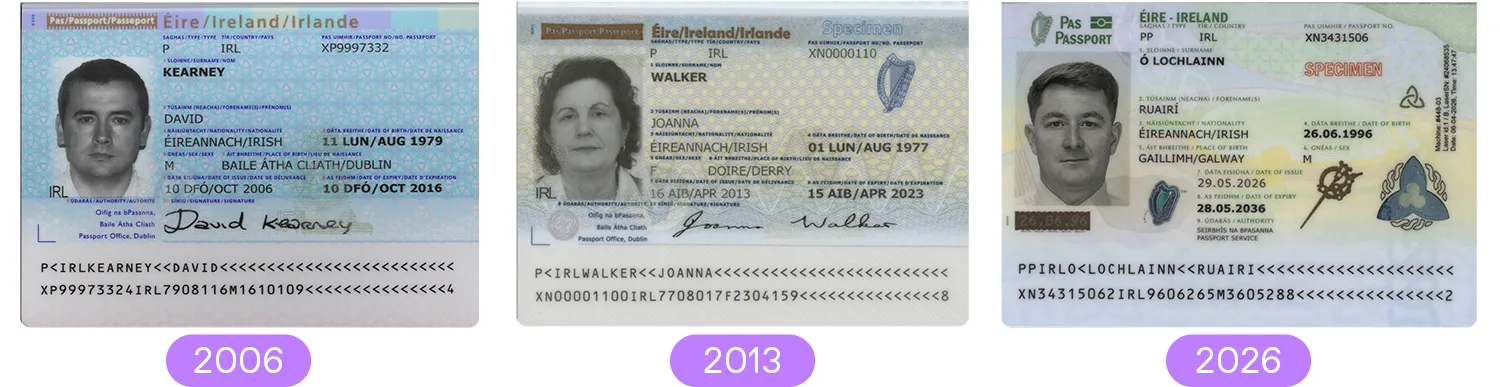
Previous and new Irish passport versions: how its data page evolved.
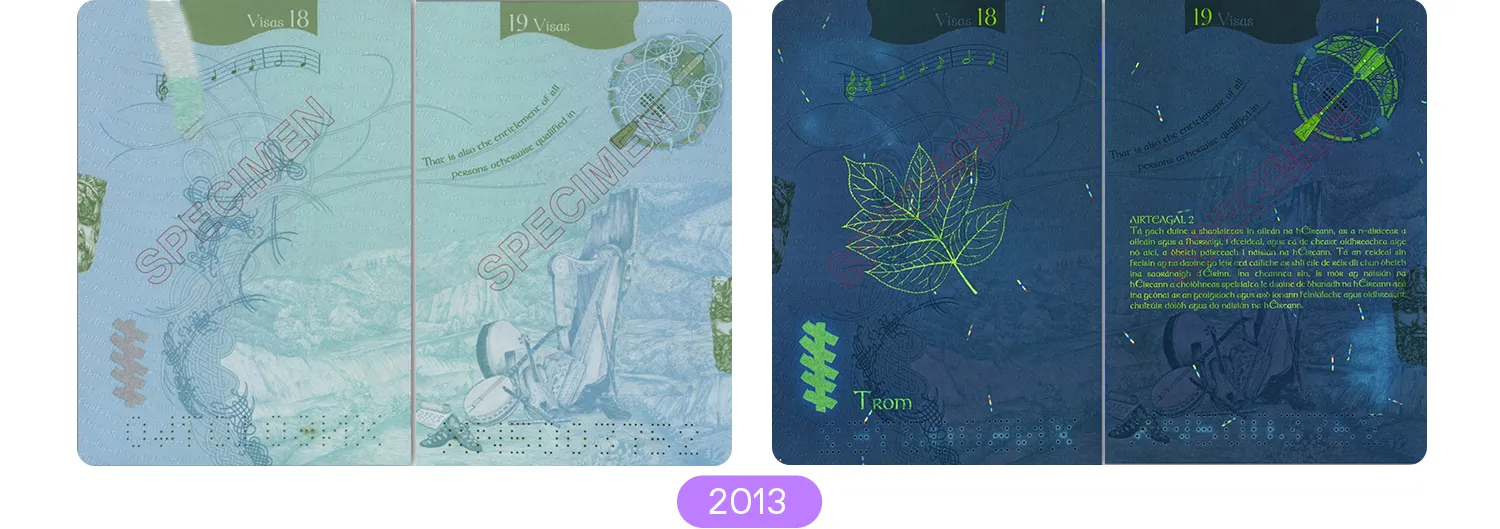
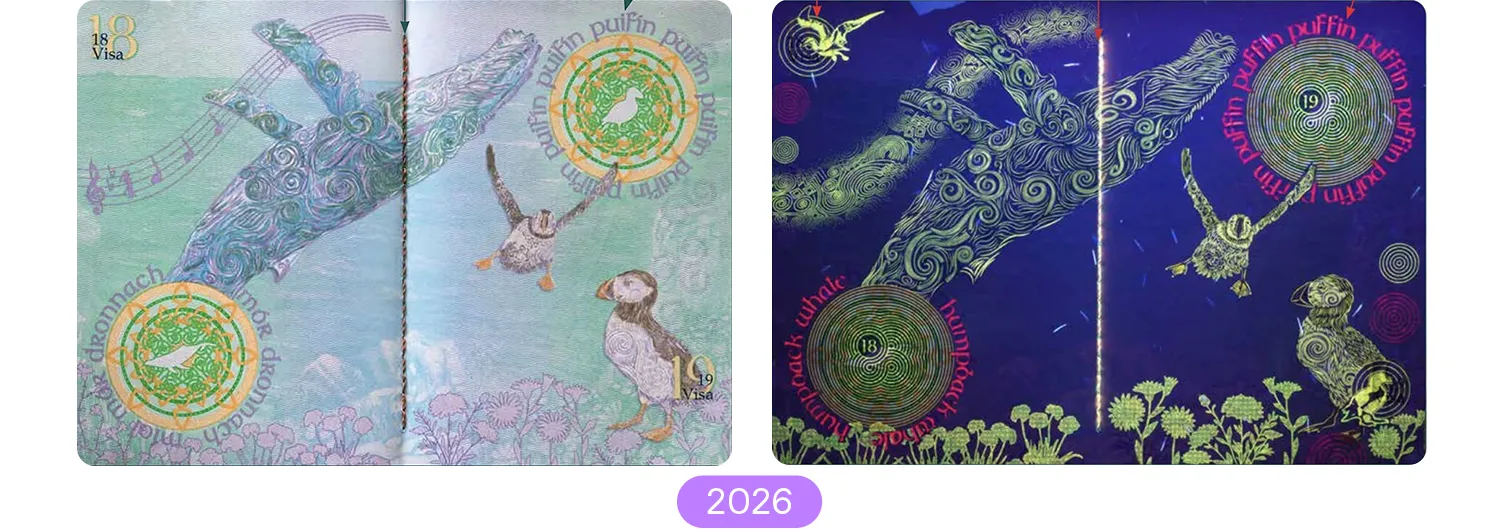
Visa pages in the new Irish passport now feature brighter, more detailed elements.
One of the central figures is the Irish Wolfhound. The animal was chosen through public consultation, where 15,000 participants chose it over 30 other Irish wildlife creatures. The hound represents guardianship, loyalty, and strength: fitting qualities for a document designed to protect the identity of Irish citizens.
.webp)
After wolves were hunted to extinction in Ireland, Irish Wolfhounds became almost extinct around 1800. In the 1860s, Captain George Augustus Graham carefully revived the breed.
The final design also draws on Irish landscapes, seasonal motifs, cultural heritage, and archaeological references such as Newgrange.
Security features follow the same logic. For example, the data page includes an OVI with the Tara Brooch, one of Ireland’s best-known early medieval artifacts. Another security feature uses the Gleninsheen gorget, a Bronze Age gold collar and one of the earliest examples of Irish goldwork.

Irish cultural artifacts became part of the new Irish passport’s security features. The Tara Brooch from the collection of the National Museum of Ireland. Image credit: Sailko.
The new Irish passport is also a good example of the balance between fraud resistance and machine readability.
Passport design always has to balance two goals: making alteration difficult and keeping the document readable. Holograms and other optically variable elements often overlap portraits or data fields, making photo substitution and data alteration harder. The tradeoff is that heavy overlap can complicate automated reading.
In the new Irish passport, the layout appears to give text fields more breathing room, while security elements still protect the portrait and personalized data areas.
The passport also uses more than one personalized portrait image. That also makes photo substitution harder: a fraudster would need to replace the main portrait while keeping the secondary portrait consistent with the rest of the document.
Irish Passport Card vs. Public Services Card: two cards, different roles
Ireland’s card-format documents can be easy to confuse if a verification flow only sees a plastic card with a name, photo, and official design. The Irish Passport Card and the Public Services Card both contain identity-related data, but they are part of different systems.
The Irish Passport Card is tied to passport eligibility and serves as an additional card-format document that is easy to carry. It’s available to Irish citizens who hold a valid passport and can be used for travel within the EU, EEA, Switzerland, and the UK.
.webp)

Irish passport card, 2021 and 2026 series.
The Public Services Card has a different role. It includes a photo, signature, expiration date, and is linked to the holder’s Personal Public Service number. It helps people prove their identity when accessing public services, such as social welfare payments. It’s also used as identity confirmation for some government-related procedures, including driver's license services and first-time adult passport applications for Irish residents.
If someone asks whether Ireland has something close to a national ID card, the Public Services Card is probably the closest practical answer. But it’s still not a classic, mandatory national ID card like those used by many EU countries.

Visually, Irish PSC resembles a bank card more than a passport-style travel credential: limited personal data on the front, with a magnetic stripe on the reverse.
In 2026, the Irish government proposed allowing cardholders to use the Public Services Card as proof of identity with banks, credit unions, utility providers, and other services. The proposal also raised the possibility of adding the date of birth to the card for age verification.
The idea has opponents because it would expand a public-services credential into more private-sector identity checks. Civil liberties groups argue that this could move Ireland closer to a de facto national ID system without a clear enough legal framework, privacy safeguards, or limits on how the card should be used.
Regardless of what Ireland's decision may be, Regula supports both Irish Passport Cards and Public Services Cards, helping teams identify the document type, extract its data, and apply the correct verification scenario.
Irish driving licenses: a machine-readable detail worth checking
Irish driving licenses have one detail that makes them more interesting for document processing than they may look at first glance: a one-line MRZ.
Machine-readable zones are expected in passports and many ID cards, but they are less common on driver’s licenses. Ireland is one of the countries where this feature appears, alongside the Netherlands, Croatia, and Slovakia.

Irish driver’s licenses include a one-line MRZ, an uncommon feature for driver’s licenses.
How to process Irish identity documents effectively
Identity documents in Ireland look clean and standardized, but still, the details matter. If Irish documents appear in your verification flow, the system should recognize Ireland’s specific document logic: a new passport version, two similar-looking cards with different roles, and a driving license that may carry machine-readable data.
Regula supports Irish passports, Passport Cards, Public Services Cards, and driving licenses, including current and legacy versions where available. If Ireland is part of your verification workload, we at Regula can help you cover both the standard formats and the details most generic flows miss — don’t hesitate to get in touch.