

.webp)
Located in West Africa, Nigeria stands out in several ways. It’s a multinational country with more than 250 ethnic groups. It’s also multilingual, with over 500 languages spoken. Plus, it’s highly densely populated, with over 236 million people living there.
How do these factors influence Nigerian identity documents? Let’s see in this article.
💡 If you’re new to this series, you may also like our other posts:
The challenges of processing Nigerian IDs
To manage identification across such a large and diverse population, Nigeria follows several unified approaches.
First, the country uses English as its official language, which is integrated into all public institutions, education, mass media, official documents, and, of course, various types of ID.
Second, Nigeria consists of 36 semi-autonomous states and one capital territory. This administrative structure partly influences how domestic IDs are issued.
Third, the most common Nigerian IDs, including passports, national identity cards, driver’s licenses, and voter cards, generally follow a similar dataset and rely on certain security features. The challenge is that many different series are in circulation, which is typical for highly populated countries.
Now, let’s take a look at the different types of Nigerian IDs.

Get posts like this in your inbox with the bi-weekly Regula Blog Digest!
The Nigerian passport: Two versions — Biometric and ICAO-compliant
Nigeria is one of the member countries of the Economic Community of West African States (ECOWAS), along with Benin, Ghana, Senegal, Togo, and seven others. In addition to agreements on economics, travel, and politics, ECOWAS members follow certain standards for ID issuance.
One such standard applies to passports. ECOWAS passports typically have a green cover with the inscription "Economic Community of West African States (ECOWAS)," or the French equivalent used by the French-speaking member states, “Communauté économique des États de l'Afrique de l'Ouest (CEDEAO).” The ECOWAS emblem is also displayed on the cover. Most passports issued by ECOWAS countries are valid for five years.
Nigeria follows these rules across various passport series. For instance, the 2014 Nigerian passport (still in use now) is valid for five years and features an ECOWAS-compliant cover.
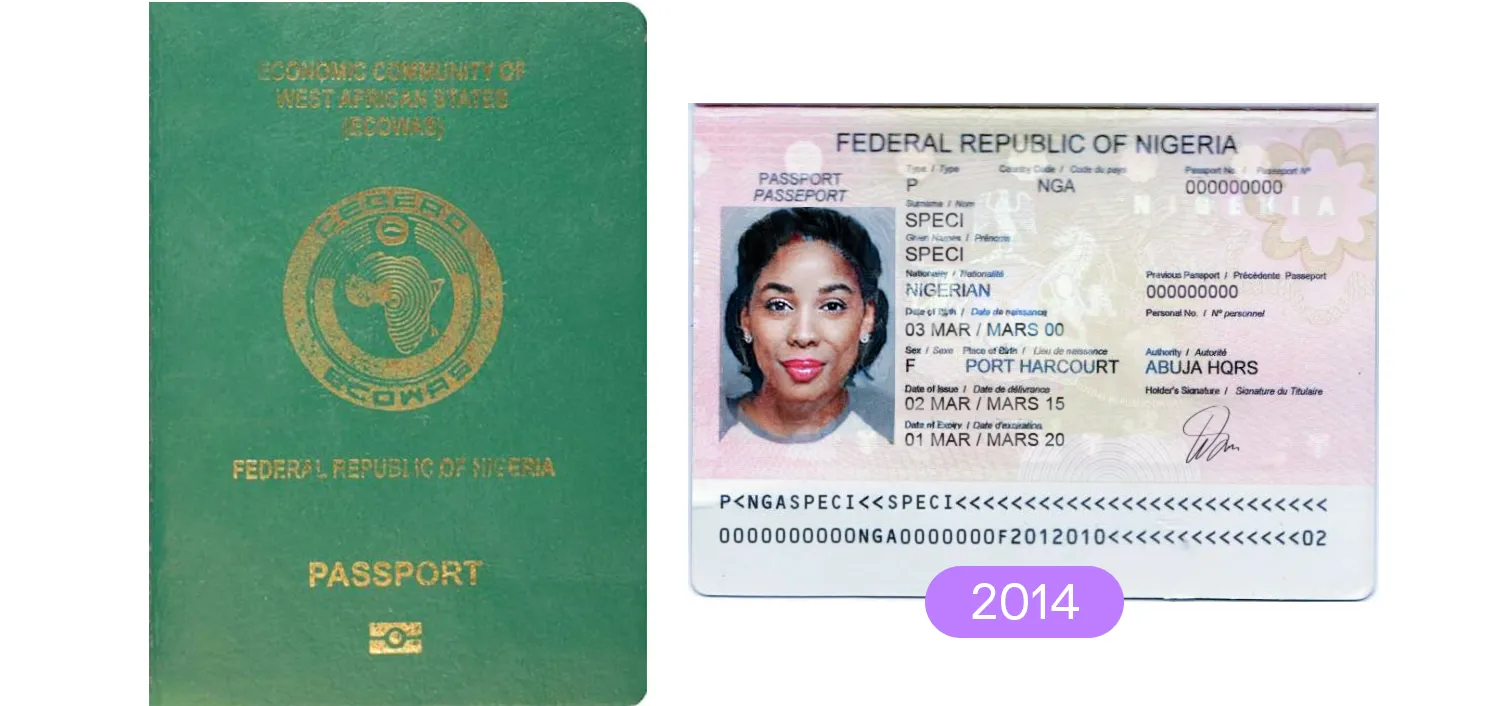
Since 2007, all Nigerian passports have been biometric. The 2014 series also includes the chip icon on the cover.
In 2019, the travel document was updated with a new design, including changes to the data page.
The personal details remained consistent with ICAO standards. Some fields, like issuance and expiration dates, are presented both in English and French. However, in the latest passport, the Personal number field was renamed to NIN (National Identification Number). In earlier series, this field could be left empty. The NIN also appears in the machine-readable zone (MRZ), allowing for cross-checking between visual and MRZ data during remote passport verification.
Another major upgrade was the switch from a paper-based to a polycarbonate datapage, which offers enhanced security. It now includes dynamic security features like Optically Variable Ink (OVI) and a Multiple Layer Image (MLI), which contains the holder’s portrait and date of birth. These features help confirm that authentic physical IDs are shown, without fakes or on-screen trickery.
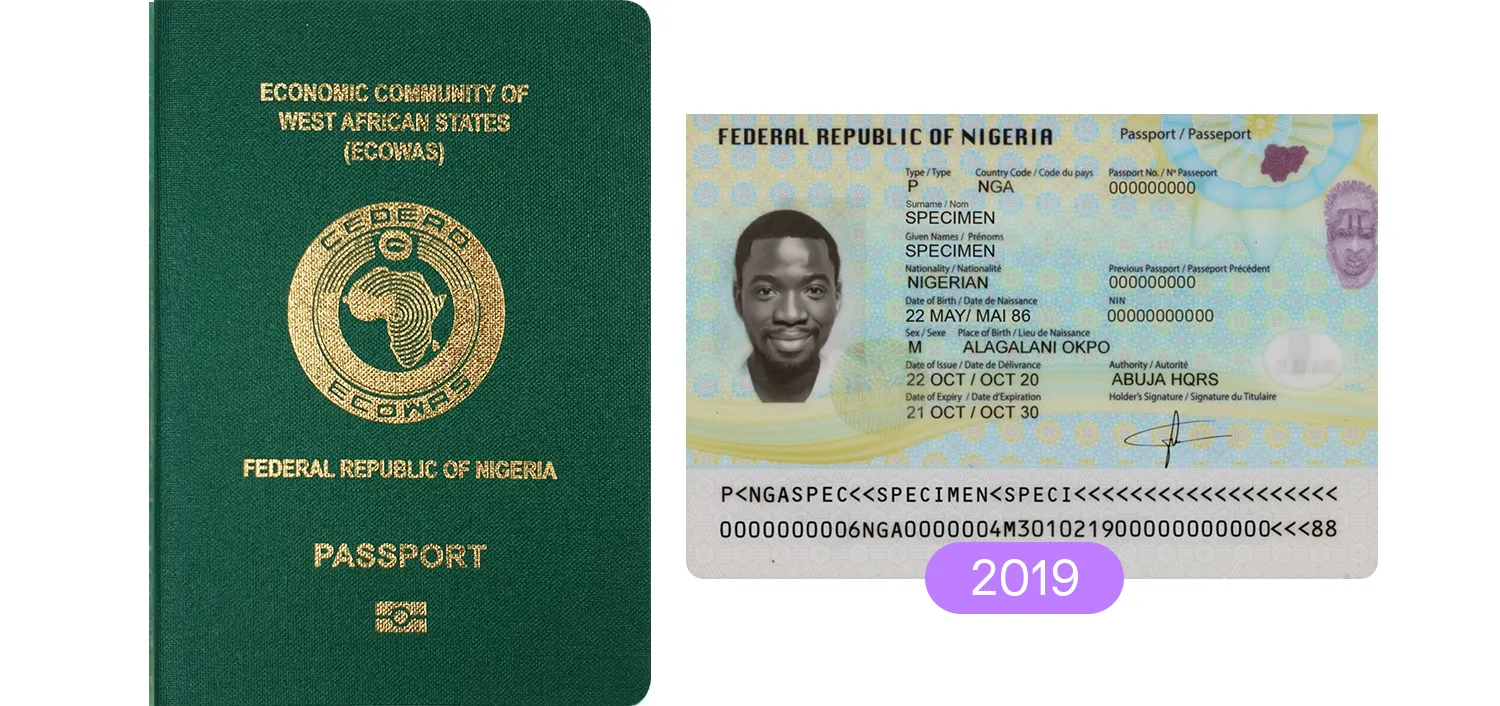
The 2019 Nigerian passport keeps the ECOWAS cover but introduces an updated data page with a new design and security features.
The current Nigerian passport follows ICAO recommendations and is valid for 10 years. But 5-year travel documents are still in use, not only for minors, but also for some adults.
The Nigerian driver’s license: Many types with slight differences
Nigerian driver’s licenses are issued to individuals aged 18 or older. The current version, introduced in 2011, is a polycarbonate document with a standardized layout and dataset across all Nigerian states. However, there are some notable differences.
License type: In addition to vehicle class categories (A, B, C, D, etc.; up to three may appear on one license), Nigerian driver's licenses are color-coded to indicate license type. The blue stripe on the front of the document is for private licenses, red for commercial, yellow for diplomatic, green for motorcycles, black for senior citizens (65 or older), and orange for young drivers (age 18–25).
Issuing authority: With one Federal Capital Territory and 36 states in Nigeria, the issuing authority is shown in the top-right corner: Kebbi state, Yobe state, etc. A three-letter code of the first issuing state is also included. Note that it may differ from the current state name if the holder has moved.
Validity term: Nigerian driver’s licenses are typically valid for three to five years, which is shorter than the standard 10 years seen in many other countries. The date of first issuance is also specified on the front.
The Next of Kin (N of K) field: All license types may include a field for emergency contact details, usually a phone number.

The 2011 series of the Nigerian driver’s license features type-dependent color coding.
Other fields include the holder’s personal details, address, blood type, and height. Observations and endorsements may also be listed. One challenge here is that most data fields are abbreviated, so identity verification software must recognize the layout correctly to capture and validate the information.
Another hurdle is the holographic background, which can interfere with OCR accuracy.
Many personal details from the visual zone are encoded in a barcode on the reverse side, which can be read for data cross-checking. By the way, Nigeria follows the AAMVA (American Association of Motor Vehicle Administrators) encoding standard for PDF417 2D barcodes, which are commonly used in US driver’s licenses and identity cards.

The Nigerian driver’s license includes a PDF417 barcode.
Digital driver’s licences (eNDL) in Nigeria
Mobile driver’s licenses are also available. To get one, holders of a physical license can scan the QR code on the official website to download and activate the digital copy. New applicants must go through a full verification process, including biometric enrollment. Notably, a NIN is required for both new applications and renewals. The digital license is available via an Android app as an official digital version of the physical card.
The Nigerian national identity card: A variety of options — and all are valid
Though not mandatory, the Nigerian national ID card is one of the most widely used forms of identification. It’s issued to citizens aged 16 and older. Notably, it’s also one of the most challenging documents to verify online.
Currently, there are at least four valid variants of Nigerian ID cards:
NIN slip
Improved NIN slip with a barcode (AZTEC)
National electronic identity card (e-ID)
Mobile ID app
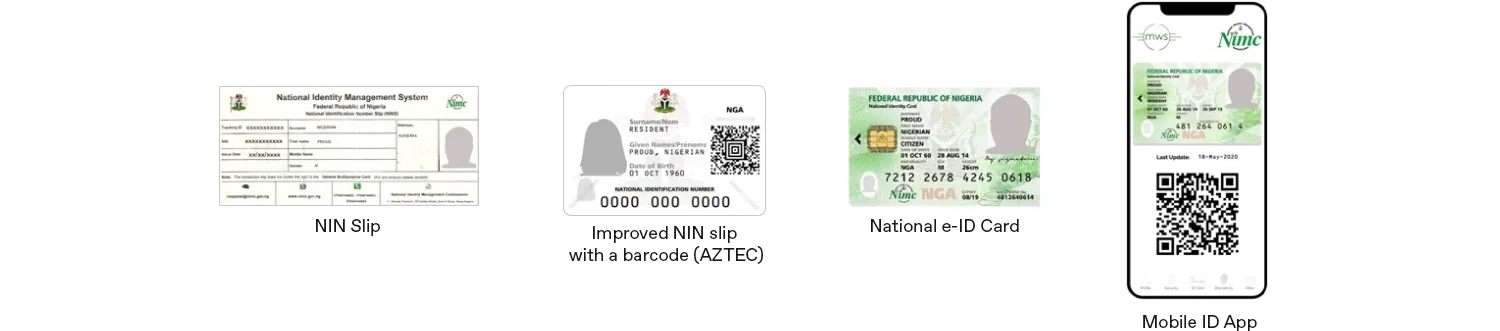
The first two options are paper-based. They vary in layout and size, and display the holder’s personal details and photo. These versions can be used for remote verification, but pose OCR challenges due to their non-standard templates and potential physical wear like creases or abrasions. The AZTEC barcode on the improved slip helps a verifier check the holder’s personal details.
The e-ID represents a next-generation version of the ID card. First issued in 2014, it’s plastic and standard-sized. What makes it unique is that it also functions as a debit and prepaid card.

The e-ID is a unique example of Nigerian ID cards, combining identification and payment features.
The Nigerian national ID shows the holder’s name, nationality, gender, date of birth, and height. It also includes a ghost portrait next to the main photo and displays a payment card number. The reverse side features a magnetic stripe and MRZ, similar to most plastic cards.
Additionally, the card has a Nigeria Quick Response (NQR) code containing the NIN, which is not printed on the card visually.
The national ID card in Nigeria can also be fully digital, available via an app. This version is legally accepted for identification in banks, schools, and government services. For verification, an inspector can scan the QR code on the digital ID to access either basic or full personal data, depending on what the user chooses to share.

Launched in 2025, the digital ID card in Nigeria is available through the NIMC MWS app. It stores the holder’s data and supports peer-to-peer (P2P) authentication only.
In addition to these options, Nigeria introduced the ECOWAS National Biometric Identity Card (ENBIC) in 2025. This made Nigeria the seventh ECOWAS member state to adopt the document. ENBIC serves as a legitimate travel document within the ECOWAS region, meaning holders don’t need a passport to cross borders within member states.

The ENBIC replaced the outdated, paper-based ECOWAS travel certificate and resident permit.
The ECOWAS card contains the standard dataset seen on Nigerian ID cards, including the holder’s name, date of birth, NIN, and height. It also stores biometric data — photo and fingerprints — for secure border checks. To improve security, it includes an MLI with a ghost portrait and date of birth, as well as a larger main portrait.
The card is valid for 10 years.
The standalone ID for elections
Nigeria is one of the countries issuing voter cards specifically for identification during elections. In fact, the Nigerian voter card is the only accepted ID for voters at polling stations. Still, it’s widely used for other identification purposes, including online verification.
The card is issued to citizens aged 18 and older and is typically permanent, meaning it has no expiration date. It contains the holder’s personal information, such as name, date of birth, address, and occupation, which is also encoded in the barcode on the back.

The Nigerian voter card lacks security features, making barcode reading — Code 128 and PDF417 — (on the reverse) a critical step in online scenarios.
How to effectively process Nigerian documents
Nigerian IDs come in a wide range of versions and formats. To verify them remotely, these technologies can make a big difference:
Image quality assessment: Domestic ID cards, especially paper-based versions, often show signs of wear, making image capture tricky. On top of that, many local users rely on lower-end mobile devices. Smart algorithms that guide users to properly position the document and take a clear scan are essential.
Barcode reading: Nigerian ID cards, driver’s licenses, and voter cards use different types of barcodes. To parse and process their data correctly, an IDV solution must support all common barcode standards.
Updated reference templates in place: Nigeria, as a large and populous country, uses a variety of valid ID types. Remote verification requires access to an extensive database of document templates covering all versions and series. Regula’s database currently includes over 16,000 IDs from 254 countries and territories.
Document liveness detection: Fraud attempts are not uncommon in the region. Technologies that analyze dynamic security features like holograms, OVI, and MLI can detect whether a document is real or a reproduction. ID liveness checks are key here.
NFC verification: Many Nigerian IDs, including passports, have embedded chips. These should be properly authenticated during remote checks. Given the high fraud activity in the region, adding server-side reverification for mobile results is a smart move.
Face matching: Matching the ID’s portrait with a live selfie or the biometric data from the chip adds another layer of protection in Nigerian ID verification.
Want to learn more about the specifics of Nigerian ID documents? Feel free to book a session with a Regula representative.