
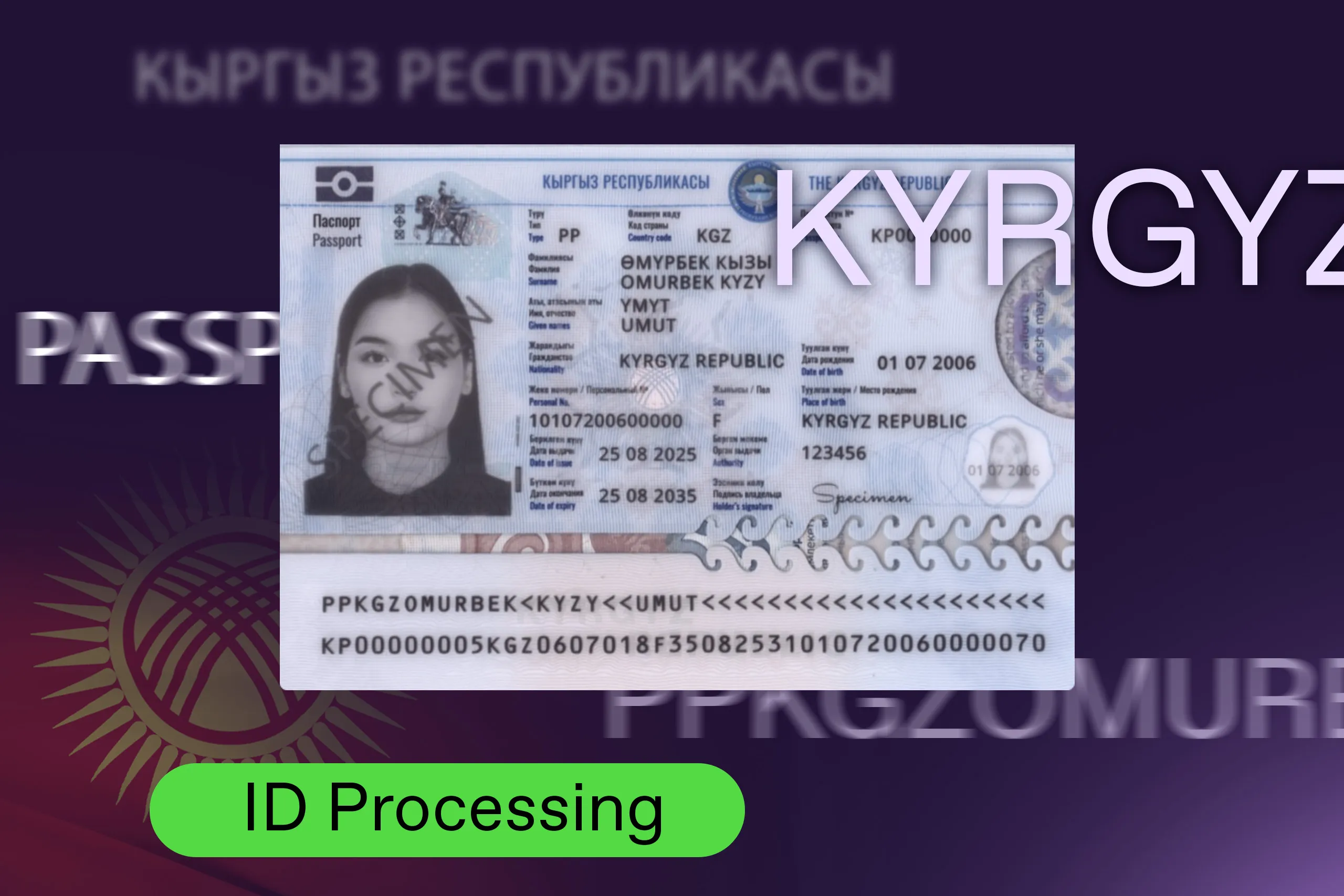
Located in Central Asia, Kyrgyzstan features Switzerland-like landscapes filled with dramatic mountains, deep valleys, and a rich cultural heritage. This country also has one of the most complex borders in the world, with six enclaves of neighboring countries, Uzbekistan and Tajikistan, located within its territory. In turn, there is a Kyrgyz exclave situated inside Tajikistan.
These traits are partly reflected in its identity documents.
When verifying Kyrgyz passports, ID cards, or driver’s licenses, you may encounter at least two key challenges: a non-Latin script and a wide variety of valid document series still in circulation.
Let’s take a closer look.
💡 If you’re new to this series, you may also like our other posts:
The challenges of processing Kyrgyzstan IDs
The Kyrgyz Republic became independent in 1991 after the dissolution of the USSR. This historical background still influences its identity documents, many of which include text fields in Russian (an official language in Kyrgyzstan), while most data is provided in Kyrgyz and English.
Kyrgyz, the state language, belongs to the Turkic language family, but its writing system uses the Cyrillic script.
Another legacy of the Soviet era is the inclusion of patronymic names alongside given names. However, in modern Kyrgyzstan IDs, this field is often left blank.
Now, let’s explore the three most common types of ID used in the country.

Get posts like this in your inbox with the bi-weekly Regula Blog Digest!
The Kyrgyz passport: Two versions in circulation
Over the past five years, the Kyrgyz Republic passport has been updated twice, and both versions are currently in circulation.
The first biometric Kyrgyzstan passport was introduced in 2021 — its first update since 2006. This version brought several changes, including a polycarbonate datapage, a redesigned layout, and modern security features such as Optically Variable Ink (OVI), a Multiple Laser Image (MLI), and a hologram.
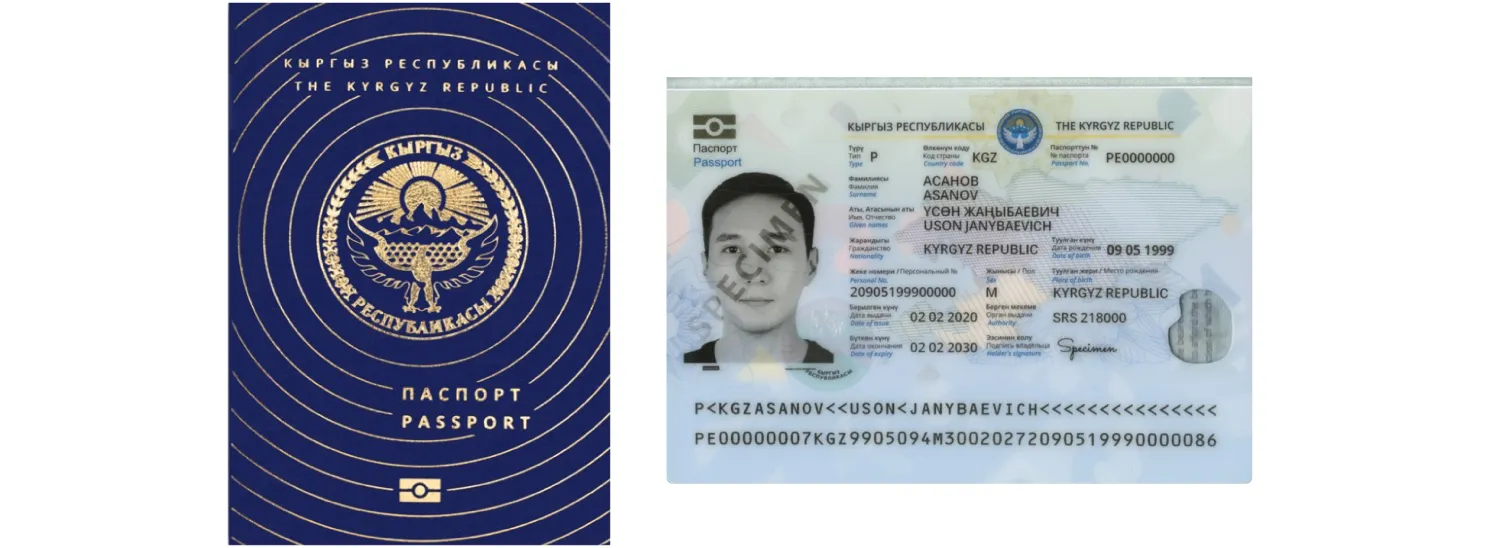
The 2021 series passport of Kyrgyzstan features a vibrant cover and inner design, along with enhanced security layers compared to the 2006 non-biometric version.
In 2025, the passport of Kyrgyzstan was further upgraded with more than 30 security features. These include two transparent windows on the datapage, each incorporating national ornamental designs.
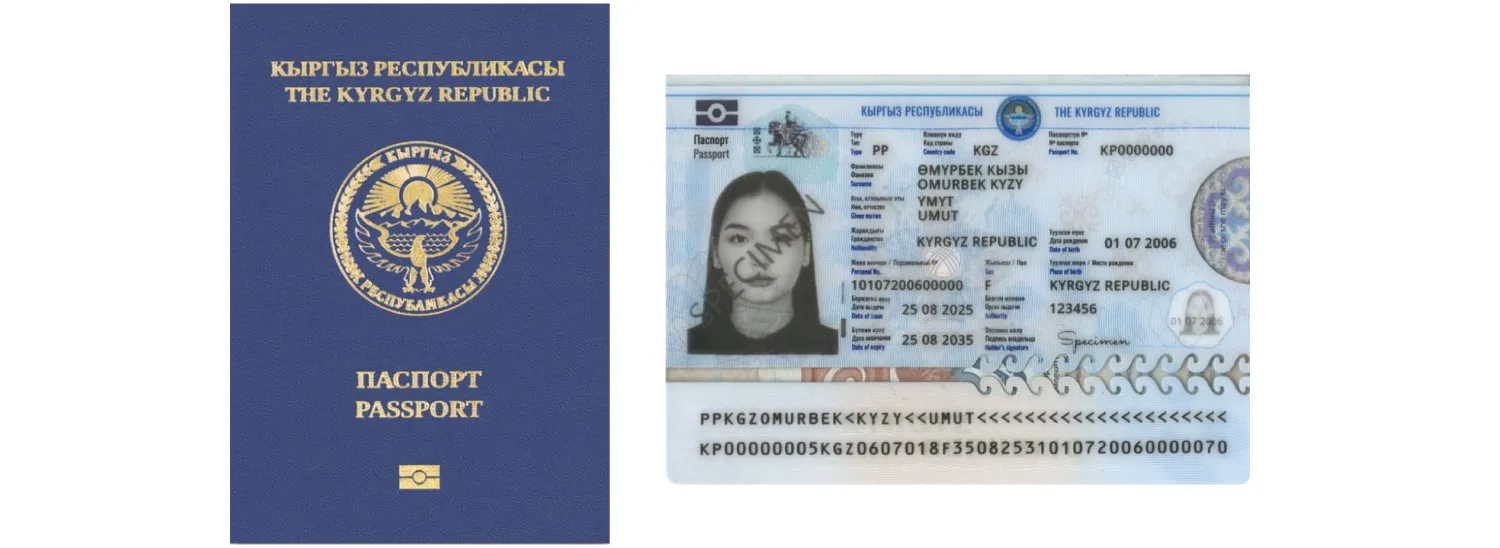
The 2025 series passport of Kyrgyzstan features a hologram placed in the center of the datapage, which may hinder OCR. In the 2021 version, the hologram slightly overlaps with the portrait but doesn’t interfere with mobile scanning.
Despite these changes, the layout and dataset in the latest Kyrgyz Republic passport have remained largely the same.
Both Kyrgyz passport versions feature three portraits (two on the datapage, and one on the adjacent page) and standard identification information.
In Kyrgyzstan passports, the patronymic (if present) appears next to the given name, making that field longer or shorter depending on the entry.
Personal data is printed in Kyrgyz and English, while the electronic chip stores mostly English-language data, as seen in the machine-readable zone (MRZ).
The 2025 Kyrgyzstan passport update also coincided with the recent redesign of the State Flag, which appears on the inner cover of both passport versions.
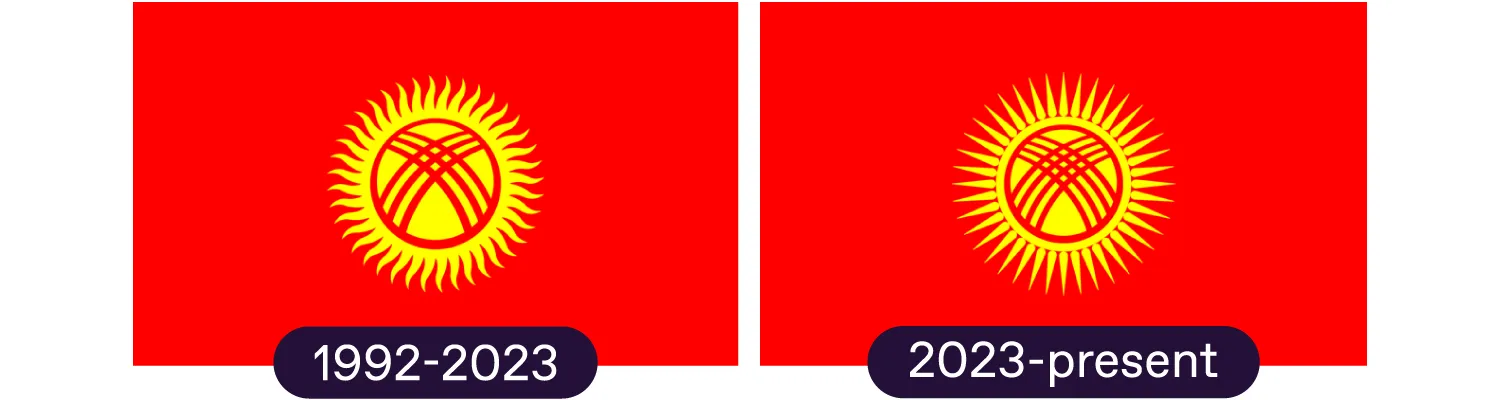
Since 2023, the solar symbol on the flag has had a slightly updated design, which has been incorporated into the latest Kyrgyz Republic passport.
With modern design and advanced security, Kyrgyz passports are well-suited for online verification. Dynamic security features (like MLI and OVI) are useful for liveness detection, while the electronic chip ensures a faster and more reliable process.
The Kyrgyz national identity card: An ID with five valid series
The Kyrgyzstan ID card has gone through several updates over the decades. Interestingly, five generations of the card are still in circulation today.
The earliest is the 2005 version. As of 2024, around 800,000 citizens still hold this card. It’s a plastic, non-biometric document that includes basic information like name, date of birth, and nationality, all in Kyrgyz. It also features three portraits and an MRZ code.
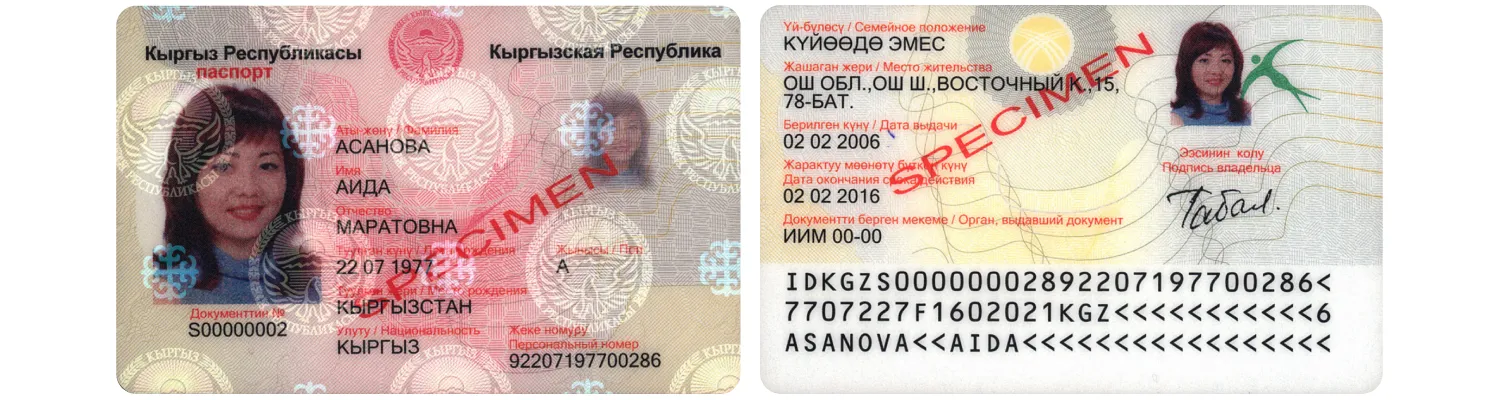
The oldest valid Kyrgyzstan ID card is the non-biometric version issued in 2005, which is still valid because some cards have no expiration date.
In 2017, the first biometric card was introduced, bringing a new design and updated security features. The document includes an MLI with a ghost portrait and the date of birth, a hologram, and two barcodes on the reverse side. These barcodes store the document and personal numbers, which can be matched against the visual and MRZ data.
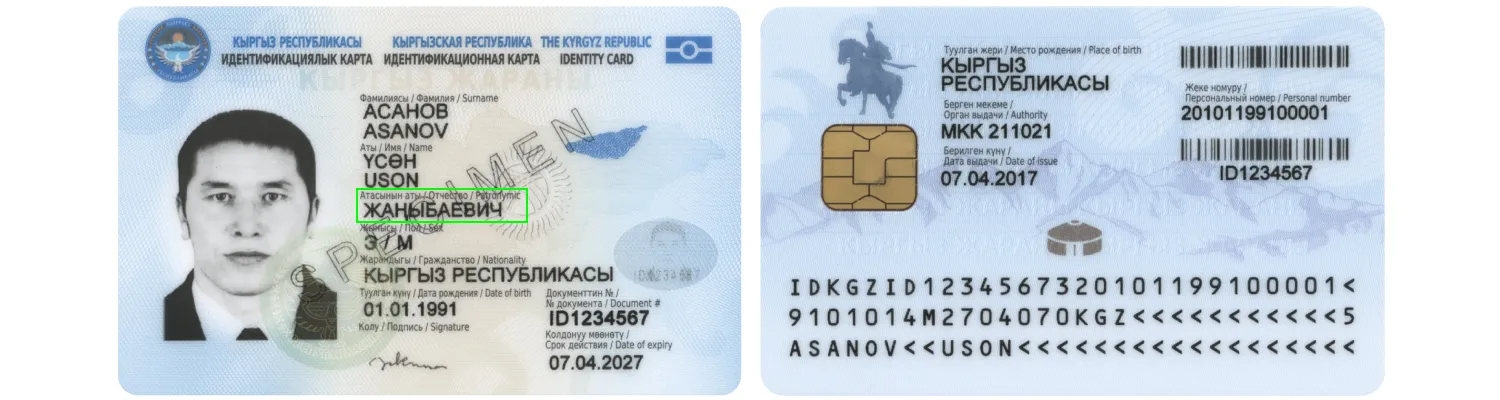
The 2017 series is Kyrgyzstan’s first biometric ID card. Like other versions, it includes a separate field for a patronymic in Kyrgyz, which may be left empty if the person doesn’t have one.
The 2020 card brought no major design changes, but added an Ethnicity field on the back. While ethnic Kyrgyz people make up the majority of the population, the country is also home to Uzbeks, Russians, Dungans, Tajiks, and other groups.
The fourth series of Kyrgyzstan ID cards was introduced in 2024. Key changes include using ‘I’ instead of ‘ID’ as the document code in the MRZ, and slight updates to some text field labels.
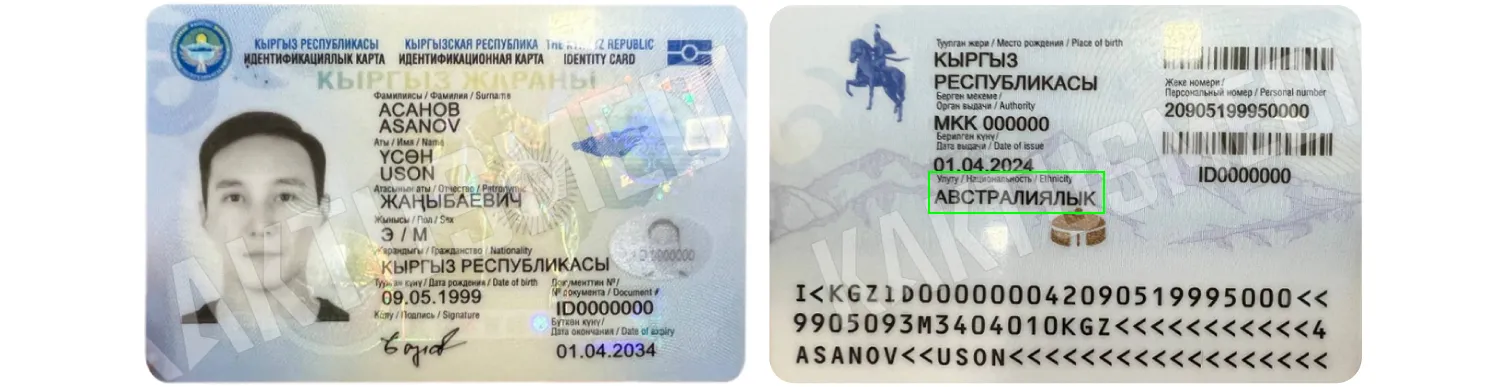
Issued starting in 2024, this version includes minor updates, making the verification process almost identical to that of the 2017 and 2020 cards.
Then, in 2025, a newly designed card was launched alongside the updated Kyrgyzstan passport. This version introduced new security features, including a transparent window along one edge, and removed the barcodes.
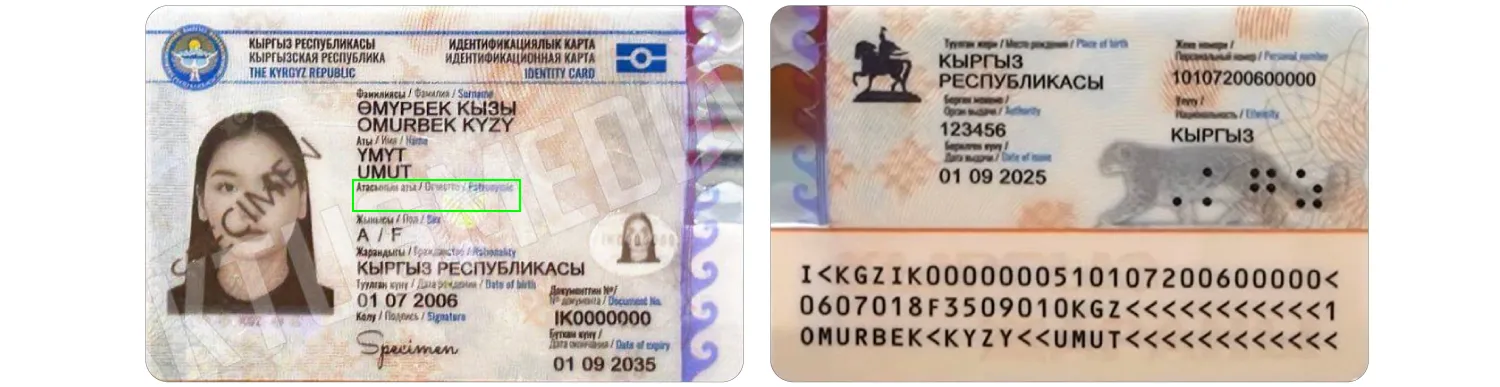
The latest Kyrgyzstan ID card features a modern design and enhanced security.
While verifying the 2005 card is mostly OCR-based, biometric versions support NFC verification, MRZ and barcode analysis, and liveness checks, thanks to their dynamic security features and machine-readable elements. However, to perform any of these checks properly, you need a specimen for each series.
The Kyrgyz driver’s license: Three valid options and constant evolution
This identity document has a story of continuous updates. Since 2005, Kyrgyzstan has updated its driver’s license three times, with each version becoming more modern and secure. Like ID cards, Kyrgyzstan driver’s licenses are valid for ten years, though you may occasionally see documents without a specific expiration date.
The 2005 series is now obsolete but still relevant as a historical specimen. This non-biometric license featured one portrait and personal data in Kyrgyz (on the front) and Russian (on the back). It included details such as blood type, driving experience, and any restrictions.
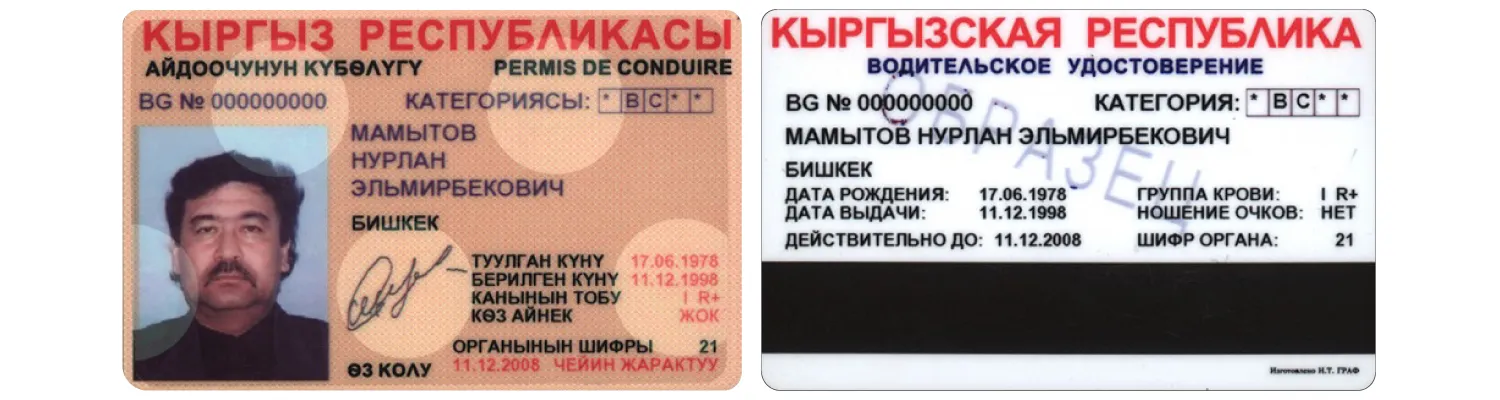
The 2005 series, now invalid, didn’t include vehicle category classifications on the back, unlike most modern licenses.
In 2012, the license adopted an EU-style design and dataset. Text fields were replaced with numerical codes, and all information was presented only in Kyrgyz. Notably, the 4b field (which indicates the validity period) is sometimes left empty in this series.
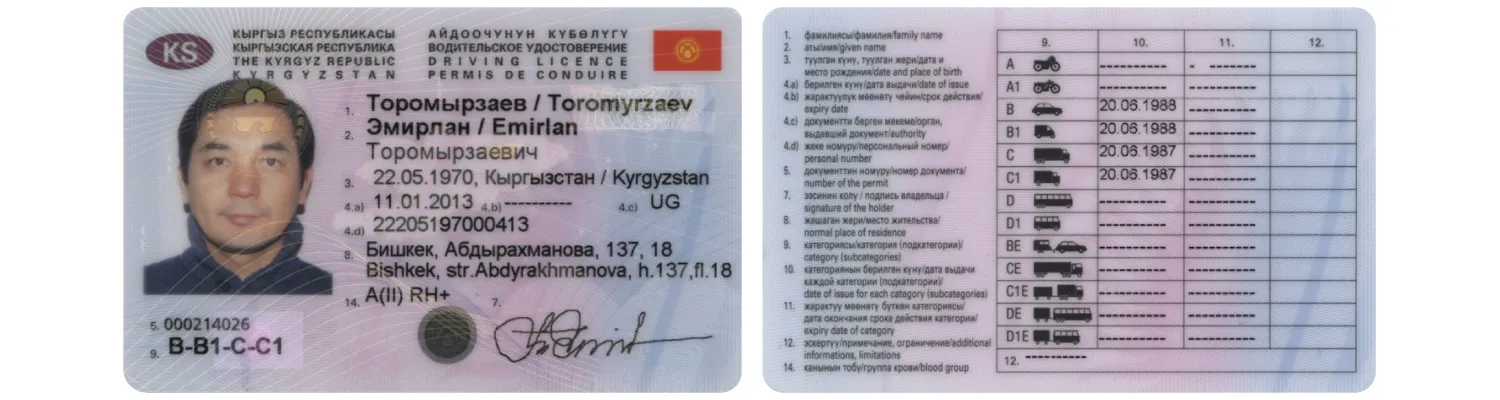
The 2012 license mirrors the layout and design common in many EU countries.
The most widespread version today is the 2019 series. This version introduced a new design and layout, with data in both Kyrgyz and English. In addition to the holograms seen in previous versions, the 2019 license features an MLI and OVI on the front. The numeric field format remained unchanged. Like earlier versions, it doesn’t include a separate field for a patronymic.
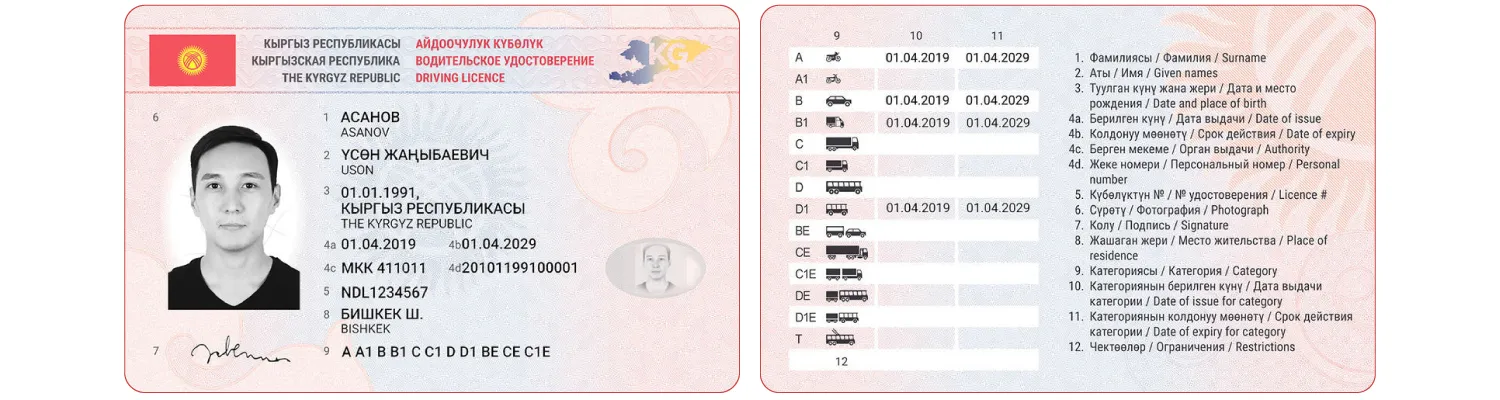
In the 2019 series, some fields, such as date and place of birth or place of residence, may span two lines.
Since 2022, Kyrgyz citizens have been able to use a digital version of the 2019 driver’s license, a format that’s widely used. It’s available through the Tunduk mobile app after logging into the Unified Identification System. ID cards can also be used the same way.
The latest update arrived in 2025. This version not only had a new design but also changed the card’s orientation to portrait. Interestingly, as with the Kyrgyz passports, 2019-series licenses will continue to be issued until the current stock of blank forms is used up.
The 2025 license includes more than 20 security features. One of its most distinctive elements is a transparent edge running across the top.
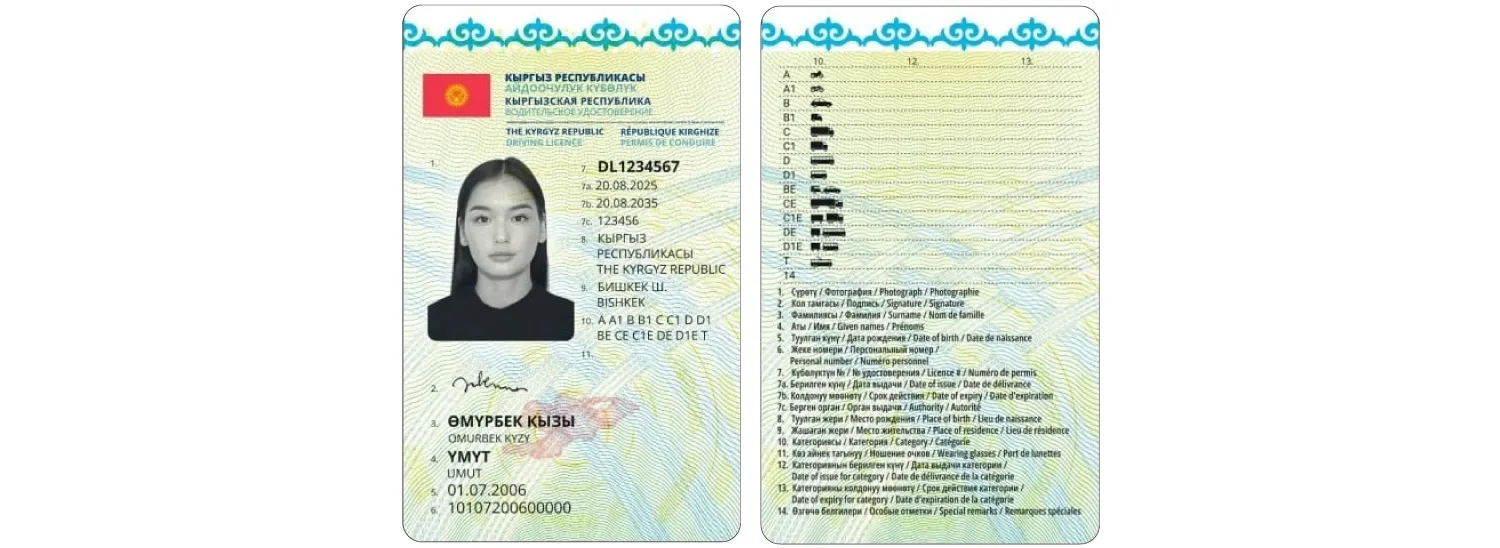
The newest portrait-oriented license was introduced in late 2025, so only a few citizens currently hold it.
To verify these licenses online, you need a full toolkit to recognize each version. Although all Kyrgyzstan driver’s licenses are non-biometric, OCR and liveness checks are essential for confirming authenticity. Due to variations in layout and design across versions, valid templates are required for accurate verification.
How to effectively process Kyrgyzstan documents
Thanks to the recent updates, Kyrgyzstan now has some of the most secure travel and domestic IDs in the region. To check them reliably in remote identity verification scenarios, your software should support the following capabilities:
Valid templates: This is essential when multiple document series are in circulation. Kyrgyzstan is a notable case, with three valid passports, five ID card versions, and three driver’s license formats. At Regula, we monitor these frequent updates and add them to our document template database, which now includes over 16,000 templates from 254 countries and territories.
Document liveness checks: Dynamic security features, such as OVIs, MLIs, and holograms, are present in all Kyrgyzstan IDs. They enable effective liveness detection, helping to block AI-generated IDs, screen-based forgeries, and other tampering attempts. It’s also good to have an injection detector in your IDV toolkit to prevent attacks that target the video feed.
NFC verification: Biometric Kyrgyz passports and ID cards significantly improve security in online verification. Kyrgyzstan chips are fully ICAO-compliant, meaning a standard NFC reader is enough to access and verify the data they contain.
Kyrgyz-native IDV support: Kyrgyz uses a Cyrillic script, which can be challenging for solutions designed mainly for Latin-based documents. Make sure your system accurately reads and processes Kyrgyz text without issues.
Face matching: Many Kyrgyzstan IDs include secondary or ghost portraits. These can be compared to a user’s selfie — and to each other — to improve the reliability of photo-based checks.
Have questions? We’re happy to help. You can always discuss your specific case in a quick call with a Regula expert. Book a call now! Let’s solve your case together.
.webp)