
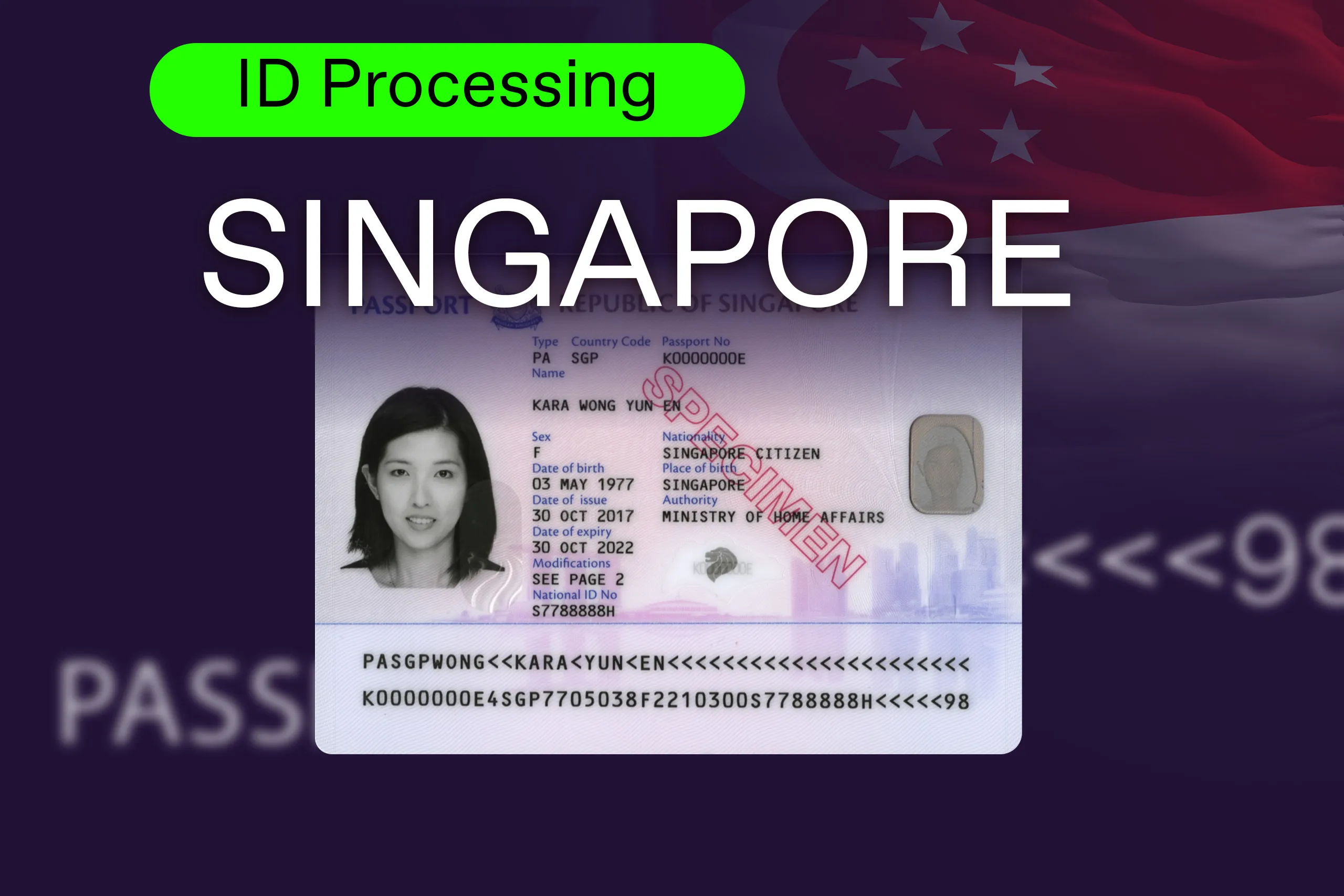
Singapore packs a lot into a small footprint. It’s a global business hub, a magnet for foreign talent, and home to a workforce drawn from around the world. Its identity document system has had to keep up.
The basics are familiar: passports, national identity cards, and driver’s licenses. Then come the passes. Singapore issues a surprisingly broad range of them to foreign professionals, workers, entrepreneurs, and family members. Many look strikingly similar while representing different statuses and permissions.
In this edition of Top-Notch, we look at Singapore’s identity documents and the pass system that makes this seemingly straightforward landscape of documents much more varied.
💡 If you’re new to this series, you may also like our other posts:
The challenges of processing Singapore identity documents
At first glance, Singapore’s identity documents are fairly easy to navigate. Its passport, National Registration Identity Card (NRIC), and driver’s license all follow familiar formats, with clear layouts and relatively minimalistic data fields.
The real variety appears in documents issued to foreigners. Singapore has a whole family of work and long-term passes, from Employment Passes and S Passes to Work Permits, EntrePasses, and passes for dependants. Many use closely related layouts. On top of that, several pass types remain in circulation across multiple card designs.
Singapore’s standard identity documents have a few distinctive details of their own, though. Let’s start with those.
Get posts like this in your inbox with the bi-weekly Regula Blog Digest!
Singapore passports, identity cards, and driving licenses
Singapore’s identity documents don’t overwhelm the holder — or the verifier — with information. But a closer look reveals a few details that are distinctly Singaporean.
The National Registration Identity Card (NRIC) is the country’s core identity document. Singapore citizens receive pink cards, while permanent residents receive blue ones.
Names are shown in English but may optionally be dubbed into another language. Depending on the holder’s ethnicity, a Singapore identity card can include Chinese characters, Tamil, or Jawi (an Arabic-based Malay script) alongside the Latin version. The front also includes the holder’s date of birth, sex, and place of birth, while the reverse carries the issue date and registered address.
.webp)
Interestingly, Singapore ID cards aren’t reissued if a person’s address changes. Instead, the Immigration & Checkpoints Authority sends you an official address sticker by mail to paste on the back of your existing card.
Singapore’s passport is also conventional in layout, but much richer in security features. The current generation dates from 2017 and includes a bright UV design, an MLI element that changes as the document is tilted, and other optical and transparent features intended to make alteration harder.
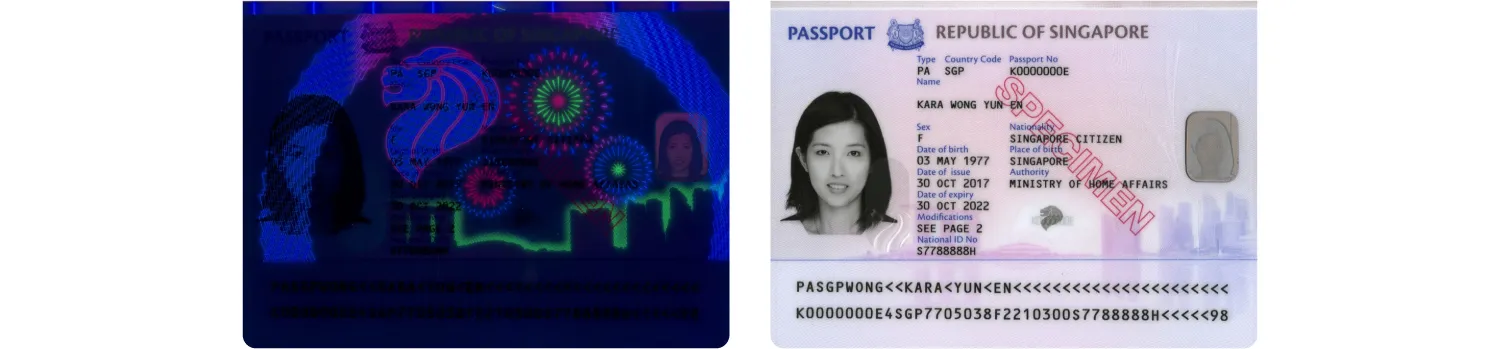
Singapore passport, 2017 series. As of 2026, it’s ranked the most powerful passport, offering visa-free or visa-on-arrival travel to 192 destinations.
The Singaporean driver’s license is the most minimalist of the three. Perhaps one reason is that having a car is considered a luxury in Singapore: very expensive, while public transport there is among the best in the world. Official figures from the Singapore Police Force, available on Data.gov.sg, show that roughly 34% of people living in Singapore hold a qualified driver’s license.

The front of the Singaporean driving license carries only the essential personal data, while license categories and their validity periods appear on the reverse.
Singapore work passes: many documents, similar designs
The Ministry of Manpower of Singapore issues a whole family of physical pass cards to foreigners working in the country, while separate long-term passes are available to dependants of Work Pass holders.
The lineup includes the Work Permit, S Pass, Employment Pass, Overseas Networks & Expertise Pass, EntrePass, Training Employment Pass, Personalised Employment Pass, and Work Holiday Pass.
Many of these cards follow the same basic template: portrait on the left, pass type at the top, identification details underneath, and a barcode near the bottom. On the reverse side, there are personal details and a QR code for checking the holder’s pass status.
.webp)
Seen from a distance, an S Pass, Employment Pass, EntrePass, or Training Employment Pass can look like close relatives rather than separate document types.
The same card family also includes the Dependant’s Pass and Long Term Visit Pass.
.webp)
One pass type can also exist in several designs. The changes, however, are subtle, so the overall document still looks pretty much the same.
.webp)
Singapore work permits, 2017 and 2020 series.
How to process Singapore identity documents effectively
Singapore’s ID documents are neat and consistent. That consistency is helpful for holders, but it can make life harder for anyone who needs to tell similar documents apart. The more Singapore document types and generations your verification system recognizes out of the box, the less custom logic you need to build and maintain as new applicants present unfamiliar cards.
Regula supports Singapore identity cards, passports, driving licenses, and a wide range of work and long-term passes. Its document template database includes 89 Singaporean templates by date and covers multiple generations, helping businesses recognize and process the document actually presented rather than forcing it into the closest familiar template.
If Singapore is one of your markets — or you simply need to be ready for Singapore-issued documents in a global flow — get in touch with experts from Regula. We’ll help you check the coverage you need and choose the right setup for your verification process.